Cónal Creedon's summer essay: Island Hopping — West Cork Style
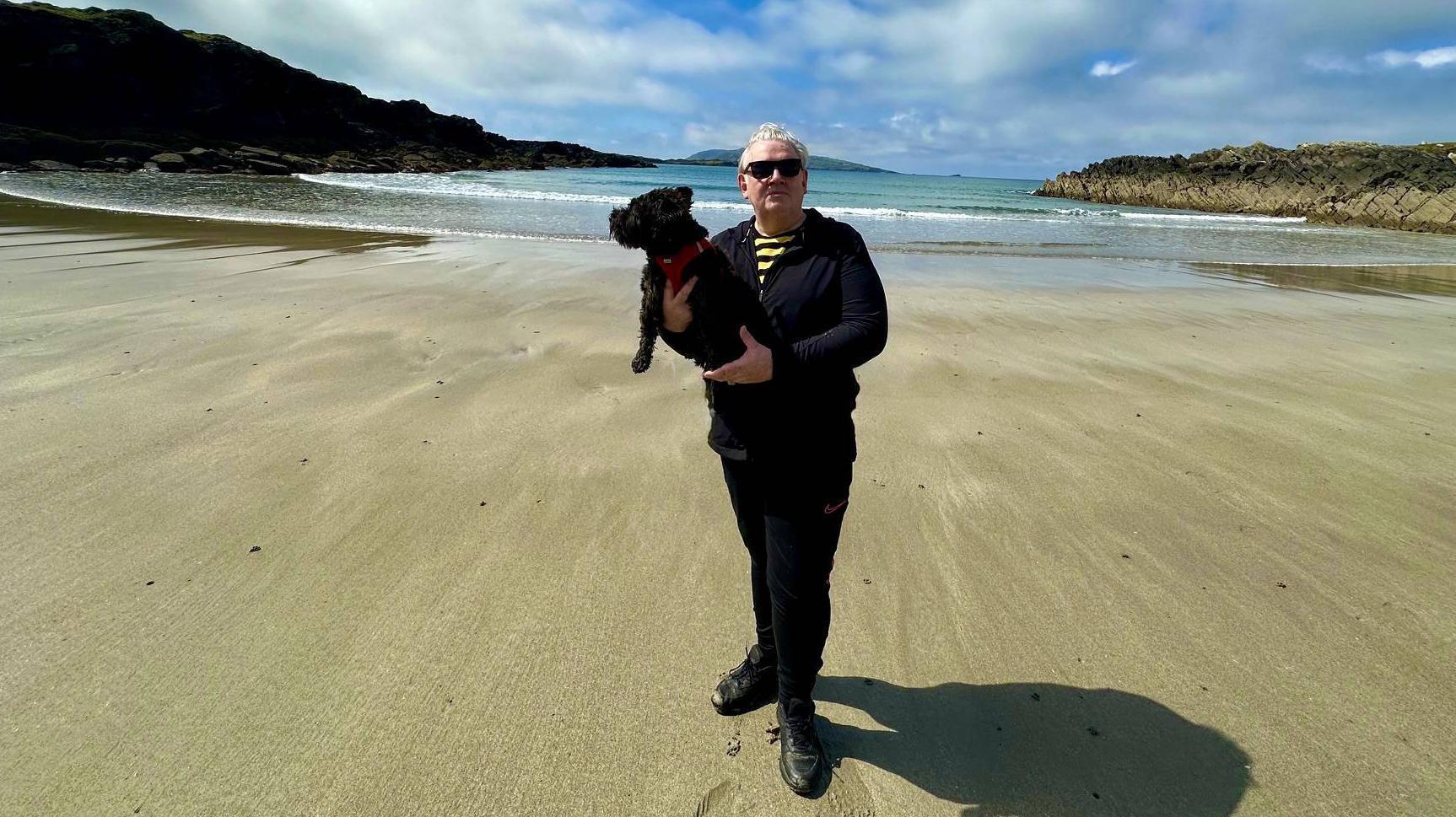
Cónal Creedon and his dog Mary Murphy at Silver Strand on Sherkin.
Five nautical miles southwest of Baltimore, heading for Cape Clear, ploughing through a bloom of mauve stingers — that’s when I first saw her. She was leaning starboard, hair billowing in the briny breeze, arm outstretched pointing frantically to a school of breaching dolphins. Her eyes ablaze, reflecting the ocean blue and the white horses stampeding against the coastline of the Wild Atlantic Way.
We chatted about this and that, and somewhere along the line she mentioned she was from Moyvore, Co Westmeath.
Slap-bang in the middle. The bellybutton of Ireland, she said.
She explained Moyvore is the most distant village from the sea on the island of Ireland. Her grandparents had spent their entire life farming the midlands and never once saw the ocean. And so, in honour of her past generations, she was making the pilgrimage to Cape Clear.
I asked if she had visited any of the other small islands off the coast of Ireland.
"Yes, she said — I was in England once."
Niall Tóibín famously described Ireland as 300 miles long and 150 miles thick. Considering we live on such a small island, our relationship with the sea raises a number of anomalies. Not only does Ireland have the smallest ratio of boat ownership in Europe — one boat for every 170 individuals, but the Irish consumption of seafood is ranked a pathetic 76th in the world.
Not to be accused of blatant whataboutery, I should admit my own personal lifestyle choices and eating habits concur with those two sets of sobering statistics.
I used to be a devout heliolater, worshipping the sun up and down the Mediterranean. But then, like the conversion of St Paul on the road to Damascus, I saw the light. I amended my ways with the zeal of a convert, and became a disciple of mist on the mountain, soft days and rain. My newfound vocation was to vacation in Ireland.
From Tír na nÓg to Hy-Brazil, mythical islands stir up the romantic imagination of our island-dwelling nation. So, like Odysseus in Homer's , it was only a matter of time before I heard the enchanting song of the Sirens drawing me to the islands beyond the west coast of Co Cork.
Baltimore, a picturesque traditional fishing village with a string of restaurants, bars and cafes overlooking the harbour, is both a destination and a gateway to Roaringwater Bay.
Towering above the village, the 13th-century Baltimore Castle stands sentinel as a stronghold of the Clan O'Driscoll, an ancient seafaring dynasty who ruled the waters surrounding "Carbery’s Hundred Isles" — a term coined by Thomas Davis in his epic poem, .
It recounts the horrific events of June 20, 1631, when the village was plundered by pirates from the Barbary Coast. Estimates suggest as many as 200 inhabitants were taken and sold into slavery.
And so, my adventure begins. Sherkin Island, a short boat ride from Baltimore, is a convenient first port of call. Stopping for a libation at the Jolly Roger Pub has become a rite of passage for generations of landlubbers.
But venture further inland, beyond the 13th-century abbey and savour the beauty of this place. Make your way to the scenic clifftop rim of Horseshoe Harbour, then along the verdant boreens, where each gap in the hedgerow becomes a living gallery, framing nature’s most inspirational landscapes and seascapes.
Keep right on track until you reach Silver Strand and Cow Strand — two most pristine beaches. Standing there seduced by sand, sea and solitude, there is a sense that time stands still.
Next stop, Long Island, with a permanent population of no more than 10 souls. This reduced human activity has created the perfect conditions for wild habitat to regenerate and thrive. A nature-lover’s paradise where visitors are advised to keep an eye out for wildlife — otters, dolphins and seals, while hiking the green and leafy less-trodden track that leads to Copper Point Light House and the abandoned copper mine.
Drop anchor at Heir Island, a personal favourite of mine. In recent decades, the unspoilt natural beauty has become the source of inspiration for artists, and a haven for those who seek peace of mind and meditation. I’m drawn to the beautiful Reen Headland past the reed beds and the white sands of Trá Mór and Trá Bán. Or proceed westward across the island until you come to the enchanting narrow gauge bridge with its beautifully cut stone harbour.
Beyond the causeway, a cluster of fishermen’s cottages with the unlikely name — Paris, stands testament to a once bustling pilchard fishery. It’s like stepping back in time, to find yourself centre frame in a John Hinde postcard. Continue westward to the promontory of Dun Cliffs and standing there, view the mighty Atlantic in all its majesty and glory.
Cape Clear Island [Oileán Chléire] 13km off Baltimore, is considered by many as the jewel in the crown. Maybe it’s the isolation, or maybe it’s because the Irish language is the Lingua Franca. Whatever the reason, Cape Clear has a profound air of independence and self-sufficiency.
The Sunday farmers’ market offers a showcase for Island knitwear and pottery, and a cornucopia of award-winning artisan produce — everything from goat’s milk cheese and ice cream to gin from the island distillery.
Cape Clear is an island of welcomes, where the seanachaoí tradition of fireside entertainment is alive and well and can be experienced first-hand at the annual International Storytelling Festival. Above all, this is an island for nature lovers and hikers — check out the Cnoicín Loop and Gleann Loop, or amble off track — there are so many points of interest to explore, from Dún an Óir on the west to the Old Light House on the east.
The Islands of Roaringwater Bay share an undeniable similarity: the star speckled night skies, the vast expanse of ocean, the fresh salt air, and above all, the freedom to walk country roads unhindered and uninterrupted by traffic.
Yet no two islands are the same. Each isle and islet has its own diversity of landscape, culture, history, tradition and language — like the famed Galapagos Archipelago, each island strides forward confidently along their own independent evolutionary path.
The waters of West Cork offer a very different experience to the sun-kissed holiday destinations of the Maldives or the Mediterranean. Irish weather is predictably unpredictable. So, expect the unexpected, maybe even experience all four seasons in any 24-hour period.
But every cloud has a silver lining, and just as the 9th-century Irish monks prayed for inclement weather to keep the Viking marauders at bay, I’ve learnt to embrace the rain; try my hand at a spot of mackerel fishing, hop on board a sea safari, or take a charter to Fastnet Rock — a lighthouse precariously perched on a rock 20km out into the Atlantic.
And because it was the last glimpse of Ireland seen by generations of emigrants on the coffin ships to the New World, Fastnet has become known as "Ireland's Teardrop".
By summer’s end, I will round the peninsula, sail into Bantry Bay and visit the islands of Whiddy, Garnish, Dursey. I plan to reach my journey’s end at the Bere Island Arts Festival in September, but all that is a long time away, another adventure for another day.
Some islands have neither shop nor pub, and accommodation is often limited to summer months. But maybe it is precisely this lack of overt commercialism that creates the conditions to unwind and reset the clock.
Island-hopping West Cork style is not merely a holiday destination — it is a journey into time, an exploration of the mind, it’s an invitation to enter a world where the spiritual and the natural complement each other without contrivance or contradiction — it’s an invitation worth accepting.
- Cónal Creedon is the inaugural writer-in-residence at Cork Civic Trust House