Decision not to prosecute garda over imported gun parts shows little has changed within the force

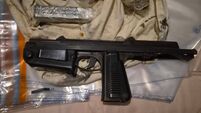
The garda organised for an import licence on the basis that the parts were needed by An Garda Síochána. As per the law the minister for justice signed off on the licence, completely unaware it was for a private entity. File photo: Leah Farrell/RollingNews.ie

The smell coming off protected disclosures in An Garda Síochána is thickening. Today the reveals a development that raises all sorts of questions as to whom exactly the law applies.
Here are the bare details. A garda organised within the force to sort out a private entity for firearm parts. The garda transported the weapons from a Leinster town to the firearms store of AGS in north Dublin.
The garda then organised for the minister for justice to sign an import licence for the parts on the basis that they were needed by AGS. There would have been no reason for the minister to suspect anything untoward. And when it was all done the same garda presented the bill to AGS, as if this had been a work expense.
Those details have been confirmed in two reports, one internal to AGS and another by Fiosrú, the garda ombudsman. The respective investigations were conducted on foot of a protected disclosure about the matter, emanating from the firearms store.
And now we find out that the DPP has determined there is no basis for a criminal prosecution in the case.
It all began in 2018 in a private gun club, according to the internal garda report. The club had a problem with some weapons. An arms dealer in the south east was approached but he was unable to locate parts that were required to repair the weapons.
The garda, who has no official role in the club, heard through a relative about the problem and offered to get the job done. He brought the weapons in his private vehicle to the firearms stores in Dublin. That is a potential criminal offence.
Some of the guns were repaired but others needed parts not available. The garda organised for an import licence on the basis that the parts were needed by AGS. As per the law the minister for justice signed off on the licence, completely unaware it was for a private entity.
In this respect the minister was presented with a false document, potentially contrary to Section 9 of the Criminal Justice Act 2018. It is also potentially a crime under the Section 4 of the Criminal Justice Act 2001, concerning deception.
The parts were imported, the guns repaired and the garda brought them back to the gun club. The bill for the parts, which ran into hundreds of euros, was paid out of the garda budget.
Billing AGS to the benefit of a private entity is potentially criminal under Section 10 of the Criminal Justice act dealing with false accounting.
There are also potential offences arising under Section 7 of the Criminal Justice act dealing with obtaining services by deception. A question also arises as to whether the whole deal came under “active and passive corruption”, which forms Section 5 of the Criminal Justice (corruption) Act 2018.
The DPP, having considered all the evidence presented, came to the conclusion that a prosecution wasn’t warranted. This decision would have been informed by the evidence, the law and as assessment on the probability of a conviction.
On the basis of the known facts, question might be asked as to why a prosecution was not pursued. However, the DPP’s office routinely declines to prosecute on the basis that the chances of a conviction are not encouraging. The DPP’s office does not give reasons for its decisions, but in this case it would be very interesting to know why the evidence was deemed insufficient.
Questions arise about how the matter ended up in the DPP’s office. The internal garda investigation was completed and presented to management in November 2024. There was no recommendation to forward the report to the DPP.
Apart from that, the report noted that the transport of the privately owned weapons in the garda’s car could be legal under a 1925 act concerning the transport of weapons in the wake of the civil war.
The report also noted that the garda at the centre of the matter claimed that the gun parts were for weapon training in AGS. Yet the weapons in question are not used in official training and there was no record of any such training. Despite all that, no recommendations were made to forward the file to the DPP.
Fiosrú only examined the matter when the discloser, frustrated at the slow pace of investigation in AGS, went to the ombudsman. And yet, in contrast to the outcome from the internal report, Fiosrú saw enough evidence to warrant a referral to the DPP.
How two different conclusions can be arrived at from the same set of facts is extraordinary.
As the DPP has decided not to prosecute, details of this escapade are unlikely to ever be made officially public, short of some external wider inquiry being conducted.
A question might well be asked as to whether much has changed in respect of internal inquiries in AGS concerning allegations of malpractice.
In 2014, senior counsel Sean Guerin investigated responses to claims of malpractice made by Sergeant Maurice McCabe. The barrister largely found that McCabe’s concerns were justified, and that they had been minimised internally.
Guerin concluded that a pattern was evident about how gardai investigated malpractice highlighted by protected disclosures.
“The overall impression given by the internal Garda investigative process was that complaints or matters of concern were put through a process of filtration or distillation so that, by the end of the process, any matter of concern had been removed as a form of impurity, and only what was good was found to remain,” the report states.
On the basis of the internal attitude to a favour given to a private gun club, along with other issues that have been highlighted recently, very little appears to have changed since then.

CONNECT WITH US TODAY



Be the first to know the latest news and updates