Summer catch-up: 20 of the best non-fiction books so far this year
Richard Fitzpatrick picks some of the best non-fiction books to enjoy this summer
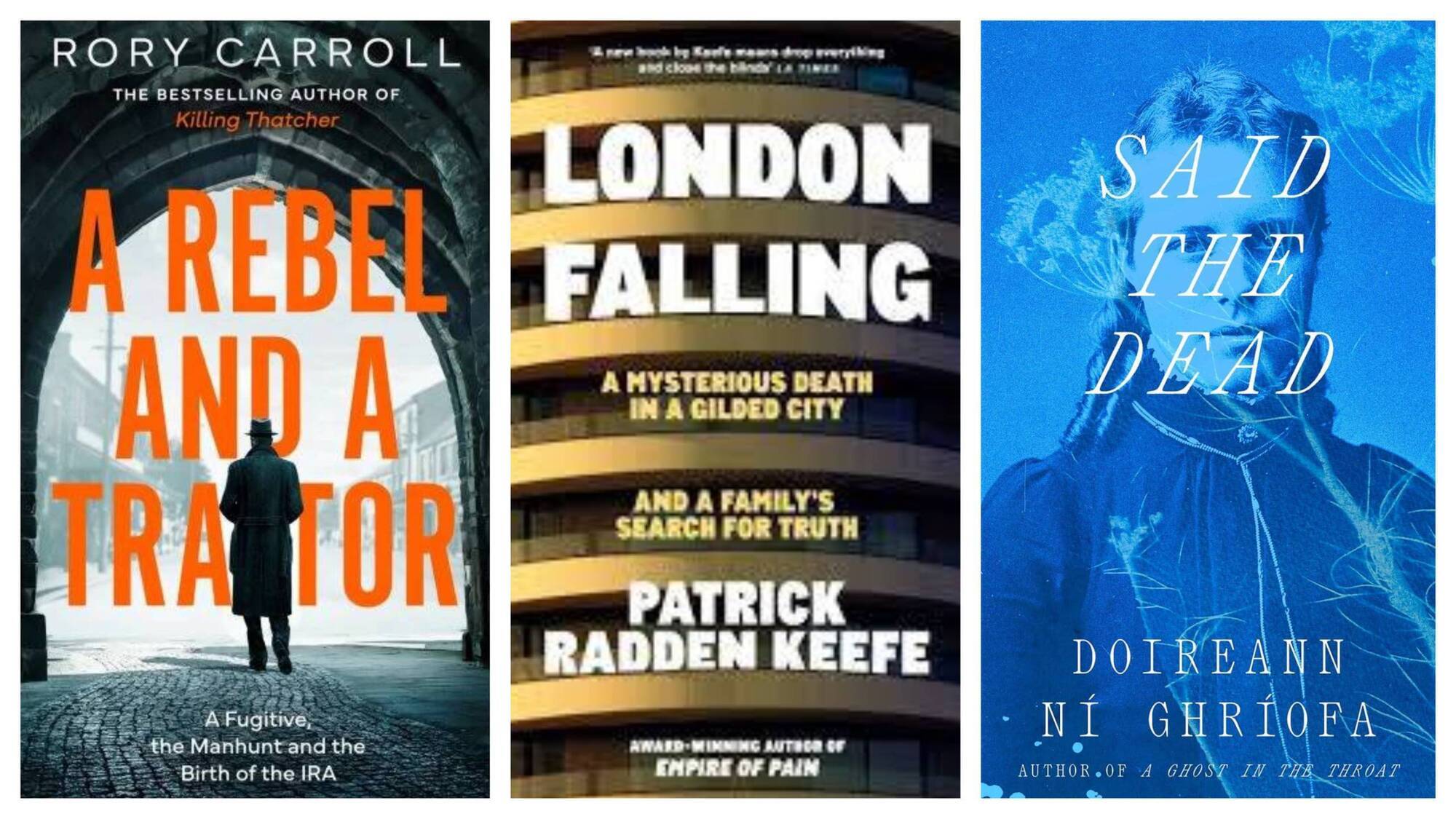
Another masterpiece from Patrick Radden Keefe, author of Say Nothing, Empire of Pain and one of the best non-fiction writers in the business. Investigating the mysterious death in London of a 19-year-old English guy posing as the son of a Russian oligarch, Radden Keefe unfurls a gripping tale against the backdrop of mobsters, charlatans and “lackadaisical” policing.
Rory Carroll has followed up his magnificent book, Killing Thatcher, with another page-turning manhunt. This time the man in the crosshairs is the 1916 martyr Roger Casement. The action rips along at breakneck speed, enriched by Carroll’s luminous writing, wry humour and wonderful characters, including dastardly spy chief Reginald “Blinker” Hall and Casement’s treacherous Norwegian lover.
Doireann Ní Ghríofa, author of the international bestseller, A Ghost in the Throat, has created her own biography genre, mixing archival research, photography, poetry and storytelling with shards of her own life. In Said the Dead, she has written another story that will haunt your dreams – recreating the tortured lives of Cork’s Victorian asylum, an imposing building that still looms over the city.

Lesley Bond and her partner got selected as part-time caretakers of the Great Blasket Island in 2019. At one point, she informed a guest there was no hot water for showers. The guest looked at her like she’d “committed a crime”. Bond brings the desolate island and its wildlife vividly to life in a book that makes you yearn to go off the grid for a while.

Manchán Magan died last year from cancer; he’s sorely missed. He has left us, however, a wonderful library of books, including a sumptuously illustrated An Post Irish Book Awards winning dictionary for rain (and sunshine), which helps keep Magan’s spirit – and the Irish language – alive.

There are few finer English-writing historians than Antony Beevor, and there are few more fascinating life stories than Rasputin’s, the sorcerer who inveigled himself into the house of Nicholas II, the last Emperor of Russia. Beevor’s beguiling story explains the Romanov dynasty’s downfall and the violent birth throes of communism.

The modern world was fashioned in the Enlightenment. To make sense of where we are today politically, German historian Jürgen Overhoff looks back at two eighteenth century models of leadership – Frederick the Great’s authoritarianism in Prussia, a man who could “yield the palm to none” and the liberal democracy favoured by George Washington.

Did Kim Philby inspire The Third Man screenplay, written by Graham Greene? Robert Verkaik’s study of the enduring friendship between Greene and Philby, Britain’s most notorious twentieth century spy, is a masterful read, which reeks of Cold War intrigue.

James Joyce’s political worldview was forged by two circumstances – the witch-hunting of Charles Stewart Parnell in the 1890s because of his affair with Kitty O’Shea, a married woman; and Joyce’s exile to Trieste a decade later, which opened him up to European influences. Frank Callanan’s sprawling political biography is written with verve and unrivalled detail.

Mark Haddon authored the instant classic, The Curious Incident of the Dog in the Night-Time. His memoir is the kind of book you can’t look away from, a captivating account, both profoundly disturbing yet funny, of an unhappy childhood.

Is Eamon Carr the most talented man in Ireland? He’s a poet, a writer, a journalist, a canny interviewer, a drummer and lyricist for Horslip. He’s also an accomplished photographer. His collection of photographs, taken while touring across North America in 1978 and ’79, capture, according to Wendy Erskine, “the strangeness of things”.

Written in his breathless style, Shane Ross pores over the scandals that have befallen “Gaybo”, the late Gerry Ryan and more recently Ryan Tubridy, amongst other personalities, while working in the national broadcaster’s house.

Caitríona Lally, a prize-winning fiction writer, has written an excellent memoir about the realities of juggling the limited income possibilities of writing with those of parenting, including her sideline, housekeeping at Trinity College Dublin to make ends meet.

In 1985, 45-year-old John Corcoran, a Garda informer within the Cork IRA’s ranks, and father of eight children, was killed by the IRA. No one has ever been charged with his murder. In a sensational new book, J.P. O’Sullivan, Corcoran’s police handler, breaks his silence about the case.

Belle Burden’s memoir about the breakup of her 20-year marriage, and the discovery her husband wasn’t the man she thought he was, is a story of privilege, secrets and betrayal in Manhattan high society.
- Richard Fitzpatrick is author of
Dave Hannigan has knocked it out of the park again with his latest book, an enlightening portrait of Roy Keane. Hannigan played against Keane in local leagues as a teenager and later, as a reporter, chronicled his glittering professional career. Now, in middle age, he casts a critical eye over Keane’s unexpected evolution as a TV pundit and cabaret act.
Lee Westwood once shared a management stable and several Ryder Cup dressing rooms with Rory McIlroy. He has a firm opinion about McIlroy’s personality: “He’s a fucking drama queen.” Alan Shipnuck writes brilliant golf books, including an excellent one on Phil Mickelson. His biography of McIlroy is another entertaining romp.
American sportswriter Keith O’Brien tells Larrry Bird’s origin story, which includes his father’s suicide, Bird’s first marriage and divorce, all in his teenage years, before Bird’s sensational college basketball career and the birth of a great sports rivalry – Bird, “the hick from French Lick” vs. Earvin “Magic” Johnson.

Kylian Mbappé, the first teenager to score in a World Cup final since Pelé, is precocious. His mother (who acts as his agent) has also always been ahead of the curve – in exploiting his business potential. Mbappé, for example, was seven when Nike first tapped him up for a sponsorship contract. Philippe Auclair, a fine investigative journalist, has written an absorbing book about a very modern tale.
There’s no better raw material for a sports book than the life of Diego Maradona, gifted footballer and a magnet for unsavoury characters. He left us in 2020, aged 60. David Arrowsmith examines whether it was inevitable he would die prematurely.
BOOKS & MORE
Check out our Books Hub where you will find the latest news, reviews, features, opinions and analysis on all things books from the Irish Examiner's team of specialist writers, columnists and contributors.