Tommy Tiernan Show recap: John Barnes on playing for Liverpool and the Hillsborough Tragedy
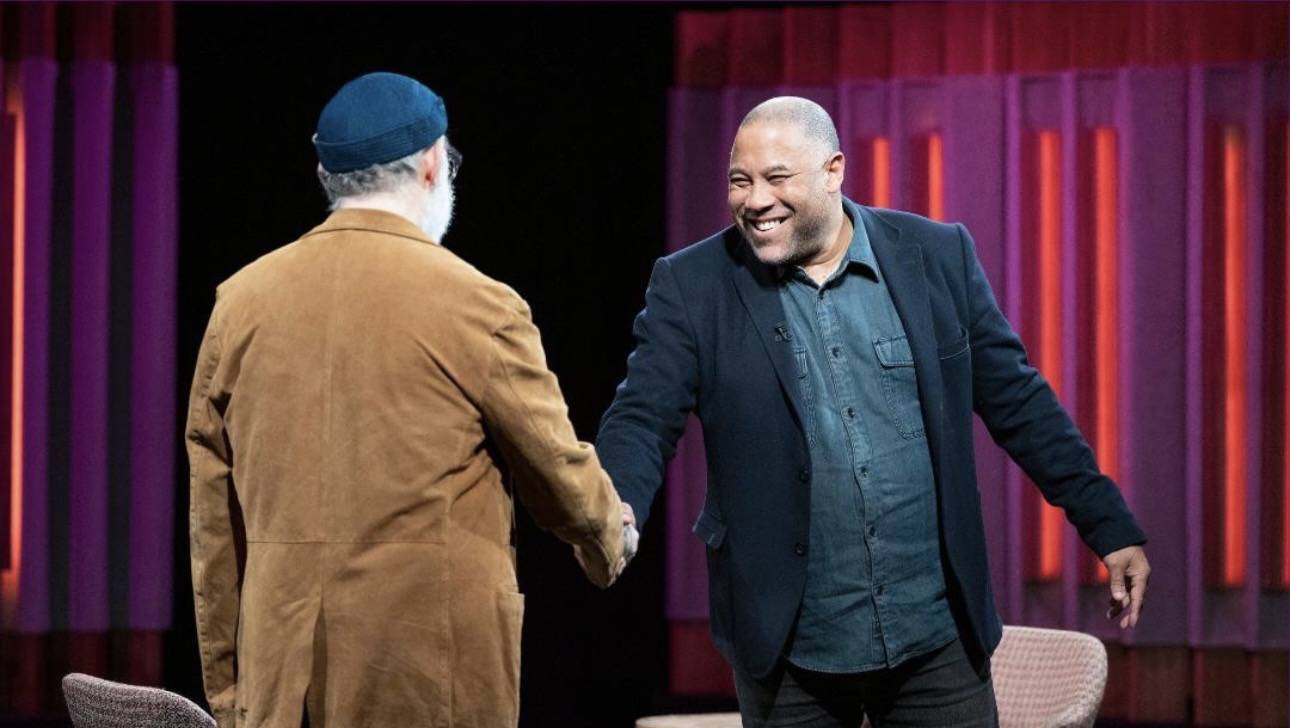
John Barnes joined Tommy Tiernan on Saturday night. Picture: The Tommy Tiernan Show/RTE.
The Tommy Tiernan Show returned on Saturday night, touching on the 1989 Hillsborough Tragedy, racism, addiction and loss.
Tommy Tiernan’s guests on Saturday night included football legend John Barnes, Australian stand-up comedian Sam Campbell, and poet and fashion stylist Jan Brierton.
Tiernan’s first guest of the night was John Barnes, a former professional football player and manager who is often considered one of the greatest England players of all time and one of Liverpool's greatest ever players.
The 62-year-old spoke with Tiernan about his family background, how he was scouted, his professional football debut at just 17, the Hillsborough Tragedy and his personal experience with racism.
Touching on how Liverpool is performing and talking about the club’s young players, Barnes said: “I look at it from a professional perspective. I think we're doing okay. We're going through a bit of a teething problem after winning the league.
"We've got new players. They're young, they're inexperienced. It's going to take time, but they're good individual players. So, we will gel. Whereas the fans just feel it, having won the league last year, and now obviously we're after the top four.
"So I think it affects them more than it affects me.”
He went on to talk about how he has always tried to keep a very “level head” in his career and in his life, describing himself as someone who never lets outside influences affect him.
“Be it 100,000 FA Cup Final or 10,000 against, because I think that you have to play the game, not the occasion. And if you're going to say that, you're going to be more inspired when you're playing in a cup final and less inspired when you're playing a normal league match, that's not the way to be,” he said.
He spoke about how his father, who was a diplomat, came to England when Barnes was 13 years old.
He said he came from “a real sporting family” and that his siblings played a lot of sports growing up.
Barnes touched on being scouted by Watford and debuting professionally at just 17. He would go on to be considered the best at what he did for a period of time, and said that it was his time at Watford that grounded him.
“I had a good grounding at Watford. The essence of Watford, as the essence of Liverpool, is about the team, the responsibility to the team. And being an army officer's son, my dad always spoke about your dedication, your discipline, your commitment, your attitude, and your willingness to work for the team rather than being an individual. I don't care how good you are as a player; your responsibility first and foremost is to the team. This is how I was when I was young,” he said.
Barnes, who played with Liverpool from 1987 to 1977, spoke about the Hillsborough Tragedy — a fatal crowd crush at a football match at Hillsborough Stadium in Sheffield in 1989, which killed 97 people.
The incident occurred during an FA Cup semi-final between Liverpool and Nottingham Forest, which Barnes said he remembers vividly.
“What is supposed to be the happiest day of your life, the FA Cup semi final, then you have mothers, fathers, children, daughters, who don't come home because they've been killed. How are you going to respond to that?,” he said.
“Now, if you go to war, your sons or daughters go to war, you half expect that they could die, but not at a football match. So how are you going to respond to that?
“The way that football fans were treated back then, when they were just herded in like cattle into these stadiums. But we had seen that for 10 years previously, I'd seen that since I started playing football in 1980… this was now 1989, whereby they were herded in, you had fences, they were pushed against these fences.
"And until that happened, everyone just took that for granted, that this is the way football is, obviously. Once that happens, then people go, ‘Well, how could this happen?’”
Recalling what happened, he said the players could see people being pushed against fences and then people started coming over fences. Thinking it was a pitch invasion, the players ran off the pitch and into the dressing rooms and didn’t know what was happening.
“40 minutes later, they said, ‘Oh, well, the game's off’… [We] don’t know why. We came out to go to the players' lounge, to meet our families, and that's when we looked to the right on the pitch and saw bodies and, you know, sheets over people. That's the first time we realised. Then, we were going up to the players' lounge, and we looked out onto the pitch, that's when we saw the devastation.”
Read More
Touching on his experience of racism in football and in his own life, he said: “So very much like I separate my life from who I am and what I am. I also separate the fact that I'm a black footballer in terms of when people tell me they love me,” he said.
“When people say, ‘You did a lot to change racism’. No, it didn't, because you’re talking about a new situation now, whereby the new England team, because their black players are well accepted, they don't abuse them anymore, in this new inclusive England team. Then, two years ago, three years ago, three black players missed the penalty, and you see what happened.
“So, if that's all it takes for you to go back to the battle ways means that you didn't do anything to begin with. So we have to stop looking for football to change society. We have to tackle racism in society from down below, for the average working-class person, average black person, to climb up the ladder themselves.”
Tiernan’s second guest of the night was Australian stand-up comedian Sam Campbell.
Campbell, who has previously won the Melbourne International Comedy Festival Award and the main prize at the Edinburgh Comedy Festival, spoke about how he prepares for his stand-up sets, his experience of being bullied in school, and his future aspirations.
He touched on his life back in Australia, and his decision to move to the UK from the Atherton Tableland, and setting up his life in London.
He spoke about meeting a lot of people because of the lifestyle of what he does, but admits he needs to get better at checking in on people and keeping up with friends.
He spoke about taking part in panel shows such as and and touched on future aspirations, which include making his own movie.
“Oh, I would like to make a real movie called … So it's a guy; his dad never came home. His dad says, ‘Run me a bath, I'm going out.’ But then he never came back, and so he and his mum left the bath water in there, and he started carrying around a bit of it in a plastic bag, looking for his dad,” he said.
He touched on his experience with different crowds at his stand-up gigs, some of which he said start horribly but turn around, with people getting on board with his positive nature.
When asked by Tiernan when he feels best at his job, he said: “I like the creation process, like, the early parts of it, figuring it out, even though it's painful. Like, I like putting it together. When it's when you start to gather a bit of momentum, and you're finally, like, comfortable in making it, that's I think the most rewarding part.”
Tiernan’s final guest of the night was poet and fashion stylist Jan Brierton.
Brierton touched on how she began writing poetry during the pandemic, describing herself as “an accidental poet”.
She spoke about how she writes about the everyday, using her poetry for body positivity and reminding people to embrace their bodies.
“Even today, like I was dancing around my bedroom in my big double gusset, you know, middle-aged knickers and push-up bra,” she said.
“I'm actually just enjoying my body, enjoying just moving it around, and not, not for anyone, not, you know, not, not showing to anyone. I don't think, I think maybe that's, that's the difference. You're not in a club, it's dark and you're not, maybe, there to be showing yourself off. Do you know what I mean?”
She read Tiernan a poem she wrote about her body, called and spoke about the first-ever poem she wrote during the pandemic, called
She spoke about how she finished writing the poem at 11pm, having scribbled it down, and that she felt “cracked open”.
Showing her husband, whom she described as the calm to her chaos, she said, felt amazing.
She said it was posted online, and then featured in the Irish Times, and that it snowballed from there.
Brierton said she went on to publish her first book the following May, and said she was “ballsy” about emailing different festivals to ask if she could come to read her poetry, and that then the second book came.
She spoke about her admiration for John Cooper Clarke and how she sent him a copy of her book, along with a letter, which led to her opening for him at the Olympia in May 2024 and at the London Palladium last year.
“That’s pinch me kind of stuff. As a result of that, now I'll be on stage with him again in Dublin and Belfast this year. And I'm going on tour with another brilliant poet, Henry Normal,” she said.
[media=insta]https://www.instagram.com/reel/DVmdQdul0jL/?igsh=MThjMGYzMWxhNW83aQ==[/media[
She touched on losing her brother, Alan, eight years ago, reading a poem she dedicated to him called and talking about his experience with addiction.
“I'm very careful.. I don't want to say my brother was an addict, because that's not the only thing about him, but it was very much a very prominent thing in our family life and in his life, and he overdosed. So, he lost his life to his addiction.”
Closing out the show on Saturday night were Cormac Begley and Liam O'Connor performing from