For players, the hardest thing is often the simplest: talking

Even the best can be baffled by it. It is an issue from the top of the game to the bottom. What can you do?
For players, the hardest thing is often the simplest: talking

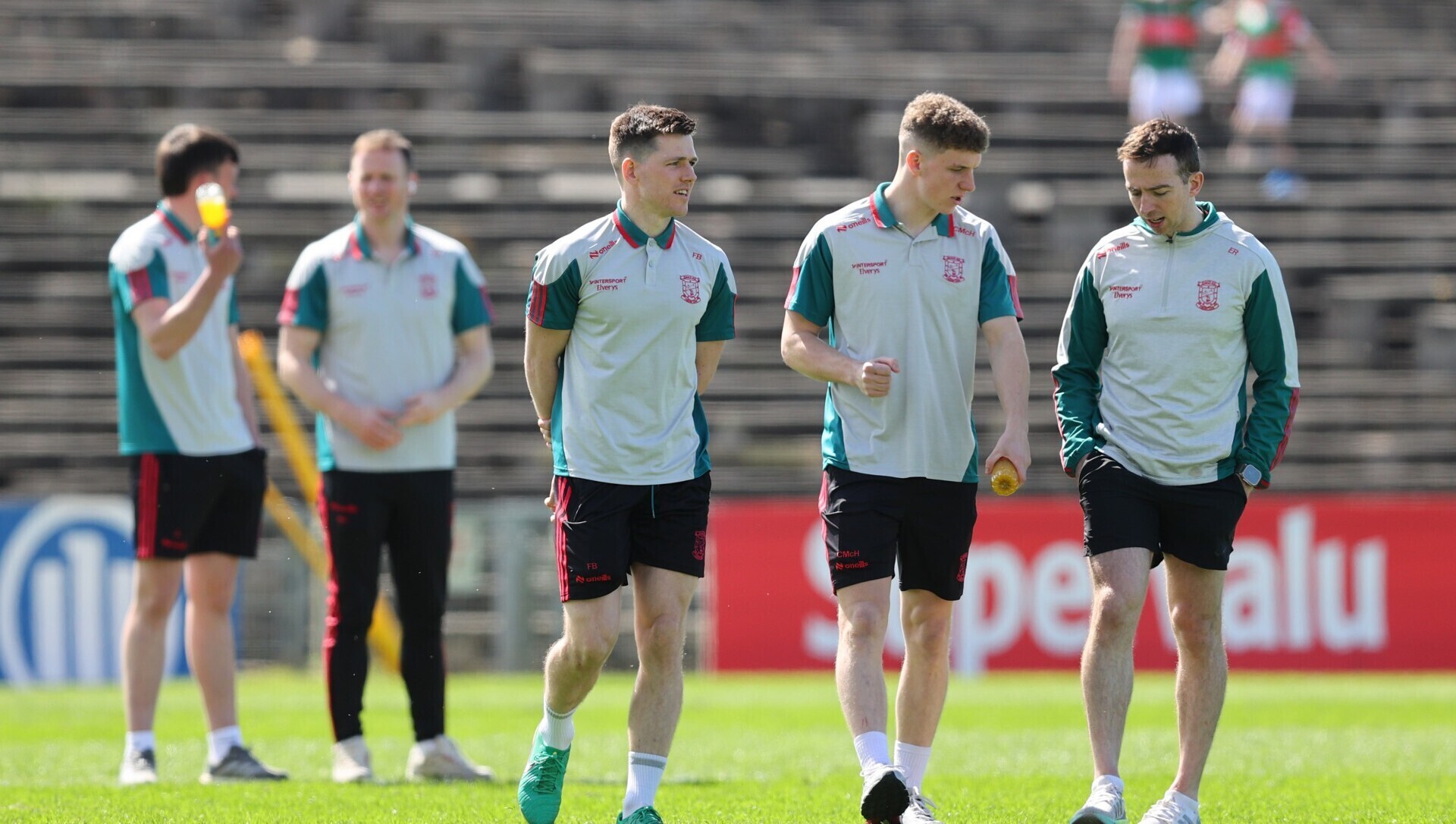
Mayo players chat while inspecting the pitch. Pic: Tom O’Hanlon/Inpho

SILENCE. Blank stares or nodding heads. Every team at every level will have encountered the same maddening problem. 

On the field, in the dressing room, in an analysis session and no one talking.

Now, no one needs to be told about the importance of communication between players on and off the field. It is widely recognised and well-trodden territory in academia. Like so much of the research around sport, everyone understands the theory. 

Making it a reality? Even the best can be baffled by it. It is an issue from the top of the game to the bottom. What can you do?

“Go first. Try,” says Antrim footballer Eoghan McCabe. “There are times when I have been sitting in video sessions and you can hear a pin drop. There is a question put to the floor, no one has said anything. I’ll put myself out there and say something regardless.

Sport Top Pics

“It doesn’t matter if it is wrong or right, just to get the conversation going. It is like anything, people see someone go first and they are more likely to follow. It is such an Irish thing. No one wants to pop their head up. There are times I throw something out, it is the completely wrong answer but it gets someone else to answer.”

For some teams, it is a badge of honour. The Duke Blue Devils have the fourth all-time wins of any NCAA men’s basketball program. 

Their playback is based on communication: ‘The Duke Way’. It is a soundtrack to sustain their energy and intensity. Quiet feet are slow feet, loud feet are fast feet.

There are levels to this challenge. In the aftermath of Dublin’s ‘startled earwigs’ capitulation against Kerry in 2009, Pat Gilroy saw the fault lines in his side. Under pressure, they didn’t understand and execute the gameplan. 

Bernard Brogan later echoed that old George Bernard Shaw line: The single biggest problem in communication is the illusion that it has taken place.

They began to pivot from team talks to team asks. When they did a workshop on emotional hijacking, they broke into groups to discuss and present on it. 

It was led by Stephen Cluxton, a science and biology teacher, who could draw the different parts of the brain with arrows to show how they worked together.

That is the central point. It has to come from players.

“It is everyone being on the same wavelength and tuned in,” says McCabe. “Players have to take a big responsibility for it. I would say every management in the country are talking about communication, chatting to each other, it is one of our big focuses. Can we raise that communication? You can coach it to a extent, but players have to drive it.”

The brashness and sureness of American sports lends itself to messaging as a weapon as much as a tool. Communication becomes intimidation. Dialogue so that we are organised and the opposition know we are organised.

External factors can inhibit the ability to cultivate that. Those relationships are cultivated over years of shared experience.

“Turnover of players and managers even, coming and going. We’ve played Armagh a few times now. You always hear their calls, their communication, everyone is on the same wavelength,” McCabe stresses.

“They have had a lot of the same team there for years. Bringing new players in too, just going up the levels year after year. You hear that stuff and think, that is the level we need to get to.”

Part of the problem is that assumption that the skill is simple. There is no escaping the fact some players simply do not know what to say.

“You need leaders on the pitch,” explains Armagh All-Ireland winning captain, Aidan Forker.

“People who know what they are about and confident in what something should look like. Being really clear to each other, where you need someone to be. Communication is multi-faceted. Obviously, you need to be well versed and practised in what you are doing but also, you need to have those relationships on the pitch to know how someone will take that information.”

COMMUNICATION is a key pillar in defending. That can start with a basic ability to say what you are doing: ‘I have ball’ or ‘double up.’ 

Such instruction extends all the way up to giving constant and collective direction: ‘You have shooter, he is going left.’ It is a hallmark of great teams in any era.

In his book, Kieran Donaghy’s memory of the pivotal 2006 triumph over Armagh was entirely framed by conversations in Croke Park. 

The instructions coming from goalkeeper Paul Hearty to full-back Francie Bellew when they were on top. 

The insults that came with it. How he told Seán O’Sullivan, the sweetest passer he played with, to stop playing the bounce pass in and instead utilise the high diagonal.

How Colm Cooper was able to offer constant encouragement to combat Hearty and the demons in his head.

There is another side to that too, of course. A sharp order or the occasional bollocking. Ultimately, it all stems from the same place.

“People know if you are being told to do something it is for the good of the team and not for any other reasons,” says Forker.

Limerick set drills built around communication. In one, the defence are barred from man-marking and instead rely solely on staying connected and compact to stifle the attack. To do that, they need endless chatter. Quick, actionable cues. Gradually that leads to a shared language and an entire unit in sync.

There are some positions that must be more vocal than others. For vice-captain Barry Coleman, the only real way to improve it is by doing it. Night after night. In every meeting and every play.

Walk the walk, talk the talk.

“It is a massive downfall in some teams,” he says. “Something we pinpointed with us after the league is we didn’t have enough communication on the field. If you can clear up something as small as what you think communication is, it can make a massive difference.

“The main communicator on the field has to be the goalkeeper. They can see everything. They are the last line of defence when you are defending, they can see when fellas need to pass on or when a fella is snaking in at the back.

“You have to instil it in training, if you can’t communicate in training, there is no way you’ll do it in a high intensity moment against Cork or Clare.”

More in this section

Cookie Policy Privacy Policy Brand Safety FAQ Help Contact Us Terms and Conditions

© Examiner Echo Group Limited