Book review: Resisting nazi occupation: How over 50 Irish fought back Paris oppression

'The Irish in the Resistance' is an important book that reclaims the vital yet forgotten history of the Irish who defied the Nazi occupation of Europe
Book review: Resisting nazi occupation: How over 50 Irish fought back Paris oppression

Catherine Crean, of Moore Street in Dublin, was arrested for helping Allied airmen in Brussels. Picture: courtesy of Archives de l'Etat en Belgique [State Archives, Belgium] 

  • The Irish in the Resistance: The Untold Stories of the Ordinary Heroes who Resisted Hitler 
  • Clodagh Finn and John Morgan
  • Gill Books, €19.99 

In July 1943, Margaret Kelly was summoned to the Gestapo headquarters in Paris.

Long resident in the French capital, the Dublin-born dancer was married to Marcel Leibovici, a composer and orchestral conductor. 

Half-Jewish, Leibovici was hiding from the Nazis in a sixth-floor attic of the occupied city. 

Twice a week, Kelly cycled to her husband’s location to bring him food, fresh laundry, and manuscript paper so he could continue writing music.

When the Gestapo official, flanked on both sides by armed soldiers, told Kelly he wanted to know where Leibovici was, she retorted: “So would I!”

Throughout the hour-long interrogation, Kelly, six months pregnant with her third child, looked the German inquisitor directly in the eye and revealed nothing of her husband’s whereabouts.

In 1944, Kelly fell off her bicycle and lay still during a gun battle between the Resistance and the Nazis on the Champs-Élysées. 

Remarkably, these experiences were just one thread in an extraordinary life. 

After the 1916 Rising, Kelly emigrated to Liverpool where she learned to dance. In 1932, she founded the Bluebell Girls, one of the most celebrated dance companies in Europe.

Her exploits in occupied Paris provided the inspiration for François Truffaut’s 1980 film The Last Metro

Kelly is one character in a largely overlooked chapter of Irish history: The more than 50 Irish men and women who risked their lives in the Second World War to fight fascist occupation.

With élan, The Irish in the Resistance: The Untold Stories of the Ordinary Heroes who Resisted Hitler redeems this oversight by illuminating how these ordinary people sheltered fugitives, broke codes, and sabotaged the enemy.
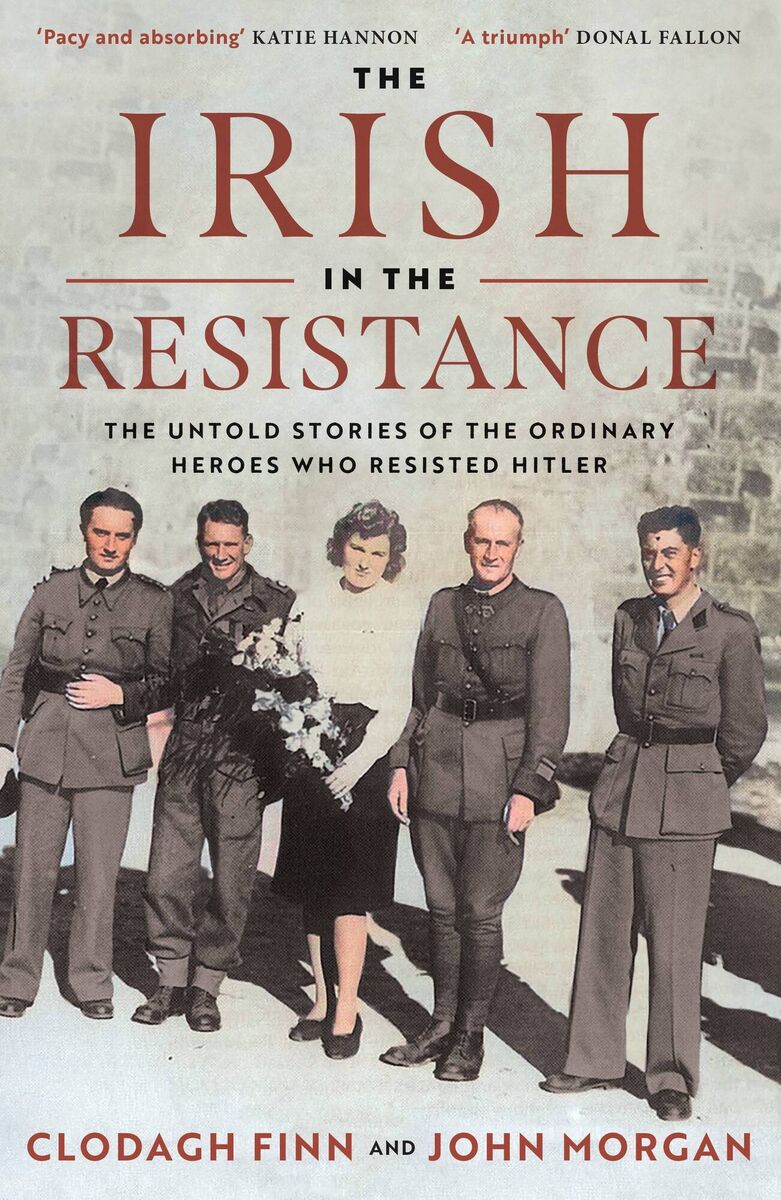
Clodagh Finn and John Morgan, the book’s co-authors, emphasise that across Europe only about one in 10 of those participating in the Resistance were women but more than half of the Irish people who resisted the Nazis were women.

Samuel Beckett, who famously returned from a holiday in Ireland to France the day after war was declared, was ranked second-lieutenant in a resistance unit. 

On the Croix de Guerre for bravery Beckett received, the citation read: “A man of great courage, over two years he provided quality information to a large intelligence network.”

In Rome, the Vatican diplomat Monsignor Hugh O’Flaherty created an escape line that, in total, saved the lives of about 6,500 Jews and Allied prisoners of war.

While the book recounts the actions of both, the best-known Irish figures in the Resistance, its primary focus is unearthing the neglected stories — frequently using recently declassified archived documents — of the Irish who defended democracy.

Among the most striking is Kerry’s Janie McCarthy, who joined at least five different resistance networks in France. McCarthy never had a boyfriend, but in 1964 at her burial, 30 men wept over her grave.

Born on Dublin’s Moore St, Catherine Crean helped Allied airmen to escape Belgium.

But after she was betrayed to the Nazis, the governess died in Ravensbrück concentration camp.

In 1945, Captain John Keany of the Royal Irish Fusiliers parachuted 100 miles behind enemy lines into north-west Italy as part of a British special forces mission to help the Italian Resistance.

Accompanied by partisans, Keany was killed in an ambush when he was shot in the face, neck, arm, and chest.

Exemplifying the complicated allegiances of many of the Irish involved in the Resistance, Keany’s father was a member of the Royal Irish Constabulary and was killed in Cork during the War of Independence.

Forensically researched, rich in the human detail of its subjects, and presented in flab-free prose, The Irish in the Resistance is an important book that reclaims the vital yet forgotten history of the Irish who defied the Nazi occupation of Europe.

  • Clodagh Finn writes regularly for the Irish Examiner on this and similar topics

BOOKS & MORE

Check out our Books Hub where you will find the latest news, reviews, features, opinions and analysis on all things books from the Irish Examiner's team of specialist writers, columnists and contributors.

More in this section

Scene & Heard

Newsletter

From music and film to books and visual art, explore the best of culture in Munster and beyond. Selected by our Arts Editor and delivered weekly.

Cookie Policy Privacy Policy Brand Safety FAQ Help Contact Us Terms and Conditions

© Examiner Echo Group Limited