10 talking points from the world of visual art in 2022
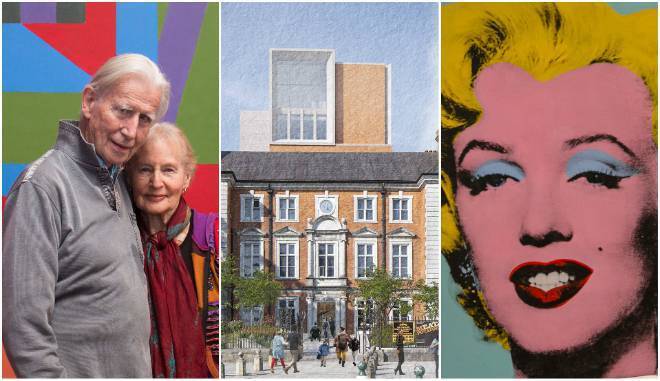
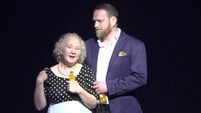
L-R: The late Brian O'Doherty and Barbara Novak; an artists' rendition of the post-extension Crawford Arts Centre; Andy Warhol's Shot Sage Blue Marilyn
In November, Ireland lost one of its most celebrated figures, when Brian O’Doherty passed away aged 94.
O’Doherty had a distinguished career as an artist, critic, author and broadcaster, having first qualified as a medical doctor in Dublin. Based in America since 1957, he lived in New York with his wife, the art historian Barbara Novak, but returned often to Ireland.

In 1972, protesting the Bloody Sunday massacre in Derry, he began signing his artworks with the pseudonym Patrick Ireland, continuing to do so until 2008, when he buried his alter ego in the grounds of the Irish Museum of Modern Art in Dublin.
His last major project was One Here Now at the Sirius Arts Centre in Cobh in 2019.
Among the artists O’Doherty hobnobbed with in New York was Andy Warhol, whose painting Shot Sage Blue Marilyn became the second most expensive artwork ever sold at auction - after Leonardo da Vinci’s Salvator Mundi - when it fetched $195,040,000 at Christie’s in May.
Shot Sage Blue Marilyn - one of dozens of paintings and screenprints Warhol made of the Hollywood icon Marilyn Monroe - was competed in 1964.

In the autumn of that year, the performance artist and photographer Dorothy Podber visited Warhol’s studio and asked if she could shoot his work.
Thinking she wished to photograph his latest screenprint paintings, he agreed.
But Podber had other ideas; producing a pistol, she fired a single shot at four paintings leaning against a wall.
Thereafter, unsurprisingly, Podber was banned from the Factory, but the works she’d shot acquired a mystique in the art world that has no doubt contributed to their lavish value.
Shot Sage Blue Marilyn is reputed to have been bought by the art dealer Larry Gagosian, though it is not known if he was acquiring the work for himself or for one of his wealthy clients.
Over the past forty years, many of the big collectors in America have been IT billionaires, such as Paul Allen, who founded Microsoft with Bill Gates in 1975.

When he died in 2018, Allen was worth an estimated $20 billion and had amassed a vast art collection, much of which was auctioned at Christie’s New York in November.
The sale was the most successful art auction ever, raising more than $1.6 billion.
The most expensive item sold was Georges Seurat’s Les Poseuses, Ensemble (petite version), at $149.24 million, followed by Paul Cézanne’s La Montagne Sainte-Victoire at $137.8 million and Vincent Van Gogh’s Verger Avec Cypres at $117.2 million.
Such prices are beyond the imagination of most Irish artists, but most still depend for their income on sales, along with grants, commissions and - if they are exceptionally lucky – prizes.
The Covid lockdowns meant many artists had no earnings at all for two years or more.
The National Campaign for the Arts has long advocated for a basic income for artists, and the government finally took note in 2022, launching a scheme that saw more than 9,000 artists apply for a guaranteed income of €325 a week over a three year period.
On 22nd September, the grant was awarded to 2,000 applicants, and of these, the majority – a total of 707 – were visual artists.
The Basic Income is a pilot scheme, which may yet be expanded. Hopefully, it will afford a whole wave of artists the time and space to create exceptional work. As the country battles a housing and cost of living crisis, isolation and focus cannot come cheaply, after all.
Most would agree that the production of art requires isolation and focus, while its distribution depends on the hustle and bustle of exhibitions, auctions, art fairs and festivals.
That aspect of the art world was much missed during the Covid crisis.
A sure sign that we were moving beyond the pandemic was the return of the Venice Biennale, the most prominent international celebration of the visual arts.
This year’s edition was postponed from 2021, but opened in April to glowing reviews, not least because it featured a 90% representation of female artists, reversing a previous trend that had grown to seem increasingly backward and sexist.

One of the highlights of the Biennale was a solo exhibition by the veteran Portuguese artist Paula Rego, featuring sculptures, paintings, pastel drawings and prints inspired by folklore and dreams.
The exhibition was brilliant – a tour de force of graft and provocation - and it seems obvious that the acclaim that greeted this late career celebration of Rego’s work would have come a great deal sooner if she had been male.
One only hopes Rego found time to revel in the praise; she passed away, aged 87, in June.
The Crawford - located at Emmet Place, in the heart of Cork city - is set to benefit from what the Minister of Arts and Culture, Catherine Martin, has described as “a once in a generation investment.”
The gallery building, parts of which date back to the early 18th century, will be upgraded and enhanced, with the addition of a new six-storey extension. There will be new exhibition spaces and additional storage for the Crawford art collection, along with a new Learn and Explore facility. The work on the €29 million project is expected to commence in 2023.
Just as the Venice Biennale profiled O’Malley’s work, so too did Kaunas 2022: The European Capital of Culture showcase the talents of the Cork-born multi-media artist Aideen Barry.
Barry spent much of last year commuting to the Lithuanian capital to create Klostes (Folds/Pleats), a feature-length stop motion film based on the short stories, myths and hidden histories of the Inter-War Modernist movement in the city.
Barry’s film had its world premiere in Kaunas in September, and has since been screened in Dublin and Galway as well as in France, Argentina and the US.
Closer to home, Irish artists once more had the opportunity to submit their work for consideration for the Zurich Portrait Prize.
This year’s winner of the adult category was David Booth for his painting Salvatore; he received a cash prize of €15,000, along with a €5,000 commission to produce a new work for the National Portrait Collection.

Two additional prizes of €1,500 for highly commended works went to Cara Rose for Double Self Portrait, a work in coloured pencil on paper, and Gavin Leane for Several Days Hence, a photographic portrait of his father.
The winner of the Youth Portrait Prize was Mellin Ava Song, aged 13, for her painting on canvas, New Beginning. The shortlisted works can be seen at the National Gallery of Ireland, Dublin until 2nd April 2023. (Full disclosure: your humble writer was also shortlisted with one of his portraits)
Two of the most exciting solo exhibitions in Ireland this year were by veteran artists. Patrick Graham’s Transfiguration ran at Dublin City Gallery: The Hugh Lane from March to July and featured many of his monumental paintings and triptychs from the 1980s to the present day.

A native of Mullingar, Co Westmeath, Graham has been one of the most intriguing figures in the Irish art world since the 1960s, producing colourful, subversive works that have earned him a considerable reputation in Britain and America as well as here.
Meanwhile, at Galway Arts Festival in July, Ana Maria Pacheco presented a solo exhibition of her work called Remember. This took the form of a series of sinister sculptural vignettes, mostly carved from wood, including The Banquet, which featured a group of men in suits gathered around a naked man they seemed about to devour.

Pacheco, a Brazilian artist who has lived in the UK since 1973, had shown in Galway before - indeed, her exhibition Dark Night of the Soul was a highlight of the festival in 2017 - but this latest outing revealed her to be an artist at the height of her powers.