Venice Biennale: Seven talking points from the great art showcase
Of course there were a few exhibitions that underwhelmed, but many of the pavilions at the 2022 Biennale contain hugely-impressive art, and the event has also made huge strides in addressing gender balance among the artists 
Venice Biennale: Seven talking points from the great art showcase

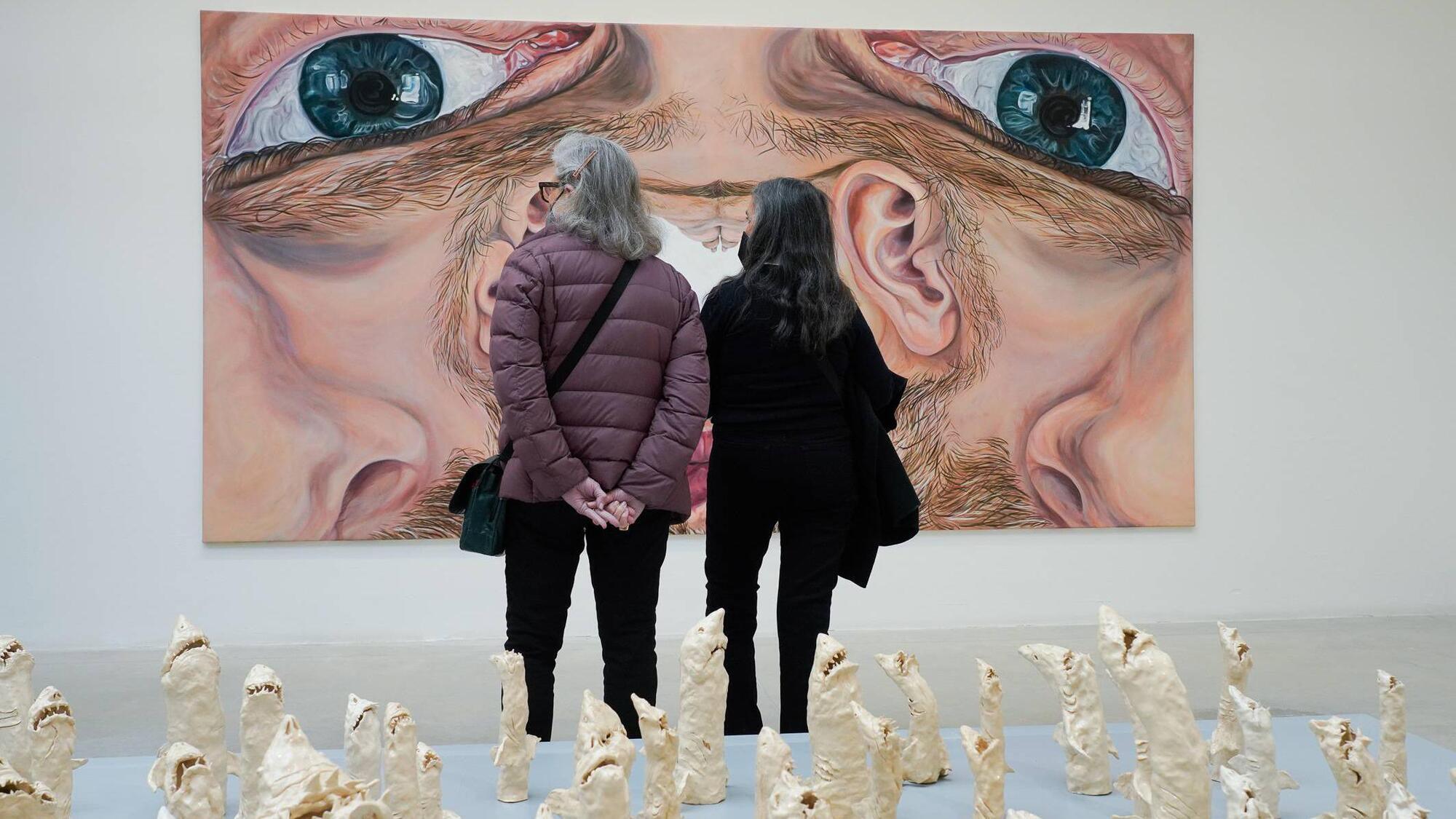
Visitors to the Venice Biennale 2022, which runs until November. Pictures courtesy of Venice Biennale

The German author Thomas Mann once described Venice as “half fairytale, half tourist trap.” It is never more so than during the Biennale, the world’s greatest showcase of the visual arts, which sprawls across two huge dedicated spaces, the Giardini and the Arsenale, as well as a number of venues around the old town, and regularly attracts half a million visitors.

Most attending this year’s Biennale, the 59th in its 127-year history, would agree that the standard is exceptional. This may be due to the postponement of the event from 2021 to 2022, which gave the participating artists more time to realise their projects, or the fact that curator Cecilia Alemani has ensured there is a higher than usual representation by female artists, or it may simply be a reflection on how the artists have responded to the social and political turbulence of the past few years.


Whatever the reason, this Biennale has been a thing of wonder. There are two main strands to the event: the first is Alemani’s selection of artists under the title The Milk of Dreams, the second of a series of national representations; all told, there are 213 artists from 58 countries, 180 of whom are participating for the first time. 

Much has been made of the fact that just 21 of the artists are men. This is in line with an all too recent shift towards gender equality in the visual arts – it is not that long, after all, since 90% of the participants were male – and one looks forward to the day when gender balance, or better yet, gender blindness, is the norm at such events.

Alemani took her title The Milk of Dreams from a book of illustrated stories by the British-born Mexican Surrealist Leonora Carrington, much celebrated as a work of magic and imagination. 

Paula Rego: Portugal

Fittingly, at the heart of Alemani’s selection is an installation of extraordinary and sometimes macabre sculptures, paintings, etchings and pastels by the Portuguese artist Paula Rego. Inspired by folklore and storytelling, they remind the viewer that figuration can take many forms; Rego is an artist who could never be accused of prettifying her subjects, rendered as they are in unflattering poses and a palette of visceral reds, purples and blacks. At 87, she is easily one of the most impressive artists at work today, cerebral and mischievous, and a master of multiple disciplines.

Malgorzata Mirga-Tas: Poland

Part of the exhibition from Poland.

Storytelling is also the starting point for Malgorzata Mirga-Tas’s exhibition, Re-enchanting the World, which occupies the Polish Pavilion at the Giardini. 

Mirga-Tas has employed members of her family and neighbours to create a series of colourful tableaux, using hand-stitching and recycled fabrics, that honour her Roma heritage. 

There are scenes of people engaging in such everyday activities as playing cards, preparing a meal, and attending a funeral, and also a series based on images made by the French printmaker Jacques Callot in the 17th century. 

While Callot’s original images seemed to poke fun at the Romas' nomadic lifestyle, Mirga-Tas celebrates their itinerancy as an expression of freedom. Her works cover all four walls of the pavilion, from floor to ceiling, and several more are displayed to startling effect outside. 

Vast and life-affirming, the entire installation would reward any number of viewings.

Simone Leigh: USA 

A view of some of American artist Simone Leigh's exhibition. 

Simone Leigh’s exhibition at the American Pavilion, Sovereignty, is surely the most lavishly funded in the entire Biennale, but this is not to distract from its powerful evocation of the historically undervalued – and often unacknowledged - labour of black women. 

Leigh has transformed the building itself – a 1930s neo-classical structure – into a West African palace, complete with a thatched façade. 

Outside soars the 22-foot high Satellite, a bronze sculpture that recalls both the female body and a satellite dish. 

Inside are several more of these monumental pieces, some in bronze, others in ceramic, all of them representations of the female form, now stooped in toil, now standing proud and defiant.

Leigh is also represented in The Milk of Dreams with a single magnificent sculpture, Brick House, which won her one of the two Golden Lion awards presented by the Biennale. 

Sonia Boyce: Britain 

The other Golden Lion winner was the British representative, Sonia Boyce. 

Her exhibition, Feeling Her Way, is an omnium gatherum of video installations, music, collage and sculpture, all based around five female singers rehearsing in the studio. The overall effect is underwhelming. 

The Scottish artist, and Turner Prize winner, Susan Philipsz’s experiments with the human voice, for instance, are far more intriguing, and have far greater depth and complexity.

Pavlo Makov: Ukraine

The Ukraine exhibition. 

The Ukrainian representative Pavlo Makov’s Fountain of Exhaustion is so achingly of-the-moment that it is difficult to believe the sculpture is actually the latest iteration of a work he first sketched out in 1995. 

On the day Russia invaded the Ukraine, the curator Maria Lanko packed the 78 bronze funnels that comprise the work into cases and ferried them across Europe by car. 

In Venice, they are arranged in the shape of a triangle, with water trickling down through the funnels to gather in a pool, whence it is pumped to the top again, an act of weary repetition that seems, in the context of the times, to mirror the endless cycle of violence in human history.

Almost as admirable as the Ukrainian team’s determination to participate in the Venice Biennale was the Russian team’s refusal to do so, in protest at Putin’s war. As a consequence, the Russian Pavilion in the Giardini stands empty and forlorn, and very much unloved.

Marco Fusinato: Australia 

The Australian Pavilion. 

If the Biennale presented an award for the least popular pavilion, however, it would surely go to Australia for Marco Fusinato’s Desastres installation, at which the artist subjects an electric guitar to various tortures, producing waves of discordant noise and triggering streams of unwholesome images on a giant video screen.

Niamh O'Malley: Ireland 

Niamh O’Malley's Gather installation. Picture: Ros Kavanagh

At the other extreme is Irish artist Niamh O’Malley’s installation Gather at the Arsenale, which includes a number of sculptures based on shelters and other urban forms, along with two videos, one of a bird in her garden, the other an oddly affecting image of a vent opening and closing in the breeze. 

Both recall the recent lockdowns, when one could spend hours engrossed in watching such vignettes through the kitchen window. 

Indeed, as the world opens up again, one will surely look back wistfully at such a quieter and more meditative time in our existence.

  • The Venice Biennale continues to November 27. Further information: labiennale.org

More in this section

Scene & Heard

Newsletter

From music and film to books and visual art, explore the best of culture in Munster and beyond. Selected by our Arts Editor and delivered weekly.

Cookie Policy Privacy Policy Brand Safety FAQ Help Contact Us Terms and Conditions

© Examiner Echo Group Limited