'Feminist powerhouse and Cork native' Louise O’Neill is looking to the future
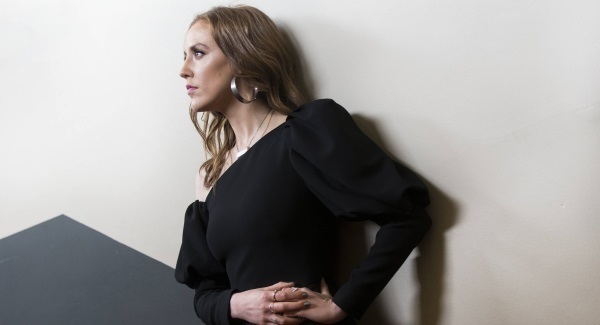
There aren’t many authors who would be so understanding when you tell them you found their book tough going. But Louise O’Neill sits across from me in a busy Cork café, nodding encouragingly as I tell her that as a mother of two young girls, I found reading Asking For It almost unbearable at times.
“That is totally understandable,” she replies. “I’ve had a lot of people tell me they could only make it halfway through and they had to stop it. I’ve just said, ‘look, you bought it, so that’s grand’,” she says, laughing.
My confession is a reflection of the harrowing subject matter of Asking For It, which deals with a horrific act of sexual violence and its repercussions for the victim and her family. While O’Neill’s first book Only Ever Yours was well-received critically and commercially, Asking For It, her second, became a cultural phenomenon when it was published in 2015. While written for a young adult readership, the book became a crossover success, staying in the bestseller lists for over a year. O’Neill has presented a TV documentary about rape culture inspired by the book and a television adaptation is also in development.
Now, Asking For It has been adapted for the stage, with the eagerly awaited world premiere taking place in the Everyman Theatre as part of Cork Midsummer Festival next month.
O’Neill, 33, has also had two books published back to back in the last few months, a novel, Almost Love, and The Surface Breaks, a feminist retelling of The Little Mermaid. But here she is, still talking about Asking For It. Did she ever imagine when writing it that it would have such an afterlife?

“No, it’s funny. I was so sure about Only Ever Yours; I was not that confident about Asking For It. I remember saying to my friends that I was unsure and that I hoped it I wasn’t making a complete mess of it. But it just kept going... a year and a half after it came out, it was still in the top ten. In a weird way, it took on a life of its own and I had to completely let it go. It doesn’t feel like my book any more, not in the way the other books do.”
The consensus among reviewers was that Asking For It was an “important” novel, for the raw and powerful way in which it tackled the subjects of sex, consent, and how women are treated in a hypersexual era of social media. The book has also turned out to be uncannily prescient in regards to events such as the #MeToo movement and a raft of high-profile sexual assault cases. While O’Neill had no idea how significant the book would become, one insightful reader close to her did.
“My dad was the first person to read it,” she says.
I can picture it exactly... I was walking down the stairs and he came over and he said ‘I finished the book’. I sat down on the stairs and said ‘what did you think?’ He said, ‘Louise, this is going to be such an important book’. A lot of people said that to me and I didn’t believe it. He said it would also be a challenging book for people, that it would make some realise they had been raped and others realise that they had raped someone. He said some people would not want to have that realisation and he wanted me to be prepared.
While her father’s prediction was borne out, not even his gentle warning could have prepared O’Neill for the overwhelming response from readers with whom the book so potently resonated.
“It became fairly clear to me pretty early on that I would have to treat the book like a separate entity to myself,” she says. “I was getting so many emails from [sexual violence] survivors. Even now, when I do a signing, there will always be someone with tears in their eyes who will tell me how much the book helped them. Obviously, as a human being I can empathise with them but as an author I can’t take on that sort of responsibility. I wouldn’t be able to function as a normal human being or ever write again, which was a big fear when I finished Asking For It.”
O’Neill also felt the sharp sting of the inevitable social media backlash to her work, and her views as a feminist.
“Because of the trolling and online abuse I was getting, I ended up having to take my website down to protect myself. I felt sad because it had my email address on it and I knew there were people who wanted to reach out and talk about it and they weren’t going to do that on Twitter. I felt guilty but I had to protect myself. I was genuinely humbled and honoured but I was afraid I would say the wrong thing. I am not trained as a therapist and I might unwittingly do some harm.”
While O’Neill tackled the trolls online, in real life, she found a more supportive response. Asking For It is based in the fictional town of Ballinatoom, whose residents ostracise the main character Emma and her family in the wake of the assault, instead siding with the local GAA stars who have participated. O’Neill drew on her own experience growing up in Clonakilty for the book, but says her formerly ambiguous feelings about the West Cork town have given way to fondness.
I had always wanted to write something about growing up in a small town, that push-pull feeling of being both trapped and also yearning to belong. As a teenager, I really hated living in a small town. It’s funny to come back as an adult and have so much affection for it. I am able to take all the positive aspects of living in a small town and maybe reject some of the other aspects.
“In general, I have found the people of Clonakilty really supportive; people did ask when the book was first released how people there were taking it. My answer always was that they know that I’m not saying that rape only occurs in Clonakilty. I had people from New Zealand, the US, the UK, all over the world, emailing me saying, ‘I feel like this could have happened in my home town’.
“So, yes it is small-town life. The problem is the way that we tend, as a culture at large, whether that is in small towns or big cities, to protect the perpetrators of sexual violence out of the fear that we might convict an innocent man, which I understand. But as a culture we seem to think that men have futures that must be protected and women have pasts that need to be dissected and torn apart to look for evidence of wrongdoing.”
The stage production of Asking For It is also a particularly timely one given the recent acquittal of former Ulster rugby players Paddy Jackson and Stuart Olding on rape charges, with the case sparking much debate and discussion about consent and the treatment of women.
“While the Ulster trial did start a conversation around the judicial system and how rape cases are dealt with, I would rather have that conversation off the back of a fictional novel or play than a young woman’s lived experience,” she says.

O’Neill is working on a US film adaptation of Only Ever Yours but says she has been happy to take a back seat when it comes to the stage version of Asking for It, which is directed by Annabelle Comyn and adapted by Meadhbh McHugh. The production company behind the show is Landmark, headed by Anne Clarke, and responsible for acclaimed shows such as Ballyturk and more recently Grief is the Thing with Feathers.
“I have completely handed it over. I really trust Landmark, I’ve seen a lot of their work and the standard is always extraordinarily high. When you’re working with people of that calibre, I just feel let them off, let them do it. Meadhbh is an incredible playwright, I’m not. I would like to write a play but I wouldn’t want my first one to be a really big project like this. Literature and the theatre are such different animals anyway. I felt that if I was to say, ‘well it needs to be like this or it needs to be closer to the book’, it would be kind of taking away from theatre as an art form.”
O’Neill says she is also looking forward to seeing what the stage team have done with the play.
“I’m really excited about the idea of going to see it and it really being fresh and new. I’m looking forward to going with my parents, my sister, and my boyfriend and being as surprised as everyone else. I am so excited about the idea of the world premiere happening in Cork. I am very proud to be from Cork, I am quite vocal about it. As my [Clare-born] boyfriend keeps saying, ‘I get it, you’re from Cork’.”
After I leave O’Neill, who is heading for the train to Dublin, I wander into Waterstone’s on St Patrick St, greeted by a table displaying her latest books, with a sign describing her as a “feminist powerhouse and Cork native”.
She’d like that.















