Imelda May: 'My brain never stops ticking — when nighttime comes, the circus arrives'
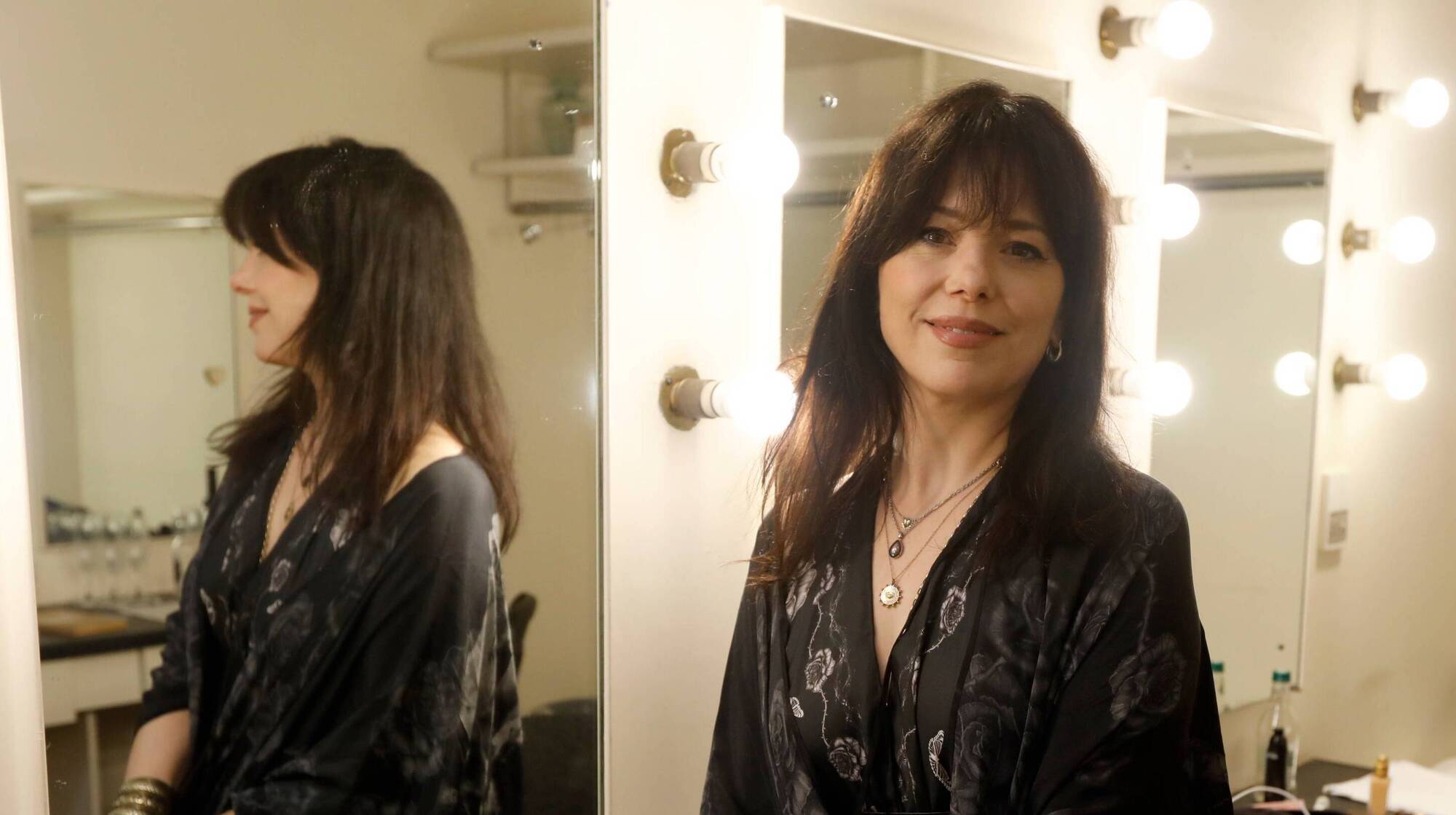
Imelda May backstage. Picture: Mark Stedman
I hear Imelda May before I see her. She’s exclaiming about the beautiful decor: “I’d love to figure out how to put fringing like that on my sofas at home”.
We’re meeting in The Glasshouse in Montenotte on the hottest day of the year so far; high up above Cork City, the view is glorious.
May has been touring around Ireland in early 2026 with a “stripped back” show and is set to bring it to Cork at Live at the Marquee on June 12.
“It’s gone extraordinarily well. I couldn’t have asked for more. And word of mouth got around, which is the best advertisement ever, because after the first or second gig, it started to sell out.”
Those gigs are Imelda May in her element, in her own environment, literally.
“I wanted to invite everyone into my sitting room. Of course, I couldn’t do that, so I had to bring my sitting room to everyone.”
She has recreated her sitting room on stage — her sofa, her rugs, lamps: “It’s all my actual stuff from my home.
“I’ve done [the big show] before, and I’ll do it again. You know, where you have a big opening and a dramatic backdrop with visuals to match each song. But I wanted to get rid of that fourth wall. I wanted to bring it back to just singing songs in your house.”
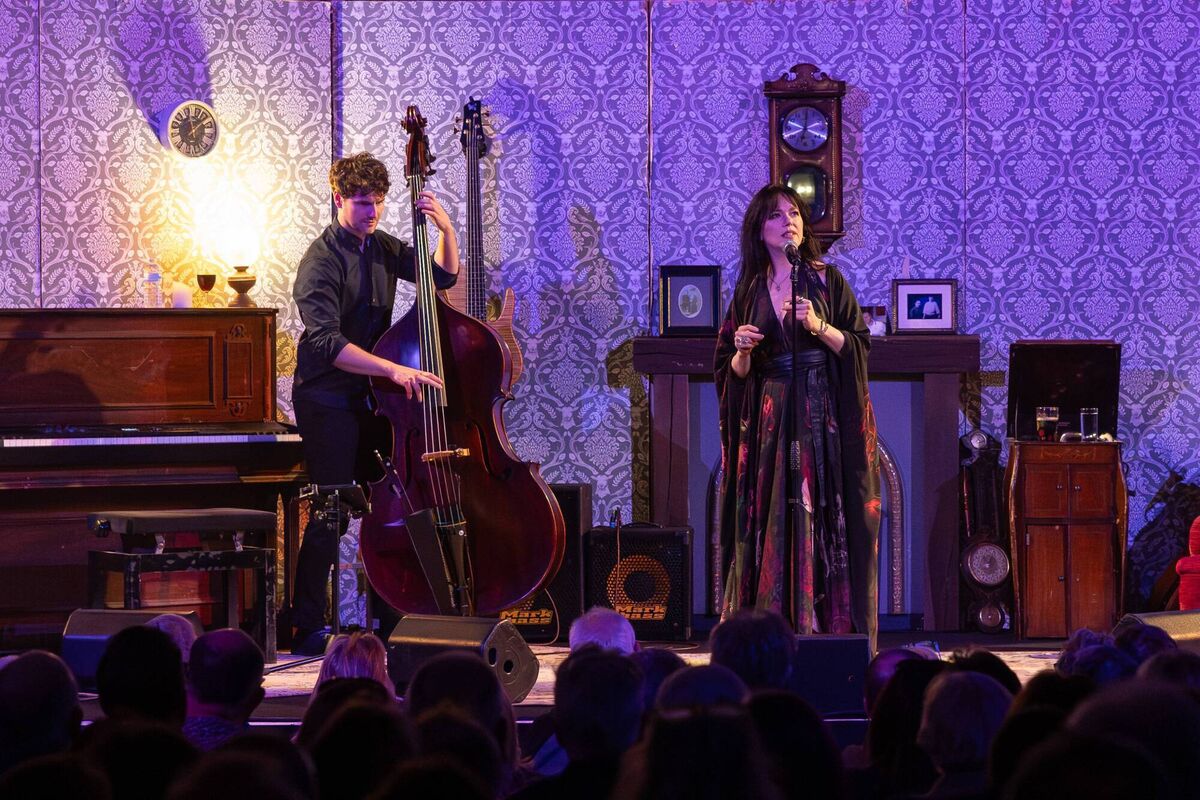
For these gigs, May is joined on stage with Oliver Darling on guitar and Barry Donohue on bass. That’s it. And while she has “a bare bones of a set list”, May says that can change at any time and largely depends on the audience.
“I’m asking the audience, ‘is there anything you want to hear?’ And people shout out the most random songs, sometimes covers. And I’ll come along and give it a go.” That can often mean that May is digging deep into her catalogue of songs, but she’s relishing the opportunity to reconnect with songs she mightn’t have sung in a while. May is also reciting poetry and telling stories. Her tour, after all, is called Raised on Songs and Stories.
The format was very much May’s own idea, and she tested it out in Connolly’s of Leap, the well-known music venue in West Cork.
“I tried it out down in Connolly’s, and it was more skeletal than what it is now, and messier, but the idea was the same. And I have to say a big thank you to Aikens for booking it, without fully understanding what it would be. I remember telling them, ‘trust me, I know it sounds weird, but it will work’. And it has.”
In many ways, the direction her live performances have taken this year are very much a follow-on from May’s experience with the RTÉ series she worked on in 2025 called Imelda May: Amhráin na nGael.
The show follows the singer through Ireland’s Gaeltacht regions and explores her relationship with the Irish language through sean-nós singing, stories, and cultural connections.
During that series, she says, “it dawned on me very much that our culture was an oral culture, and the way that the English could eradicate our language so quickly and so successfully was by stopping us from speaking to our grandparents about our stories and our culture. By doing that, we were immediately cut off from our history. So I wanted to tap into the importance of our stories and songs.” Before the RTÉ series, May says she, like many of us, had basic Irish that she learned in school, but she was embarrassed to speak it. During the show, she was travelling around the Gaeltacht regions with director and producer Maggie Breathnach, herself a Gaeilgeoir.
“Maggie would hear me using little bits of Irish, and she’d say, ‘use more’ and I would immediately clam up. And Maggie would say ‘you’re well able to speak it’ but I felt I couldn’t speak my Irish in front of her because she was fluent. We both start chatting about why that is, why do people feel like that?” Breathnach and May concluded that people on both sides — whether a Gaeilgeoir or not — feel uncomfortable. “The Gaeilgeoiris can feel like they’re backwards — Moya Brennan spoke of this a lot when Clannad first started recording in Irish — and then you find with people who don’t speak Irish, that they feel embarrassed they’re not able to speak their native language.” With that revelation in mind, May says she stepped out of her comfort zone and regularly uses Irish now, day to day.
“Now I’m just doing it in my own time. I learn a new word or two a day and I try to use that, and then I’m also continuing to use the words I already know. And my new thing now is using the Irish version of placenames. Like if you think of it, Cork means nothing, but Corcaigh means marsh – I looked that up on the way here today – so now I call it Corcaigh. And that goes for all placenames; there’s meaning behind the Irish versions of them, that is completely lost in the English translations.” May, a restless soul, is invigorated by the idea of lifelong learning and constant curiosity. “I love pushing myself out of my comfort zone to learn something new,” she says. “And look, I get bored easily. I have to keep moving.”
That zest for moving and learning has seen May embrace poetry, theatre acting, creating docu-series, and acting on screen. Her one-woman show, Mother of All the Behans, where she plays the indomitable Kathleen Behan received rave reviews. She’s also appeared on the big screen in 2022’s Fisherman’s Friends: One and All, 2024’s The People Before, and in 2025’s Four Letters of Love where she plays Pierce Brosnan’s wife in a romantic drama.
Moving between the different mediums makes sense to May. “I’m predominantly a storyteller. That’s my vocation. It’s my job to help us connect, and not just me personally, I mean as an artist. I think that’s what art is supposed to do, isn’t it? It’s to speak to you in some way. I think that’s why I love poetry and film and literature and documentaries. I’m a storyteller.”
It’s clear that May doesn’t like being tied down to one thing. Moving and changing is her modus operandi. “I’m not into restrictions. We keep growing and learning until we die.” She’s eager to understand new things and gobbles up information.
“I remember being a pain in the ass in school. I was always asking why. And I noticed my daughter does the same now. But it’s a good question. I think it’s good to question things all the time.”
It’s that curiosity and creativity that drives May onwards. “It never stops. My brain never stops ticking, and when nighttime comes, that’s when the circus arrives. But I love to learn and I get upset that I can’t learn more and know more.
“I want to speak Turkish so that I can learn the poetry there. I want to know how pistachios are picked so that I can crush them and make beautiful meals. There’s so much beauty in this world, and I want to experience it all.”
Staring into her intense brown eyes, I’m absolutely buying what she’s selling. As we part ways, after a lovely, unexpected hug and a poetry recommendation, I have this sudden urge to get back into my abandoned Spanish classes and take a walk in my favourite woods and look at the trees. Imelda May’s enthusiasm for life is contagious.
- Imelda May plays the Marquee, Cork, on June 12.
CONNECT WITH US TODAY



Be the first to know the latest news and updates