McFall's Chamber have a long tradition of blurring boundaries
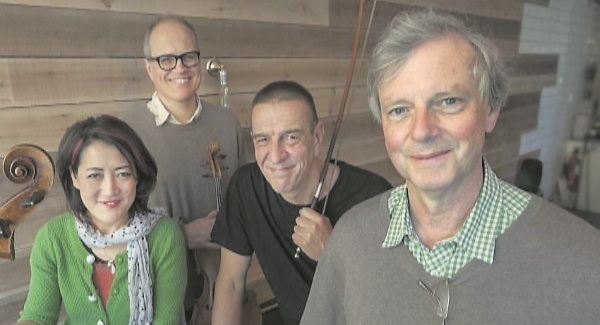
THIS week’s Irish debut by avant-garde classical ensemble Mr McFall’s Chamber will be a home-coming of sorts for the collective, notwithstanding that founder and driving force Robert McFall has never previously performed here.
At the invitation of Cork Orchestral Society, McFall and his musicians will on Thursday play a suite inspired by transatlantic commerce across the centuries. Coming to a mercantile city with a history of oceanic trade, the theme could not be more appropriate.
“The programme was originally put together for the Commonwealth Games in Glasgow, a year ago,” says McFall. “We decided to work with the concept of islands and, in particular, connections with the Caribbean.
People in this part of the world are very conscious of the links with, say, Canada and Australia. But we are less cognisant of the deep historical relationship with Jamaica, in particular. It makes sense that we should bring it to Cork.”
Their repertoire will be impressively eclectic, encompassing Afro-inflected Caribbean pieces, music, and poetry by Kurt Weill, Henry Purcell and Robert Burns, and a song cycle by Belize-born Errollyn Wallen.
For classical fans, it promises to be a plunge into strange and uncanny waters. McFall would have it no other way. Shaking the audience out of its zone of comfort is part of his raison d’être. He lives to surprise.
Mr McFall’s Chamber was established in Edinburgh 20 years ago, when classical and contemporary music held one another in mutual suspicion.
Of the opinion classical musicians should reach out to audiences beyond the concert hall, McFall played in clubs and theatres — attracting crowds that had often previously regarded the classical universe as the preserve of snobs and purists.
“I’m a working, classical musician and have played in orchestras all my life,” he says. “At a certain point, I became frustrated and wanted to communicate with younger audiences. This has since become quite mainstream. At the time, nobody else was doing it.”
McFall remains fascinated by musical slipstreams, the quixotic borderlands between classical and other genres. “We were looking for opportunities in the fringes,” he says. “Those places where classical meets jazz or folk or electronics. It’s always interesting to be out there, at the edges.”
In the early ’90s, classical circles were, in Scotland at least, notoriously stuffy, and McFall’s endeavours were not always looked upon kindly.
“I’m not sure if it was wholly approved of,” he says. “This was before BBC Radio Three had embraced the world-music thing and opened the floodgates. At the time, classical music was still a bastion and was very straight.
One did feel the oppression of those boundaries. Classical musicians tended not to have anything to do with folk musicians, and vice versa. Nowadays, the biggest worry is whether you can get the attention of your audience, or whether they’re going to simply keep speaking.”
If the establishment was wary, musicians embraced McFall’s curious little experiment. They relished leaving their formal wear at home and playing scuzzy art spaces and pokey rock venues. “They were usually very interested in it. The opportunity to try something that they wouldn’t have an opportunity to do in the day job was appealing.”
He had little inkling Mr McFall’s Chamber would prove instantly successful, or that, two decades on, he would still be leading the project.
“I suspected people might take to it. But I didn’t think it would go on quite as long as it has. I’m proud that we perform to such a broad cross-section.
“I also play in an orchestra [the Scottish Chamber Orchestra] and the audience is rather elderly nowadays. So, it’s nice to know you are communicating with a diverse listenership. “












