Age-old issues facing Ireland as time ticks away to next World Cup
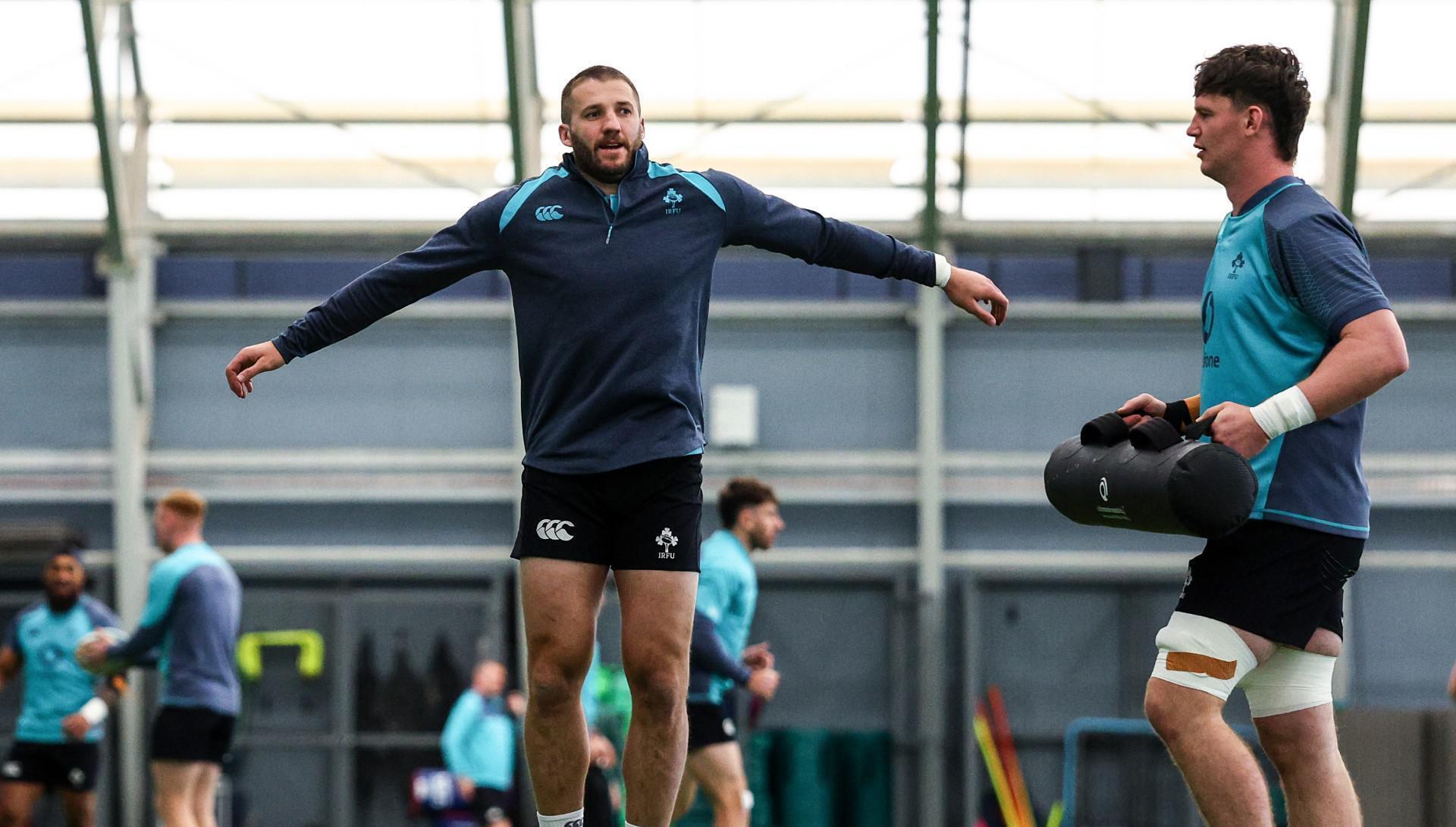
LIKE A FINE WINE: Stuart McCloskey during an Ireland training session. Pic: ©INPHO/Ben Brady.
We’ve a few more days to go yet before the Rassie Erasmus Show pitches up in these parts again, but the Springboks boss is always worth a listen regardless of whether he finds himself in Dublin, Paris or in Rome.
It was in Turin last week where the former Munster director of rugby and the game’s great disruptor gave his thoughts on stubborn perceptions that the sides he has been sending out on to the field of play may actually be closer to being put out to pasture.
“Well, everybody loves to beat the drum that the team is getting older,” he said at a press conference. “I mean, it’s unbelievable. It’s heartwarming when South African people are talking about the team getting too old.” This is not new territory.
The Boks beat New Zealand in the last World Cup final with ten thirtysomethings in their starting XV. Duane Vermeulen was the grandest of their old warhorses at 37. They had four more grizzled servants already into their fourth decade who appeared off the bench.
Deon Fourie was 36, Kwagga Smith and Trevor Nyakane only two years younger. If not a Dad’s Army then it was at least a well-armed and dangerous Dad’s Platoon. And it got them over the line in yet another one-point knockout game.
The starting side’s average age in that Stade de France decider was 30.4. The average age of the team that got the 66-7 romp against Italy underway last weekend? 30.3. Ten thirtysomethings in the ranks this time too, but a vastly different selection.
Only six players started that 2023 match against the All Blacks and this latest against the Azzurri. Teams evolve. Constantly. The ‘age-old’ question is one that tends to be surface-deep and can make it a less-than-accurate barometer of a collective’s shelf-life.
Erasmus has been judicious in giving younger players - and some older ones with limited or no Test experience - their opportunities, but there is an acceptance from him that it hasn’t always been easy to balance long-term needs with short-term priorities.
The Bok team that went down to the Wallabies in Perth in September had 13 changes from the version that started when seeing off New Zealand in Baltimore, Maryland two weeks earlier. It paid for it with an error-strewn defeat.
“We didn’t play well enough to deserve the victory,” Erasmus said after that loss. “We took a bit of a gamble with some guys who hadn’t played together for a long time, but that’s not an excuse. The better team won on the night.”
Erasmus has gone for a second straight experienced selection for Friday night’s meeting with the French in Saint-Denis. He is standing by his older men this month again, but questions of an ageing team aren’t limited to those supporting the world champions.
Of the world’s top six sides at the moment, the Boks fielded the selection with the oldest average age in the last round of Nations Championship games. Next to them were Ireland and Scotland, both of them coming in at 29.2.
Like the Boks, Ireland went as close to locked and loaded as possible. Swap Jamison Gibson-Park in for Craig Casey and the average age would have hit 29.7. That would translate as 30.7 come next year’s World Cup which, to be frank, would be pushing on.
Until the Boks last time around, the average age of sides lifting the Webb Ellis going back to England in 2023 was somewhere in the bracket between 27 and 28. And that England side was already on its way down the mountain when they won.
Mileage can be counted in more ways than one.
Ireland, with plenty of vets, showed signs against Argentina that they are rediscovering a vein of form that has been missing the last few years. The question is whether a team whose collective body clock is ticking this long can keep time for another 12 months.
Though this is an issue applicable to the whole squad, the nub of it has centred on a midfield department where the four leading candidates are deep into their 30s. One of them, the 34-year old Stuart McCloskey, was bullish on that this week.
“Touch wood, I think we'll all still be fairly good.” Like the Boks in Perth two months ago, Ireland will move plenty of pieces around the chessboard this week for Fiji’s visit. It’s the kind of mezzanine fixture that in the past has failed to convince Farrell there may be a battalion of options ready to man the front line.
The 20-year old Billy Bohane aside, the ranks of those hoping for auditions are filled with guys like Sam Illo, Sean Jansen (now injured), Darragh Murray, Jamie Benson and Jamie Osborne, all of them already in to their mid-twenties.
Time, and matches, are running out for this next line of players, or any others besides, to freshen up the side that Farrell will trust in come the business end of Pool B and the knockout stages in Australia this time next year.
South Africa (30.3); Ireland and Scotland (29.2); New Zealand (28.0); England (27.4); France (26.4).
CONNECT WITH US TODAY



Be the first to know the latest news and updates