Gravity blasts off to the final frontier
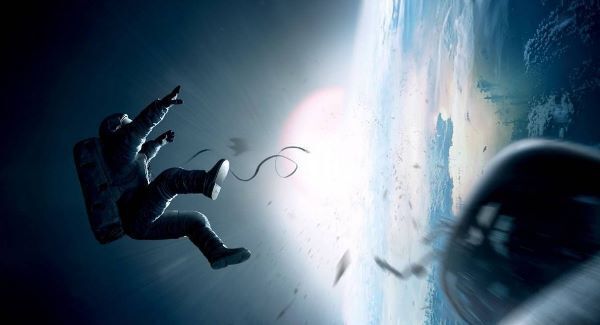
It’s akin to the effects leaps represented by 2001: A Space Odyssey, Star Wars, and Avatar. So realistic and breathtaking, in fact, that you’ll forget you’re watching special effects, and feel as if the movie were actually shot in space.
But as great as that is, there’s far more to praise about director Alfonso Cuarón’s masterpiece than just the greatest special effects to yet grace the big screen. Let’s look at some of the box office and budget considerations, before I give you my full review.
With a modest $80m price tag (a surprising figure, because the film looks better than most movies with budgets twice or three times that amount), it should be easy for Gravity to get into the black. It faces little competition on opening weekend, and good word of mouth should help it pick up additional viewership in subsequent weeks.
The film should also be helped by the strong Oscar buzz for director Cuarón, for stars Sandra Bullock and George Clooney, for the visual effects, cinematography, sound editing, film editing, and for the overall movie itself. It’s likely to get nods in most of those categories, and should be a lock to win the award for visual effects and sound editing.
Filmgoers will be drawn to Bullock and Clooney, but also younger audiences attracted to the sci-fi elements and brilliant special effects. The sci-fi genre has performed extremely well this year, and Bullock is coming off the box office success of The Heat.

The marketing campaign has been excellent, too. The studio released a few extended clips that demonstrate the remarkable visuals and long single-shot sequences, while conveying the concept simply and completely. Some of the clips went viral, spreading on Facebook and Twitter quickly, and accompanied by breathless reactions from viewers.
So its box office run should be long and lucrative. Now, how good is it?
Gravity is one of the finest portrayals of space travel in cinema history. The level of technical detail and accuracy is amazing, and Cuarón’s use of extended sequences without cuts magnificently enhances the sense of place and realism. If you’ve seen the IMAX film Hubble 3D, you might have some idea of what to expect with Gravity.
The audience experiences the weightlessness and vast distances in space in a way no other film has accomplished before, and the intensity of the experience for the audience causes a greater sense of connection to the characters as they endure one crisis after another. As Bullock gasps for breath and desperately cries for help as she spins uncontrollably away from the shuttle and other astronauts, we move closer to her until we’re actually inside her helmet, watching her oxygen levels drop lower and lower.
Much will be said about the visual effects, and rightly so. However, Gravity deserves equal praise for its brilliant use of sound and silence. There are moments of mass destruction in orbit that unfold silently, except for the breath or voice of the characters and the score. Most of the film lacks much in the way of ambient sound, by nature of the environment, so it’s important that the filmmakers put as much attention into getting the sound right as they did the perfect visuals.
I cannot imagine the immensity of the work and precision involved in the film editing on this project. On every technical level, it is simply amazing and represents a huge leap forward for visual effects. In the coming years, it will be interesting to see this level of realism applied to other films (as a huge fan of the superhero genre, I salivate at the prospect of such effects work in future comic book adaptations).
But one of the best things about Gravity is that its success isn’t just in the technical realms, but also in storytelling and character. The concept itself is simple enough — astronauts on a routine mission who end up stranded in orbit and must fight for survival. But upon that foundation is built a powerful character arc, given life by Bullock in a performance that is sure to earn her a second Oscar nomination.

It’s a carefully crafted emotional journey for a woman whose life has (due to a tragedy in her past) lost purpose or feeling beyond her work, who isolates and insulates herself from other people, and who must confront her loss and fear, and regain a desire to live rather than just exist. Her arc is — like the survival story itself — straightforward and not driven by particularly complicated plotting, but rather by great emotional complexity and atmosphere (pardon the expression).
Clooney’s supporting performance takes his usual easy charm and turns it into an important component of the fight to stay alive. With Bullock’s novice consumed by fear and the situation around them so precarious, Clooney’s veteran astronaut must break through her emotional wall and convince her of his faith in her inner strength to not only overcome this crisis that’s left her drifting in space, but also overcome her inner crisis that left her drifting through her personal life.
Cuarón’s previous film, the acclaimed Children of Men, demonstrated such virtuosity that we all wondered whether he could top it. With Gravity, we have our answer, and it’s a resounding yes.
You don’t have to love sci-fi to love Gravity, you just have to love the power of cinema to provide a transcendent experience. While filming the movie, Bullock had a serious mind-body problem.
“Your body had to be trained mechanically,” the actress said, describing the movements she had to master for every scene of the 88-minute film. “Your mind had to be able to dislocate itself from what the body was thinking so it could give the performance that was organic.”
In space, things are counterintuitive. Humans are used to seeing the world as vertical and horizontal, and to the relationship between weight and gravity. As Bullock’s character Dr Ryan Stone says in the opening sequence: “I’m used to the basement lab in the hospital, where things fall to the floor.”
A medical engineer (Bullock) and an astronaut (George Clooney) work together to survive after an accident leaves them adrift in space.
But in space, when you throw a ball, it keeps going until another force changes its direction. “Not only that, if you throw a ball in space, you also travel backwards,” said Cuarón.
The slightest movement causes a reaction in the body, which partly explains why astronauts move to a slower rhythm. Sans movement, an astronaut feels the sensation of weightlessness, as if floating in water.
It took a retraining of the mind and body for the filmmakers and actors to plausibly portray zero gravity, and to pull off a thrilling storyline (co-written by Cuarón and his son, Jonás) in which two astronauts become untethered from their space shuttle.
The learning curve “was a nightmare,” Cuarón said. He brought in scientists and physicists to give seminars, and Bullock spoke to Nasa astronaut Catherine Coleman, in space at the time, as part of her research.
“She said you can take a hair, hold it in your finger, and point it outward, and push it against a wall in space. Just that little push will push your body backwards,” Bullock said.
“Certain analogies were incredibly helpful.”
For scenes showing her tumbling into the depths of space, Bullock was strapped into a ‘light box’ whose walls were covered with LED panels. Because getting in and out was so complicated, she often stayed harnessed between takes, relishing the silence.
“I don’t think we spend enough time in silence, just realising what’s floating around in our noggin,” Bullock said.
“I just had to tune everyone out, because there’s a lot going on technically around you that they had to execute on your body. The minute they were ready, I was able to click in and give them what they wanted.”
She also had to remind herself to move slowly, as if in space — a difficult feat while maintaining a normal speaking pace. “Just always reminding yourself OK, that was too fast. Your body wouldn’t do that,” Bullock said.
“Her focus was always performance and emotion,” Cuarón said. “She’s scarily focused.”
The rigorous physical demands also helped Bullock channel feelings of isolation, frustration, and fear into her character’s rich interior life.
Putting herself through such a filming process gave her “a sense of how unnatural and lonely and mechanical space would be”, she said.
“You didn’t have any of your crutches as an actor.”
*
The animated movie, Brave, and Elysium, starring Matt Damon, both use the sound format, Dolby Atmos.
Gravity, the Warner Bros movie, which opens in the US this weekend and Ireland on Oct 12, is the first to be filmed in the next-generation sound format, Dolby Atmos.
Introduced in Apr 2012 by San Francisco-based Dolby Laboratories, Atmos allows filmmakers to place or move specific sounds, such as a raindrop or closing door, anywhere in the cinema. Filmmakers say the technology creates a more realistic sound experience for viewers.
“Just as 3D offers added visual dimension, Dolby Atmos creates a virtual reality of sound, which fully immerses the audience in the aural journey,” Alfonso Cuarón, Gravity director and screenwriter, said.
“There is no sound in space, so we incorporated music as an integral element of the movie. The music was composed and designed for a surround experience — different harmonies emerging from the different speakers around the room, constantly moving, crashing and blending to create a dynamic experience.”
The film will be released in 3-D, 2-D and IMAX versions. Warner Bros and Dolby did not say how many cinemas would screen the movie in the Dolby format.
So far, more than 300 Dolby Atmos screens have been installed, or committed to, in 30 countries, with more than 85 exhibitor partners.
At least 75 films from 10 different countries have been, or are scheduled to be, released with Dolby Atmos, including Disney’s animated movie Brave, The Hobbit: An Unexpected Journey and Elysium.














