Sounds from another time
THE great thing about early music, particularly instrumental, is that one does not need to know about it to enjoy it. The 10th East Cork Early Music Festival starts on Thursday, Oct 4. Early music is different from symphonic/sonatas/chamber music, which developed structures to suit their modes of expression. An appreciation of these structures enables listeners to appreciate the compositions.
Before approximately 1750, there seems to have been a musical world of infinite variety. Rarely does one find pieces of music prior to that date that last for more than six or seven minutes. There was a great dependence by composers on dance forms, both slow and fast, and the instruments used, and their tuning, were subject to constant change.
Consequently, there can be no such thing as an absolutely ‘authentic’ performance (ie, exactly as the composer might have heard it) of any piece of music.
Enormous research has been undertaken, by gifted scholars and players, and there is some agreement between them regarding style, tempo, dynamics, expression, techniques, etc.
Luckily, the curious listener does not need to know about this. All that is needed for the enjoyment of the music is a curious ear, imagination, and a delight in beautiful sounds.
Opening the festival this year is the French keyboard specialist, Pierre Goy, playing on the new clavichord acquired by CIT Cork School of Music.
This rarely heard, very gentle-sounding keyboard has strings that span it and which are struck from below by a small metal blade, called a tangent.
The strings vibrate and the sound is transmitted through a bridge to a soundboard. So soft is the sound that composers could use them indoors and people in the next room could not hear them. Pierre Goy’s inaugural concert is free, and takes place in the little Stack Theatre, of Cork School of Music, at lunch, 1pm, on Thursday, Oct 4.
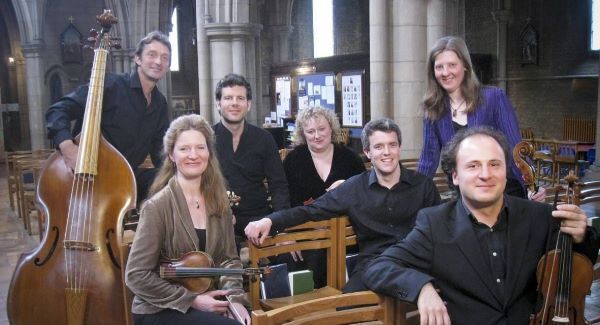
Later that day, at 8pm, the Curtis Auditorium, also of the Cork School of Music, will be the venue for the return to the city of Rachel Podger (violin) and her Brecon Ensemble. In Mar 2011, Podger, Pamela Thorby (recorder), and Malcolm Proud (harpsichord) gave an unforgettable display of stylish brilliance in the same venue.
I particularly remember Rachel’s moving performance of Telemann’s Fantasie in f minor. This time, her musical friends join her for performances of concertos by Bach and Vivaldi.
Her living room window looks out on the Brecon Beacons, in Wales, hence the name of the ensemble, which has recorded the Bach Violin Concertos and attracted critical acclaim wherever it has played. Rachel will play another free concert in the Aula Maxima in UCC at lunch (1pm) on Friday, performing solo music by Bach, Telemann, and Biber.
Anyone who imagines that early music is a soft, easy option for performers should attend this concert.
As well as Bach sonatas (including the Chaconne), Rachel will be playing the incredibly virtuosic sonatas of Biber.
The intriguingly-named group, Joglaresa, made their Cork debut at the 2009 festival. Playing in Cloyne cathedral, the perfectly matched voices, together with the virtuosic skills of percussionist, Tim Garside, multi-instrumentalist, Stuart Hall, and harpist Jean Kelly, created a sound-world that was foreign, strange, ancient, and utterly captivating.
I will not want to miss their performance in the Curtis Auditorium on Friday night, at 8pm.
Irish harpsichordist, Tom Ó Drisceoil, is the soloist in a programme of French and German chamber music with the Vater Ensemble at lunch (1pm) on Saturday, in St John the Baptist Church, Midleton.
Friday night brings that brilliant bassoonist, Peter Whelan, and his Edinburgh-based Ensemble Marsyas, to the wonderful Grainstore, Ballymaloe, where the Irish Baroque Orchestra played a thrilling concert recently under the direction of Monica Huggett.
Ensemble Marsyas comprises two oboes, bassoon, theorbo (a giant lute), violone (precursor of the double bass), and harpsichord.
As well as music by Handel, Vivaldi, and Boismortier, Ensemble Marsyas will perform the work of Jan Zelenka, the most important Czech Baroque composer who, in his lifetime, was better-known than his contemporary, JS Bach.
On Saturday, Oct 7, the Sirius Arts Centre, in Cobh, is the venue for the final lunch recital, again given by Peter Whelan and Ensemble Marsyas.
* Tickets for all events available from Everyman Palace Theatre, McCurtain St, Cork. Tel: 021-4501673, www.everymanpalace.com














