Success of family farms 'highly dependent' on labour efficiency
New research from Teagasc Moorepark shows that overall labour requirement on a dairy farm can be "significantly reduced by applying appropriate farm facilities and efficient practices".
A "core strength" of Irish dairy is the role of the family farm, however, the success of these farms is "also highly dependent on conducting a labour-efficient operation".
Teagasc has released a new study on achieving labour self-sufficiency on family dairy farms.
New research from Teagasc Moorepark shows that overall labour requirement on a dairy farm can be "significantly reduced by applying appropriate farm facilities and efficient practices".
This focus is particularly important now since reduced availability of farm workers is being experienced, combined with farmers themselves placing greater emphasis on achieving a good work-life balance.
This research used a case-study approach and is published in the Irish Journal of Agricultural and Food Research.
The study emphasises the importance of managing farm facilities, work tasks, and practices in an efficient manner, particularly those associated with the most time-consuming jobs of milking and calf care.
The case study highlighted how a 119 cow dairy herd can be managed with less than 3,000 (2,986) hours of labour input per year (or 54 hours per week).
In this instance, the farmer contributed 77% of the labour input (2,314 hours per year or 47 hours per week).
According to Teagasc, previous research obtained through questionnaires has indicated that farmers considered working less than 55 hours per week to be an acceptable working week.
This level of labour efficiency was achieved while the farm met all of the key targets for a spring-calving herd.
This study indicates the importance of efficient facilities, work practices, and technologies.
The report reads: "Grassland management, milking, calf rearing, and cow care are the most time-consuming tasks within a spring-calving system.
"Previous research has highlighted different practices that offer time-saving; for example, automated oestrus detection reduced the total cost of labour for the breeding season compared with manual heat detection, as well as improving overall labour efficiency."
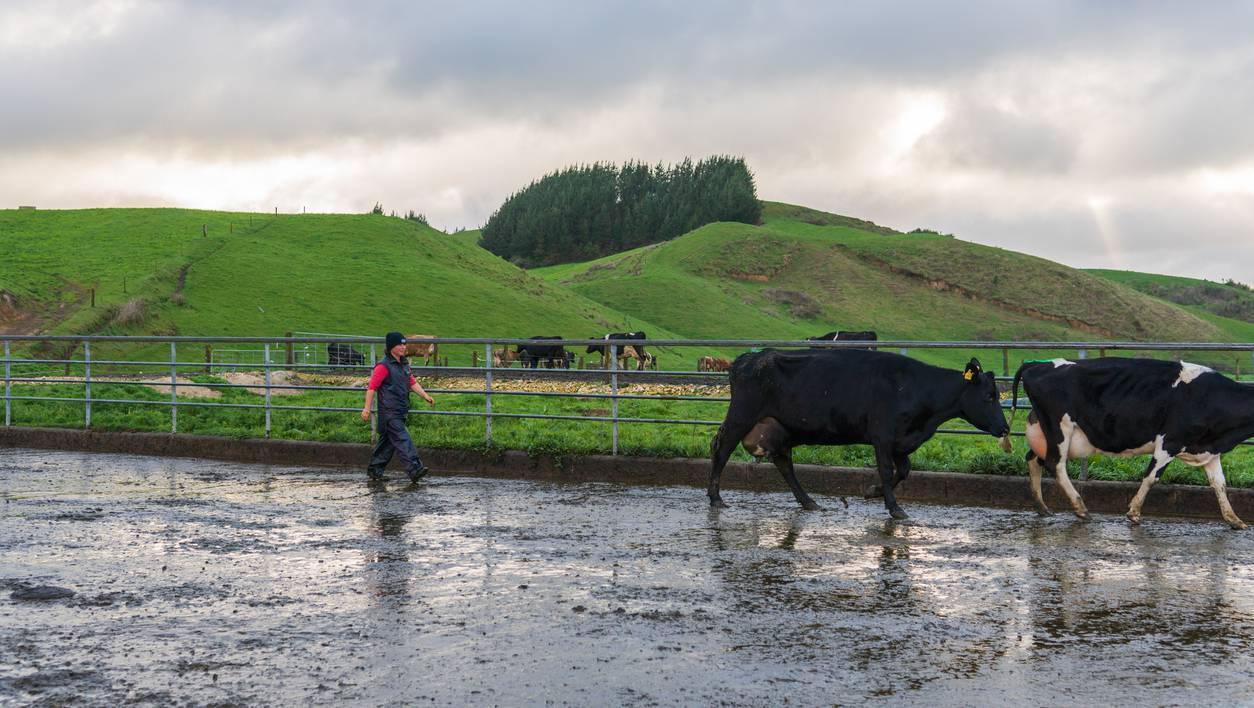
The advantages of group-calving pens "in eliminating the need to move cows into individual pens, and thereby potentially improving labour efficiency" was also highlighted in the report, and "further references to technologies included an automatic gate-opener timer that negates the need for a person to herd cows from the field to the parlour for milking, automatic drafting, and automatic calf feeders".
Teagasc said that such an approach is particularly important in ensuring that the peak workload in spring is managed effectively, and it also ensures that the need for additional labour input is not overestimated by being based on inefficient facilities and practices.
Lead author on the study Dr Marion Beecher from Teagasc said this study shows that dairy farming systems can be sustainable in terms of workload.
"The consideration of the different strategies highlighted with respect to farm facilities, work practices, technologies, and work organisation will allow farmers to make logical decisions to address their labour challenges," Dr Beecher said.
"Placing greater value on the sustainability of workload will be essential for future dairy farming systems."
Dr Bernadette O’Brien, Teagasc researcher and co-author on the study added that once efficiency is optimised through facilities, practices, and technologies on farms, "the farmer has the option to reduce their own contribution further by hiring staff or contractors, depending on economic performance".
Teagasc's National Farm Survey Sustainability Report shows that in 2022 overall, 93% of dairy farms were economically viable.
Average economic returns per hectare in dairy tend to be multiples of those in the other farm systems in Ireland and the gap between dairy and the other farm systems has tended to widen since the EU decided to eliminate the milk quota system, Teagasc said.
This gap widened further in 2022, which saw a significant spike in milk prices, due to the slow growth in milk production globally, allied with strong international dairy demand.
Dairy continues to exhibit a stronger performance in terms of social sustainability relative to other farm systems; it tends to be associated with a lower isolation risk, and fewer dairy farm households have a high age profile in comparison with other farm systems.
However, dairy farming is typically a very labour-intensive system. In terms of labour input, on average the main dairy farm operator works significantly more hours per year than the average farm operator in the other farm systems.
Given the hours required on farm, relatively few dairy farmers work off-farm.
However, even when the labour from time spent working off-farm (which can be significant for drystock systems) is combined with time spent working on-farm, the labour input of dairy farm operators tends to exceed that of farm operators of all other farm systems.