Rye not? Darren weighs up the results of his cereals trials at Ballymaloe Farm
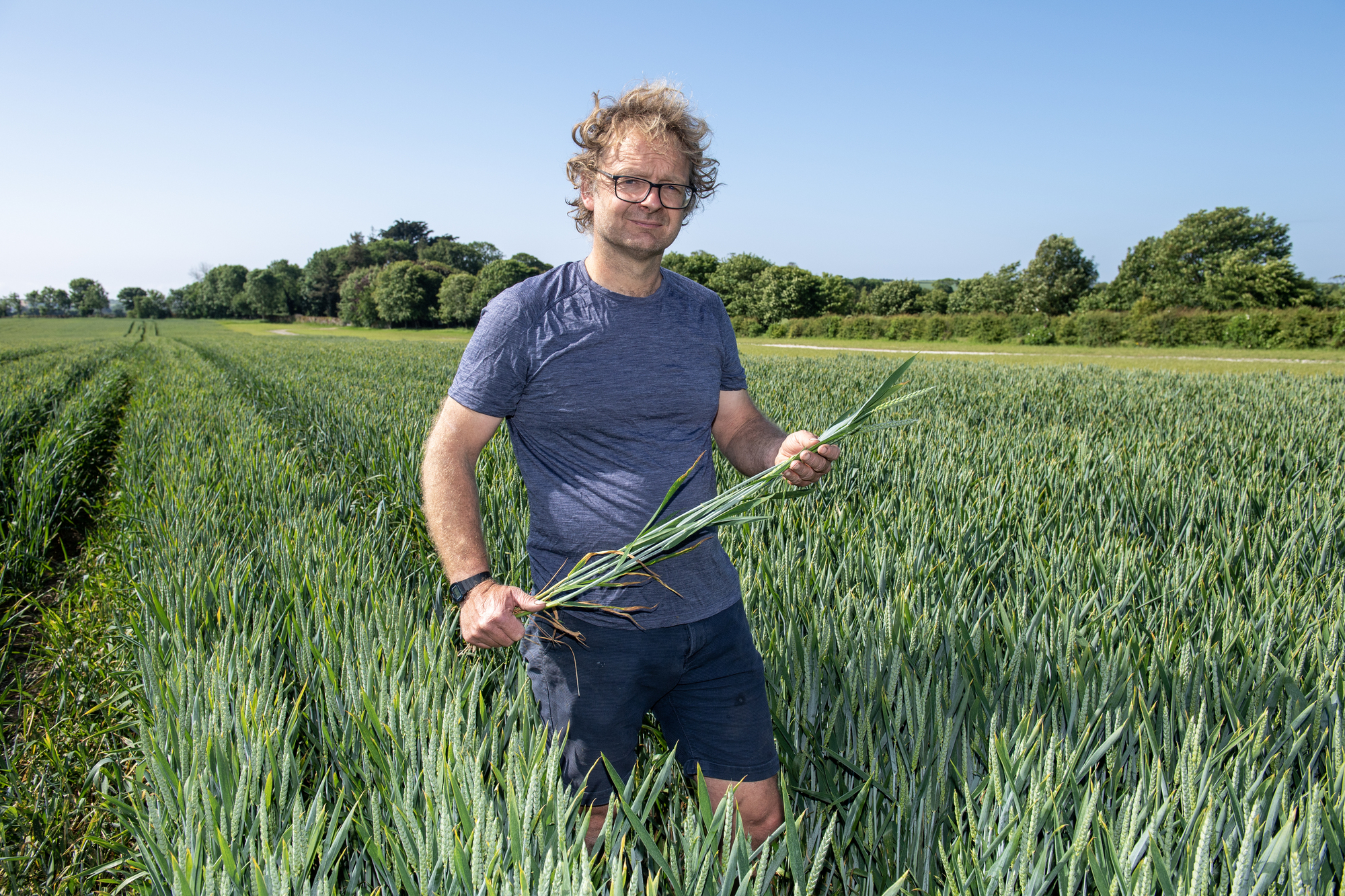
Darren Allen pictured with his wheat crop earlier this year. The crop ultimately yielded 4.5t/ac. Picture: Dan Linehan
The winter oilseed rape yield 2t/ac, which I’m happy enough with. The winter wheat did very well, yielding around 4.5 t/ac.
I did some of my own trials with establishment methods and biologicals, which had interesting results. The winter wheat established with a strip-till method has outperformed the plough, with respect to the yield and the profit margin. I applied pig slurry in the spring to my growing crop of winter wheat, which is a bit of a venture into the unknown, but I had no lodging, and I definitely got better value out of the slurry than if I had just applied it to stubbles.
Winter rye was a brand-new crop for me to grow. I learned a lot, but I am gearing up to try it again this year. I think I planted it a bit too late last year, and it was a bit too thin. I got approx. 3.5t/ac, but I feel there is lots of room for improvement. I’m going to plant it two weeks earlier this year.
I am following the winter rye with winter oilseed rape, so the turn-around between harvesting the rye and baling up the straw was fairly tight. I was advised to plant a break-crop after the rye in order to be able to kill any volunteers that grow in the following season.
There was a bit of straw breakdown, and I reckon I left 0.2t/ac behind with heads on the ground, but I’m very happy with it. I found it to be a low-input crop, which reduced my costs. I only gave it one fungicide; it didn’t get BYDV or suffer from take-all. I am planning to plant it in the first week of October.
On the spring barley front, I am happy that it all passed for malting bar one load. The variety was Planet, and I had some straw breakdown, but it didn’t seem to be as bad as other fields in my local area, and I got it harvested relatively early.
You'll not be surprised at this rate to hear that I did some more experimenting with the spring barley, too. It yielded approx. 3t/acre in the normal fields, but where I didn’t apply any fungicide, it gave only 2.2t/ac.
We have all our catch crops in the ground for the autumn, and they are well established now and we’re up to date on all the stubble cultivation where it was necessary. My nature crop planted for the NPWS scheme is looking fantastic, attracting a lot of insects and birds, which I love to see. I have my 2024 winter oilseed rape in the ground, and I have planted some companion crops in some of it, including beans, sunflower, buckwheat and crimson clover.
Before planting the OSR, I disced in some cattle slurry, which was also applied with LESS equipment. All the slurry was incorporated within hours of applying to maximise how much nitrogen I could keep for the crop and, secondly, to minimise greenhouse gas emissions. I’ve sent a sample of the slurry away to be tested, which will help me with nutrient management planning going forward.
Other than that, I am taking some time to attend some farm walks and talks; and completing some land drainage and maintenance jobs.
I made a presentation at the recent Teagasc Crop Forum, where I spoke about the actions I’m undertaking on my farm to improve my farm profitability, reduce carbon emissions and improve the environment.