A Munster dairy farmer with around 55% of his milk volume tied into fixed-price contracts has said he is being “burned” with the losses he is incurring.
The supplier said: “This year, it is €115,000 that I’m going to be out of pocket, in addition to €25,000 I lost last year.”
The estimated figures have been calculated from the gap between open market prices and those received in the fixed price schemes he is in.
This year, he remains in a Glanbia Loyalty Scheme with a fixed base milk price of 31c/l, along with a fixed milk scheme of 30c/l, and another at 32c/l.
Meanwhile, other Glanbia suppliers were paid a total of 50.08c/l for April, factoring in a 3c/l agri-input support payment and a 0.5c/l sustainability action payment.
He’s not alone - around 500 Glanbia suppliers currently have more than 35% of their total supply volumes committed to fixed milk price schemes.
However, it’s a widespread issue across the industry, with almost all of the major processors offering fixed-price contracts over the last five years.

Trying to exit
“I’d have 55% of my milk total this year in schemes, so this year I’d have over half a million litres in fixed schemes and that drops off to next year approximately 190,000 litres [at 32c/l], so I’m gradually coming out of the schemes if I leave it to run its course,” he told the Irish Examiner.
He explained he has expanded the family farm substantially since he left ag college.
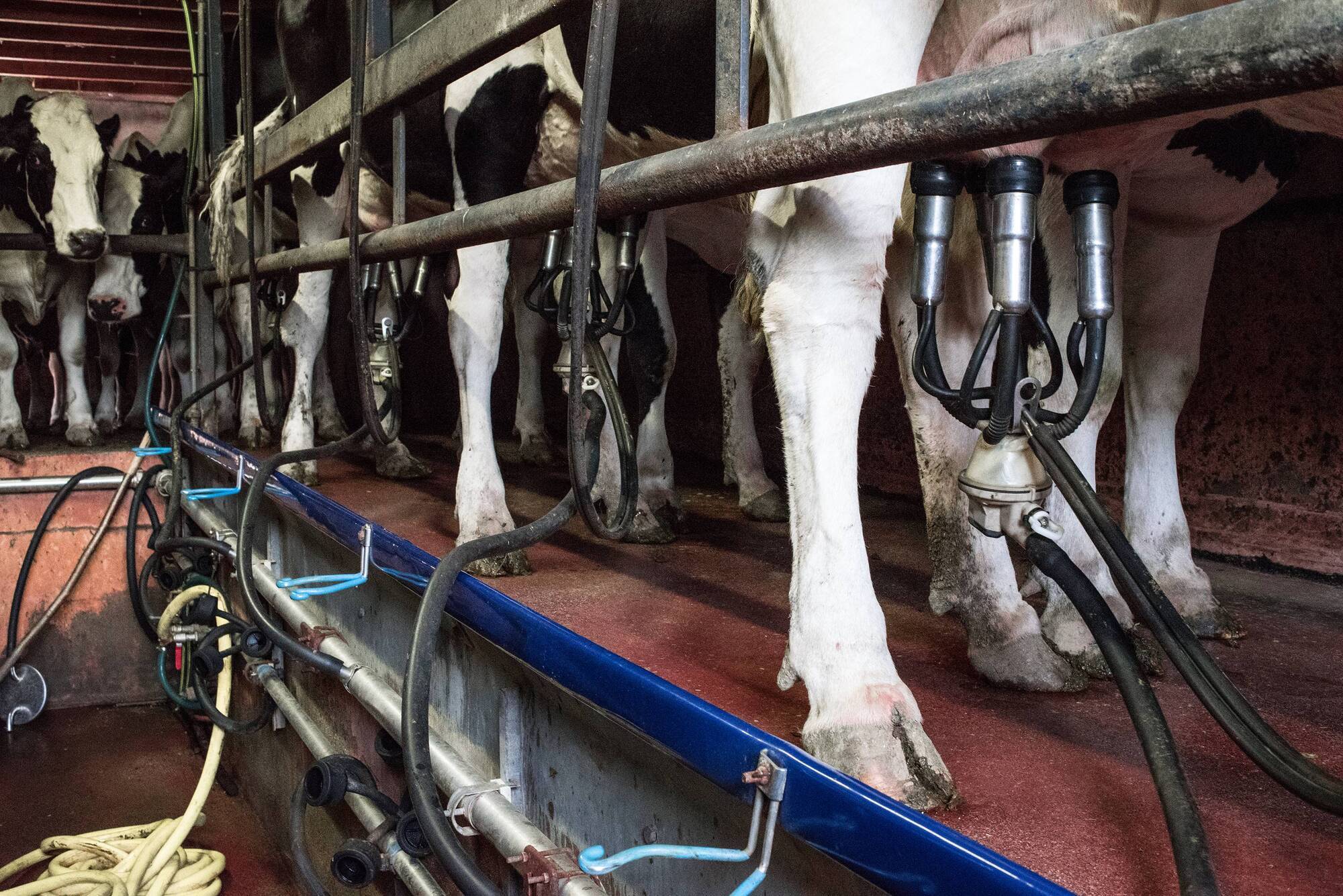
“At that time, we were milking 80 cows and gradually we increased up to 170 over the number of years,” he said.
“I heavily borrowed in those years, I’ve built milking parlours, I’ve built accommodation for cows, done jobs on roadways — everything that goes with expanding a dairy herd.
“At the minute we’re milking 170 cows — myself and my father.”
When Covid-19 hit, the uncertainty hit, and it was at this time he signed the most recent scheme he is in.
“People jumped at that one in order to gain stability of an income and now I would be heavily borrowed in the banks and they would have looked favouringly at fixed milk as well,” he continued.
“Initially, when Covid came, the markets were weak because there was a logistical problem getting the dairy products to the customer because it was all changed because of foodservice being shut down, so initially there was a weakening of markets, but then it recovered quite quickly.
“And since then there was a slight gap [between fixed and open market prices], marginal, but it gradually got bigger and bigger to where we are now.
“You could see it happening, but the losses were marginal, even up to the end of last year I knew I was after making losses, [but] didn’t realise they were to the sum of €25,000 - it’s only when I went back a couple of weeks ago to do the figures I realised.”
"Farmers are asking 'will I or won’t I survive?'"
He is currently projecting that he will lose out on €115,000 this year as a result of being in the fixed milk price contracts. “And very possibly this could be higher because the milk price will rise by another few cents — I’d say it’ll get closer to 60c/l,” he said.
This is in addition to the dairy farmer facing increasing input prices. CSO figures show that input prices have increased by 34.8% in the year from March 2021 to March 2022, with fertiliser prices up 149%, feeding stuffs up 22.6%, and energy up 54.9%.
“Nitrogen this time last year it was probably in or around €320 per tonne, and now you’re looking at up around €900 a tonne, that’s a quick insight into the costs of inputs,” the farmer said.
“Meal then, I ordered some last week at €415 a tonne compared to €300 last year, so there’s a massive gap there.
“Obviously, it would be great to be on base price; if I was on total base price I would be making good money this year; despite the inputs being so high, you’d still make a decent income this year.
“It’s a combination of both [fixed milk price and input rises].
“If the inputs were where they were last year I would survive this year, whereas now it’s kind of in the middle.
“Look, I probably will survive; I’m after getting loans from the banks already - I got credit lines and whatever else that was going in order to survive for the year.
“I know of guys with a lot more of their milk in schemes and they’re asking ‘will I or won’t I survive?’
“They actually don’t know can they make it through the year - that’s no exaggeration, that is the truth of the matter.”
Managing volatility
A spokesperson for Glanbia told the Irish Examiner that fixed milk price schemes have “assisted suppliers in planning their financial commitments to allow them to build facilities to allow for expansion over the past decade”.
Glanbia said that around 2,000 milk suppliers take part in fixed milk price schemes.
“The board of Glanbia Co-op is very conscious of the impact of rising input costs, particularly for those milk suppliers with a larger percentage of their milk contracted under fixed milk price schemes.
“A decision was made early and swiftly to assist those with larger volumes [>35% of their milk supply] fixed.
“The fixed milk price support schemes were designed to help address the challenges faced by farmers with larger volumes contracted or over 35% of their milk supply fixed in schemes.
“The fixed milk price support scheme offered an uplift of 9c/l from circa 31c/l to 40c/l for that proportion of their fixed pool.
“Suppliers were also offered the farm input cost support scheme. This provides suppliers with a milk price prepayment of 5c/l on all volumes above the 35% threshold.
“This 5c/l support goes into the supplier’s Glanbia Trading Account in a lump sum. It will be deducted in 2025 and 2026.
“Around half of those milk suppliers who were eligible applied for the support schemes.”
Against a backdrop of record farm input costs, the board has agreed to pay a 3c/l agri-input support payment on all milk supplied in April, including all milk volumes in fixed schemes. Suppliers also receive the 0.5c/l sustainability bonus.
“Fixed milk price schemes have continued to evolve over the years and it is expected they will continue to do so. The latest phase offered an innovative feed price adjuster that tracked international feed price indices to help protect against input cost volatility,” the spokesperson added.
However, the dairy farmer interviewed told the Irish Examiner that he has not signed up for the fixed milk price support scheme, as he views it as a “fixed milk extension scheme” — a situation that he wants to avoid, as he is already “heavily involved in fixed schemes”.
To qualify for the extra money in the fixed milk price support scheme this year, suppliers would have to commit to the same milk volumes in 2023 and 2024 at a base milk price of 38c/l.