Spreading lime? Ideal time when grass covers are low
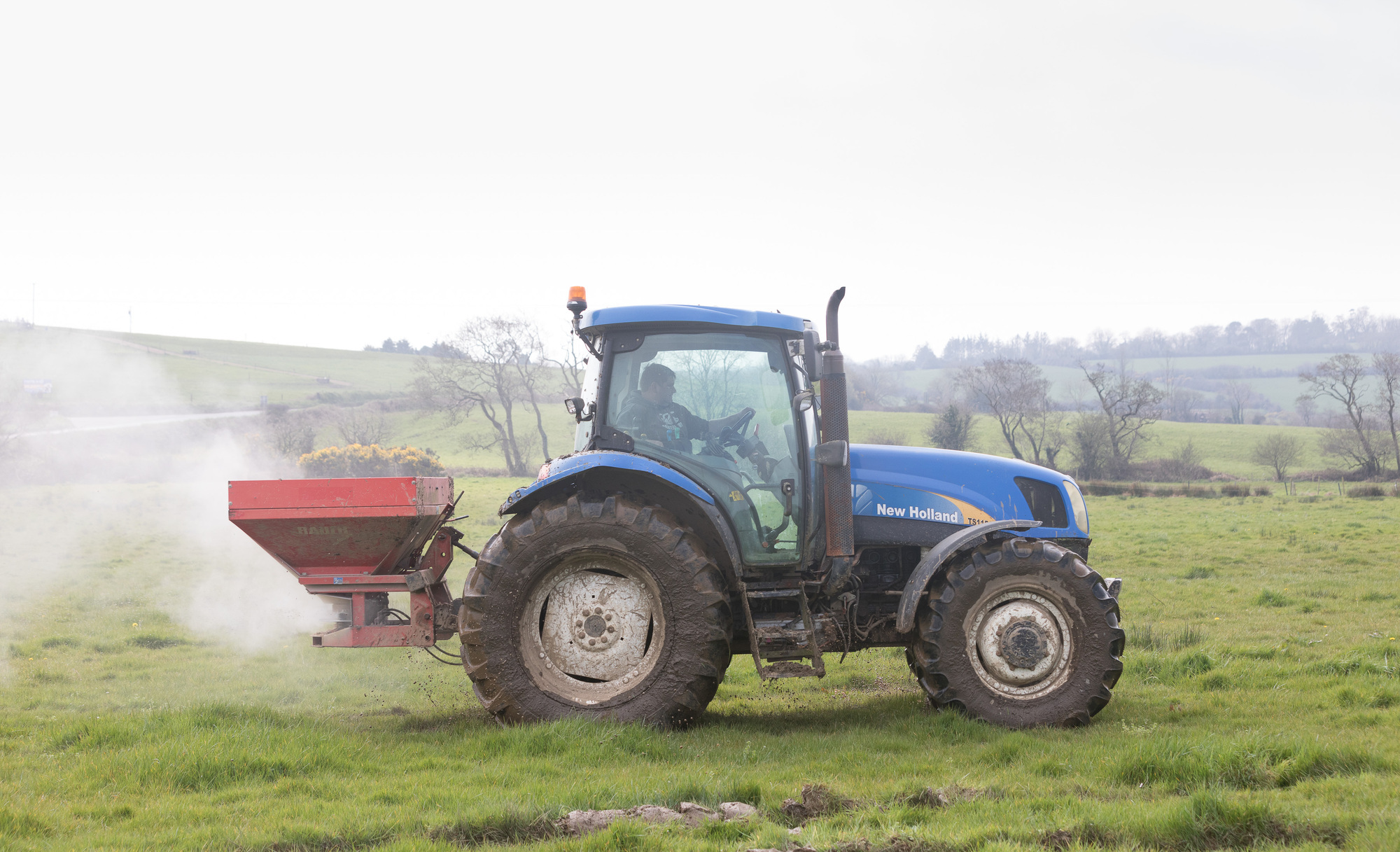
Brian Holland spreading Gran-Lime on his land outside Riverstick, Co Cork. Picture: David Creedon, Anzenberger.
Once fields have been grazed-off and grass covers are low, it is an ideal time to apply lime.
Identify blocks of land that require lime, for example this could require ordering a load of lime (20t) after each grazing rotation to correct soil pH (covers approximately 10 acres at a 2t/acre lime application rate). Aim to avoid high grass covers (over 800kg DM/ha).
Ideally apply lime to low grass covers, to reduce the risk of lime residues.
Rainfall will typically wash most of the lime from the grass down to the soil.
Where a small amount of lime remains on the leaf, it will not affect grazing animals.
Grass covers on farms tend to be lowest (500kg DM/ha) during April and August, good timing for lime application.
Soil types where a relatively thick (5-10cm) organic layer has formed above the top soil may be more prone to poaching during wetter periods of the year.
This organic layer holds a large store of acidity.
Liming these soils to neutralise acidity and raise pH will create favourable conditions for biological activity (grass roots, earth worms, etc), and the release of the nutrients stored in the organic matter.
As nutrients are released from organic matter, the resistance of the top few centimetres of soil to heavy trafficking may be temporarily reduced.
To minimise these effects, apply lime on “a little and often basis”, and improve soil pH in stages over time.
Don’t exceed 5t/ha in a single application. Apply split applications (2.5t/ha) over a number of years.
Leave sufficient time - up to three months in dry weather - between applying lime and closing for grass silage, for the lime to be fully washed into the soil.
If lime is transported to the silage clamp or picked up in the baled silage, it may affect good preservation conditions for the silage (acidic conditions).
Spreading cattle slurry on fields that have received lime recently or freshly limed land, where the lime has not had sufficient time or rainfall to be washed into the soil, can result in a loss of up to 50% of the available slurry nitrogen.
To minimise these nitrogen losses from slurry, apply cattle slurry first and then apply the lime seven to 10 days later.
For urea, a similar situation to cattle slurry, where increased nitrogen loss (ammonia-N volatilisation) may occur, where straight urea fertiliser is applied on recently limed land.
Therefore, apply urea first and apply the lime seven to 10 days later, to reduce the risk of N losses.
However, where protected urea is being applied, early trial work indicates that it is safe to apply protected urea to fields that have been limed recently.
Soils with high Molybdenum status may increase the risk of inducing a copper deficiency in grazing animals.
On these soils, increasing soil pH above pH 6.2 increases the availability of Molybdenum in the soil and higher uptake of Molybdenum by actively growing grass.
Where farms are affected by high Molybdenum soils, maintain soils at or below soil pH 6.1-6.2. Alternatively, apply lime as recommended, and supplement animals with copper.
Once lime is applied and is washed in, it starts to adjust soil pH. At least 35% of ground limestone (350 kg/tonne)has a particle size of less than 0.15mm.
This component of the lime is fast acting, and very reactive, and will start working immediately (0-6 months).
The remaining 65% of lime (650 kg/tonne) will be broken down in the soil in the medium term (6-24 months) and helps to maintain soil pH levels in the longer term until the soils are re-sampled in year 4-5.
Research shows that liming acidic soils increases grass production by 1.0t DM/ha.
On a drystock farm, this is valued at €105/tonne DM, and €180/t DM on a dairy farm.
An application of 5t/ha of ground limestone to correct soil pH represents a cost of €25/ha/year over five years.
The return on investment from lime gives €4-7 worth of extra grass for every €1 invested in lime.
There are two main types of ground limestone available nationally, Calcium and Magnesium.
Calcium lime is most widely available, while Magnesium lime is mainly available in the South East.
- Mark Plunkett, Teagasc, Johnstown Castle