Danish robots lighten the meat work load
With labour shortages at the lower-skilled end of the jobs market becoming apparent, the meat industry has to rely heavily on workers from outside the European Economic Area (the EU plus Iceland, Liechtenstein, Norway), for whom hundreds of permits are issued annually by the Government.
The answer to the labour difficulty could be robots, as more and more machines are being developed which can replace meat processing workers, especially for repetitive work.
One of the top technology companies in this area is the Danish Meat Research Institute (DMRI).
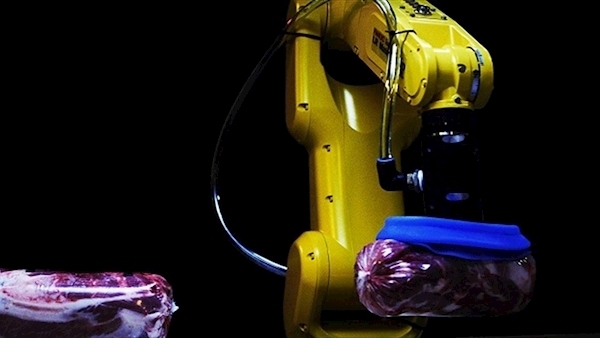
Their latest breakthrough is a hygienic vacuum-based robot application for moving fresh or wrapped meat.
It can transfer 1,500 vacuum-packed products from conveyor to box per hour, or 1,100 fresh products per hour from box to conveyor.
It can move 1,200 fresh products from conveyor to conveyor, per hour.
It includes a high-precision complex vision system, and a product-specific suction cup.
Hygiene tests indicated no growth in bacteria on the suction cup during an average working day (eight hours).
The hardware has been thoroughly tested and found suitable for the meat processing industry.
The robot has a 978 mm reach.
Other products developed by DMRI include a robot which pulls ribs from pork bellies, thus eliminating a physically demanding slaughterhouse task.
Previously, workers in Danish pigmeat plant had to manually loosen the ribs from the pork belly before further processing for the Japanese and Korean markets.
The pork belly initially passes through an x-ray scanner, and the scanned two-dimensional image is analysed on a computer.
Orders are then sent to an industrial robot, which moves a special tool down to the pork belly ribs and loosens them three at a time, until all 12 ribs have been loosened.
The DMRI, which part of the Danish Technological Institute, has also developed a robot that can produce more uniform and precise pork loin cuts, trimming the layer of fat from pork loins with extreme precision.
This results in better quality, more uniform products, and less wastage.
Previously, abattoir workers in Denmark had to manually evaluate the thickness of the layer of fat on pork loins.
Now, the robot generates an exact 3D computer image of each individual pork loin, and determines where the fat meets the meat.
A patented system of eight individual knives then automatically cuts the pork loin, processing each pork loin in four seconds.
Even though the raw material (the individual pig) can vary greatly, Danish processors can now create a better and more uniform end product with less wastage.