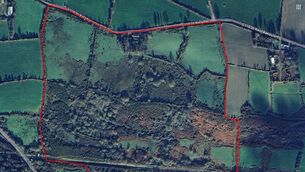
Drought is killing the primary feed source in threat to farm industry
Make the most of grass that looks dead, but is still of reasonable feeding quality, because it will be lost to decay once the rain returns.
This sobering drought advice to farmers this week, from Teagasc’s Animal & Grassland Research and Innovation Centre, sums up the unprecedented drought threat for the farm and food industry.
Permanent grassland and meadow makes up 77.8% of Irish farmland, and farmers are advised that the period following drought is critical to allow autumn tillering (production of new grass shoots) to occur.
Otherwise pastures will thin out over autumn, feed production will be poor, and weeds will invade.
Already, spring tillers are dying in drought-stricken areas, and the remaining tillers are stressed.
As a result, grass growth has practically ceased in counties such as Carlow, whereas in a normal year, daily growth is 70kg in dry matter terms per hectare in July. The other worst hit counties, according to PastureBase Ireland (PBI) data, are Dublin, Laois, Louth, Waterford, and Wicklow, all with 10-16 kg of grass growth early this week, and Kilkenny and Meath with 17-19 kg.
Growth was measured at 22kg in Galway, 19kg in Offaly, 22kg in Tipperary, 22kg in Limerick, 21kg in Wexford, 28kg in Cork, and 33kg in Kerry.
Only in Donegal (56kg) are grass measurements anywhere near the seasonal norm.
Grass plants that are still alive but growing slowly due to lack of moisture can quickly recover, green up, and be back into production, according to Teagasc experts.
Dormant plants, where above-ground parts have died back, but buds at ground level are surviving, can begin tillering from these buds when rain falls.

New green shoots can be seen in the base of dead pasture within one or two weeks after rainfall, but recovery in terms of pasture growth rates will still be some weeks away after rain.
The drought threatens the farm and food industry because grass is the primary source of feed on Irish farms.
Teagasc’s key drought message for future plant growth is to avoid short grazing rotations (the recommended target is 25-30 day rotations).
Along with rotation lengths to stretch the grass supply and maintain some grass in the diet of the country’s 6.7 million cattle, farmers have to replace the missing grass in the cattle population’s diet.
Advisers in Glanbia, which processes about 35% of Ireland’s milk supply, said last week its farmers were growing enough grass daily for 1.5 cows per hectare, but had about 3.5 cows per hectare to feed on their grazing area or to conserve for winter silage.
This meant growth was only 40% of demand.