EU Agriculture Commissioner Phil Hogan moves to reduce form filling fear with new preliminary checks
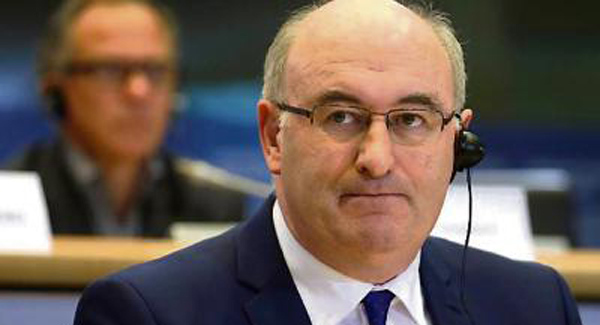
He urged member states to implement his new preventive preliminary checks as part of the aid application process, which he announced at last Monday’s meeting of EU agriculture ministers.
“This should allow national administrations to identify problems with farmers’ applications so that, even up to 35 days after the final date of submission, farmers will be allowed to make corrections without the application of any penalties,” said the Commissioner.
He also announced a CAP simplification to reduce the level of some on-the-spot farm checks in 2016.
“Where overall error rates are below 2%, and Member States have updated their Land Parcel Identification System (LPIS) within the last three years, it will be possible, for certain schemes, to reduce the on-the-spot checks from 5% to only 1% of the sample size.”
He said controls and checks can also be reduced by carrying out a range of different checks during a single farm visit.
Mr Hogan will also introduce collective claims in agri-environmental and climate measures; and further possibilities to adjust parcels for greening, if farmers need to adapt their cultivation plan during the growing season.
Most of the changes he announced will be applicable in claim year 2016; some will be applicable retroactively for 2015.
Discretion will be given to national administrations regarding access to the young farmers scheme for farm companies jointly controlled by young farmers, and for other farmers who do not meet the young farmer criteria.
Mr Hogan said several Member States had requested greater flexibility in determining who could qualify as young farmers.
Agriculture Minister Simon Coveney welcomed the Commissioner’s CAP simplification initiatives, including extra flexibility in amending Rural Development Programmes, which Mr Coveney said will “allow Member States such as Ireland amend their programmes to target specific measures, as conditions we operate in are constantly changing.”
Among changes which Ireland is seeking in its programme are a further scheme of assistance for farmers with large tracts of hen-harrier land, and inclusion of sheep fencing as a TAMS eligible investment.
Commissioner Hogan took the opportunity to urge member states to use flexibility to modify rural programmes by including financial instruments to benefit the rural economy, in particular by bringing affordable finance to young farmers, which he sees as one of the most significant potential CAP improvements for 2016.