The farmer and the fraudster
Susan Bourton, originally from Louth, conned banks and their customers in New Zealand with an elaborate string of crimes set up to cover her own debt and her greed.
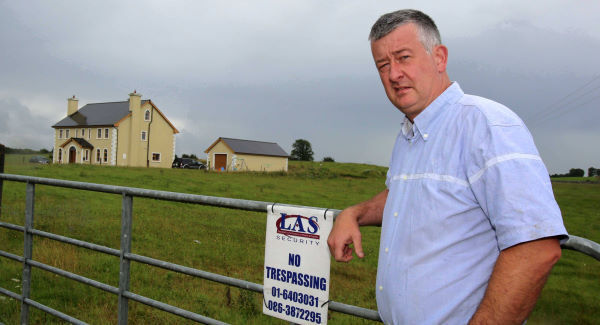
Eugene Costello, who owned a dairy farm outside Ballinasloe, was one of her victims. In July, he was imprisoned for failing to surrender his farm and his livelihood to the subprime lender who introduced him to Bourton.
When their paths crossed in early 2009, both were trying to deal with their debts.
Bourton skipped hers aboard a first-class flight from Auckland. Meanwhile, Mr Costello was looking to borrow €650,000 for an agreed full and final settlement with his subprime lender and escape the unaffordable 26% interest rate arrangement.
He had approached his lender, Carlisle Mortgages, looking for help to find an alternative source of finance. Bourton was one of three names presented to him.
For the next 18 months, she spun various yarns to explain why nothing arrived into Mr Costello’s account.
After the first 12 months of Bourton leading him on, the settlement offer, affected by an interest bill of €289 a day, had risen to €750,000.
He was accused by a judge of playing “ducks and drakes” with his lender.
He was held in contempt and a committal order was made last year. This summer it was enforced by Mr Justice Brian McGovern.
Mr Costello, who has a wife and two young children, collapsed with panic and had to taken away from the Four Courts by ambulance to be treated before being discharged into custody.
When he purged his contempt after two nights in Mountjoy he returned to Ballinasloe. The 160-acre farm, which had been in his family for at least five generations, was locked up.
Mr Costello had told the High Court about the role Bourton played in his case. It did not save his farm.
He believes Bourton was a crook but also blames Carlisle Mortgages, who introduced him to Bourton.
On June 28, 2012 at Hamilton District Court Judge Phillip Connell delivered his review of the trial of the 36-year-old Irish woman who stood before him.
The breakdown of Bourton’s convictions involved 60 counts of using a bank’s computer system to benefit herself, 11 counts of dishonestly using documents to defraud, five counts of knowingly altering documents or using forgeries and five counts related to theft. She was sent away for seven years.
However long Bourton spends in a cell, it will still be less than the duration of a crime spree that was characterised by Judge Connell as a process of robbing Peter to pay Paul.
Judge Connell’s sentencing reports, released to the Irish Examiner, document how an Irish immigrant then aged in her mid-20s set about stealing her way to success.
She borrowed $35,000 in July 2001 pledging securities that did not exist and using a forged endowment policy.
Later, she applied for a Diners Club card using a fake date of birth.
The judge said Bourton had disputed most of these charges but there was an abundant paper trail to prove the prosecution’s case.
By October 2004, Bourton had created a fake business called Carrickeanna Enterprises and, while working for Westpac Bank, gave this “company” a $90,000 overdraft — just under the limit she could authorise herself before needing approval from further up the chain.
The money evaporated paying off loans Bourton had drawn down from other people’s accounts and a Visa Gold card.
She set up another fake account and used its overdraft to cover her tracks. This was set up in the name of ‘Anthony Cleary’. Detectives could not find any evidence that such a person ever existed.
The judges did not accept any alternative explanation other than that the Louth woman was taking money to service her own debts.
“Illegitimate funds loaded as an overdraft into a fictitiously commenced bank account, which is then distributed for the personal benefit of Ms Bourton, who has to record misrepresentations to justify the overdraft, can only be seen as dishonest and fraudulent,” said Mr Justice McGovern.
With each phase of her crime,s the stakes rose. An account in the name of a customer, who was a friend of her father’s, was approved for an overdraft that was drawn down to close her other accounts.
The man whose account it was, a cattle buyer who was not deemed to be au fait with his own finances, did not know anything about the debts racking up in his name.
In August 2006, she set about buying a property for $264,000 using money she defrauded from various individuals’ accounts.
On December 31, 2006, she left for London on a first-class flight with the known overdrafts associated with her hitting NZ$316,007 (€196,000).
The court was told that she lived in Ireland for the next three years.
Eugene Costello can trace his family’s ownership of his farm at Taughmaconnell, Ballinasloe, for at least five generations.
In 2004, he responded to an advert for finance in the classified section of the Farmers Journal that had been placed by a broker in the Midlands. This led to a quick offer from Carlisle and a promise from his broker that it would be short-term until a bank came on board.
Last July Mr Costello, representing himself, laid his argument before the courts and begged for its mercy to allow him more time to find a solution.
In a sworn affidavit, he said he felt he had been taken advantage of since he was first briefed by the broker.
He said he was told a loan could be arranged within three hours and was only a short-term construction while mainstream banks were considering his application.
“This finance was short term, for one year at 26% interest... [The broker] assured me the finance was only for three months and would have the loan moved to a lesser rate within this time,” he told the court.
But, like many others, he found out that once someone was in the grasp of the unregulated subprime sector, the traditional banks were slow to refinance such arrangements.
Mr Costello’s initial loan of €440,000 was drawn down in two parts. The largest segment was €400,000.
The broker introduced him to Carlisle Mortgages, run by Athlone man Frank Fahey, who lives on Merrion Rd in Dublin 4.
Mr Fahey, 84, had been a truck dealer for many years but in the late 1990s set up Carlisle Mortgages and by 2011 was owed €14m by debtors across the country.
Initially, Mr Costello serviced his loan. In 2004 and 2005, he paid 12 installments of €800 a month.
In 2008 and 2009, he paid off €81,000 in two installments.
However, by then he needed alternative finance to get a grip on his loans and stave off a possession order Carlisle had got against his farm.
Into his life came Susan Bourton.
Mr Fahey is the main shareholder in Carlisle Mortgages and a network of other companies owned between him and his children.
In the late 1970s his company, Frank Fahey Commercials, got the distribution contract to introduce Fiat trucks to Ireland and built up a successful company in Athlone before it was taken over.
He then turned his attention to importing vehicles from Yugoslavia from a new base off the Naas Road in Dublin.
His company, Dublin Diesel and Electrical, was put into receivership in the early 1990s and by the end of the decade, he had set up his new venture offering mortgages to subprime customers.
He currently has more than €14m in mortgages due to his company and has numerous possession cases pending before the courts.
In his evidence to the court, Mr Fahey said Bourton was neither an agent nor an associate of his, just somebody he had come across.
“I furnished [Mr Costello] with the names of three persons who I had become aware of during the course of my business,” Mr Fahey said. “And I made it clear at the time this did not involve any recommendation on my part.
“I did not know any of these parties personally and neither were any of them either my agents or associates.”
He said he did not deal with Bourton directly, other than to check if finance was coming, and once he referred Mr Costello to her he left it at that.
Bourton was not an employee of Carlisle Mortgages. She did owe it a small amount of money.
“It is absolutely untrue that the said Susan Bourton secured alternative finance or re-financing for any other customers of Carlisle Mortgages Limited,” said Mr Fahey.
But there were other ties to Bourton. Emails from Bourton to the Faheys show that when she returned to New Zealand she left her car parked at Mr Fahey’s home for safe keeping.
She was also introduced to a number of its other clients. In 2009, she was soliciting upfront commission fees from customers to arrange loans from seemingly legitimate lenders to pay off Carlisle.
In other correspondence to Carlisle, Bourton spoke about a number of its cases where customers of the subprime lender had been working with her.
The details correspond with evidence separately gathered by the Irish Examiner. These involved agricultural and commercial loans in Louth and Tipperary.
However, they also show that Bourton owed Carlisle money and that at least for a period in 2009, the subprime lender believed money from her would be forthcoming.
In an email in 2010, Bourton claimed to have drawn down loans for six Irish clients in the first four months of that year but this did not mention who the original lender was. These cannot be verified or taken at face value given the level of fantasy surrounding many of the other claims she made.
In March 2009, Mr Costello’s loan was in default and a possession order had been made against him. He paid Mr Fahey €75,000 towards his debt but he still owed a considerable amount. Bourton said she negotiated a settlement figure of €650,000 which she claimed to be able to refinance with Leeds Building Society.
Mr Costello told the court that, in March 2009, Mr Fahey “insisted I work with Ms Bourton to raise funds to settle with him”. Mr Fahey said he only suggested her as an option.
Either way, it was Mr Costello who paid Bourton a small arrangement fee to organise his loan and pinned his hopes on her. But Mr Costello said the sum, at less than €2,000, was strangely small considering the level of engagement they had with her over 18 months.
However, right at the point of execution, Bourton’s scheming was interrupted when she was foiled in an attempt to draw down NZ$1.5m just as money was supposed to be transferred to the Costellos.
Money promised to the Costellos was always nearly there but never quite made it.
However, on August 14, 2009, five years of stress looked like they had come to an end.
On headed paper, ‘Leeds Building Society’ confirmed it was making a loan offer of €650,000.
A full loan pack with authentic- looking paperwork supported the ruse with an offer of a 4.35% interest rate.
It came as a relief because there had been such delays and excuses, complicated by the fact that Bourton had left for New Zealand.
On July 20, the Costellos received an email apologising for the additional time spent in New Zealand.
“I am having to stay on in NZ for another short while due to my Dad being ill,” she wrote. She also assured the Costellos she would talk to Mr Fahey directly to given him details of the loan offer.
What emerged in court during her trial was that Bourton was charged and bailed for fraud charges on July 12, 2009.
According to her trial judge, she brushed of her arrest and reverted to type in New Zealand, trying to swindle more lenders out of money.
Her persistence was shameless. In November 2009, Bourton faxed the Costellos to say she had made a serious complaint about Leeds Building Society’s delays in getting them money and had organised for what she knew to be a fictional official to “get his finger out”.
Within a month, the loan from Leeds Building Society had evaporated and a new cover story was dangled on the horizon.
For every day Mr Costello got dragged along by Bourton’s scam, the wider the gap he had to bridge.
Between his introduction to Bourton in March 2009 and the renewal of Carlisle’s possession order in October 2009, more than 210 days elapsed.
Daily interest of €289 on their loans to Carlisle meant that that spell of uncertainty cost them €60,000 in interest.
In his affidavit, Mr Costello said while he was unaware of what was happening in New Zealand news of losing the Leeds offer was a setback.
“My situation was worsened even further when Mr Fahey rang me to tell me that my wife and I were no longer getting the Leeds money that he had arranged with Ms Bourton, a new figure of €750k from a lending institution called PMIT New Zealand,” said Mr Costello.
PMIT was short for the Professional Mortgage Investment Trust which, in her trial, emerged as a vehicle the Louth woman used in New Zealand in what the judge described as the final phase of her offending.
Mr Fahey has told the court he knew nothing about the company or Bourton’s connection with it.
“I never had any connection or knowledge of Private Mortgage Investment Trust New Zealand and it is untrue to assert that I assured [Mr Costello] of their good standing since I knew absolutely nothing about them,” said Mr Fahey. “I had no knowledge whatsoever of Susan Bourton’s involvement or otherwise with that company.”
The truth was that, despite her back story, Bourton had no actual ties with that company for anybody to know about.
Three years earlier, while in Ireland, she had applied for a loan from PMIT using a forged commercial lease and was approved for credit.
In 2010, she retailored this PMIT loan agreement to claim she had been approved for €14m in funds.
Mr Costello believed the PMIT line and that it had already advanced the money to him. On April 22, the Costellos emailed Bourton looking for an update and for specific details on the Bank of Ireland account where the money was.
Bourton said she was “tied up with family” and could not deal with it so queries were handled by ‘Damien Bradford’.
It dragged into June with more fingers being pointed at fictional staff in the Bank of Ireland and problems with standard anti-money laundering checks.
Another €17,340 in interest fell due to Carlisle but privately it had already given up on Bourton.
On April 1, 2010, Carlisle pushed for repossession in the courts and Mr Costello was hospitalised.
In an email on April 2 from Mr Fahey to his son Brian, who owns a third of the company, the subprime lender concluded that “these promises about giving finances to Costello was all a delaying tactic”.
He said they had done all they could to facilitate the Costellos.
“Under no circumstances do we accept that we have been guilty of doing anything other than bend over backwards to co-operate with [Bourton], Costello, solicitors, and PMIT,” said Mr Fahey. “It is now our firm belief that it was never [Bourton’s] intention to give Costello the money.”
Elsewhere, Bourton was busily using PMIT to try generate other funds.
Bourton had used the same PMIT offer to try and tap a separate solicitor’s firm in Ireland, for a NZ$16,400 administration fee. She used the fake names of Angela Lawless and Damien Bradford.
But when one of the workers in the Dublin solicitors enquired directly of PMIT as to discrepancies in the loan agreement, Bourton was rumbled.
Linking documents in Ireland to her crimes in New Zealand shows that stringing the Costellos along was wrapped up with the final set of crimes for which Bourton was convicted in New Zealand.
On July 27, 2010, Bourton applied to Kiwibank for a $1.5m loan to buy a property. She used a false driver’s licence to throw her scent.
A day earlier, the Costellos’ solicitor and Carlisle were emailed from New Zealand by ‘Damien Bradford’. He claimed €750,000 had been sitting in a suspense account at Bank of Ireland on College Green since April 2010.
He said PMIT had been in “constant communication” with Bank of Ireland, its solicitors, and the Irish regulator.
However, for some reason, the money would not transfer and instead he would forward a bank draft by post.
On August 9, Bourton made the same NZ$1.5m application to another bank using a false licence. A day later, Mr Costello got an email to say the funds had been released by a bank draft and the courier company was now responsible for their passage.
Mr Costello told the High Court he felt he was the victim of a scam that his lender was complicit in.
“I believe that Mr Fahey was aware that Ms Bourton, PMIT, and their solicitor Damien Bradford were fraudulent, the latter two in fact not existing,” he said. “I say that, on Ms Bourton’s advice, I engaged a solicitor she recommended and spent 18 months further trying to draw down this loan.
“I say that Mr Fahey was speaking through both sides of his mouth directly assisting me to raise funds which turned out to be fraudulent to settle with him, while at the same time using the court process to push for possession.”
Confronted by these allegations, Mr Fahey swore an affidavit to say he played no part in the fraud.
“I have absolutely no knowledge of the said Susan Bourton’s activities in New Zealand or with the [Mr Costello]. I vehemently deny that either I or Carlisle Mortgages Limited were ever a party to an alleged fraud,” Mr Fahy said.
He also denied that he has vouched for the bona fides of Susan Bourton and “and neither did I or Carlisle Mortgages Limited recommend her”, he said.
In New Zealand, the court jailed Susan Bourton. In Ireland, the court jailed Eugene Costello. The subprime lender who brought them together so he could be paid off has control of a 160-acre farm near Ballinasloe and has installed a receiver to sell it.