Polish baler launched
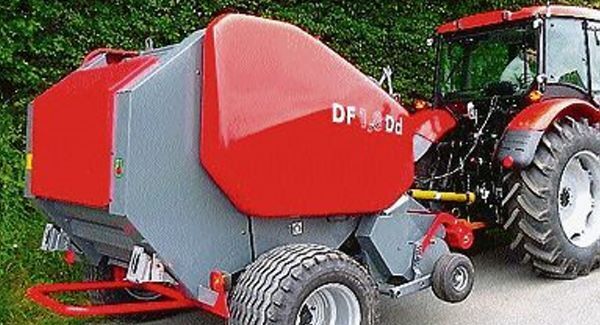
Marketed by McHale Plant Sales of Birdhill, Co Tipperary, the DF1.8Dd roller baler is designed for grass, hay and straw, with a PTO power demand of 70-90hp. It delivers a 1.2 metres diameter bale from a cylindrical winding chamber comprising 17 rollers supported on maintenance-free bearings.
It has two rows of feeder tines, a 14-knife cutting system that can be lowered hydraulically to the neutral position, an automatic chain and gears lubrication system, and a remotely-operated pilot box that controls all operations, which includes a ‘chamber full’ alert and bale counter.
During operation, the rear cover is locked to give high levels of compression without loading the tractor’s hydraulic system.
Augers feed material into the rotor while a pressure roller facilitates the collection of high swaths, and a smooth flow to reduce jamming risk. When jams occur, a hydraulically-lowered foot gives safe access for cleaning and removal.
Other standard items include a rear bale thrower, a binder to control the number of wraps, and an automatic oil feed to the hydraulic system.
Extras include a twine binder.
A scientific breakthrough which enables all crops extract nitrogen from the air, rather than depend on artificial fertiliser, will be commercially available within the next two to three years.
The University of Nottingham has licensed Azotic Technologies Ltd to commercialise its technology for uptake and fixation of nitrogen in a range of crop species, proven to work in the laboratory.
Azotic is now working on field trials, and will seek regulatory approval for N-Fix initially in Europe.
Only a few plants, mostly legumes such as clover, peas, beans can fix nitrogen from the atmosphere, with the help of nitrogen fixing bacteria. The vast majority of plants have to obtain nitrogen from the soil, usually from added synthetic fertiliser for cropping.
Professor Edward Cocking of the University of Nottingham made the breakthrough of finding nitrogen-fixing bacteria in sugar-cane which can colonise all major crop plants.
Plant seeds can be coated with these naturally occurring bacteria to provide every cell in the plant with the ability to fix nitrogen.
Over the last 10 years, the university’s researchers have proved the technology in their laboratories, growth rooms and glasshouses, and they say N-Fix technology can transform agriculture, while bringing significant cost benefits to growers, by cutting their fertiliser expenditure.
Firestone’s new Maxi Traction Combine tyres are built to sustain grain tanks with a capacity of up to 12,500 litres. Reinforced casing helps withstand these loads.
Special sidewall construction allows for higher flexion, thus creating a bigger footprint and larger contact patch, for slow and even tyre-wear and reduced soil compaction.
Dual angle lug is designed for better traction, lower soil disturbance and better self-cleaning.
The new tyres are available for the agricultural tyre replacement and original equipment markets in several sizes.