Rising new business and employment boosts 'accelerating growth' in Irish services sector

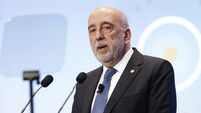
AIB chief economist David McNamara said activity levels were 'boosted by rising new business and employment, alongside easing inflationary pressures'.
The Irish services sector saw "accelerating growth” during July with activity levels boosted by rising new business and employment as inflationary pressures eased, the latest AIB Purchasing Managers Index (PMI) shows.
During July, the PMI recorded a reading of 55.2, up from the 54.2 recorded in June. The PMI is calculated from a question that asks for changes in the volume of business activity compared with one month previously.
The index varies between 0 and 100, with a reading above 50 indicating an overall increase compared to the previous month. The rate of growth in the Irish services sector was well ahead of the flash eurozone, UK and US PMIs at 51.6, 51.8, and 53.6, respectively.
Chief economist at AIB David McNamara said activity levels were “boosted by rising new business and employment, alongside easing inflationary pressures”.
The PMI found that despite some easing last month, the growth of incoming new business remained solid. The rate of growth was the second-fastest in seven months.
New business from international markets rose for the third month running, and at the fastest rate since December 2024.
He said the four sub-sectors covered in the PMI “registered a mixed performance” during the month.
“Technology, media, and telecoms, financial services and business services all expanded activity levels. However, transport, tourism and leisure saw a further marginal fall in activity for a fifth successive month, albeit new business and employment saw growth in that sector,” he said.
The sub-sector with the strongest PMI reading was technology, media, and telecoms with a reading of 61.4 — the strongest expansion in nearly three years. Business services had the next highest at 55.4 followed by financial services at 52.6. Transport, tourism, and leisure had a reading of 49.4.
On inflation, the PMI found that input cost inflation eased further from the 40-month peak reached in April and May to a level broadly in line with the long-run survey average.
“However, remaining cost pressures were driven by rising wages, supplier and freight costs, energy and fuel,” Mr McNamara said. “The rate of increase in prices charged also decelerated to a five-month low, but it remained elevated in a historical context.”
The service sector workforce grew at the fastest pace in six months, and one that was broadly in line with the long-run survey average.
“Higher employment was driven by increased demand, business growth, and the recruitment of technical and sales staff… The rate of job creation was the strongest since January,” the PMI said.
Technology, media, and telecoms as well as business services posted strong increases in staffing while transport, tourism, and leisure posted the first round of job creation in six months. Financial services posted broadly no change.
Business outlook sentiment recovered in July reaching a seven-month high.
“The overall uplift in confidence was entirely driven by the business services sector, however, with slightly softer expectations since June in the other sectors. Financial services registered the weakest outlook for almost six years,” the PMI said.

CONNECT WITH US TODAY



Be the first to know the latest news and updates