Financial Services Ireland calls for tax exemption for investment accounts
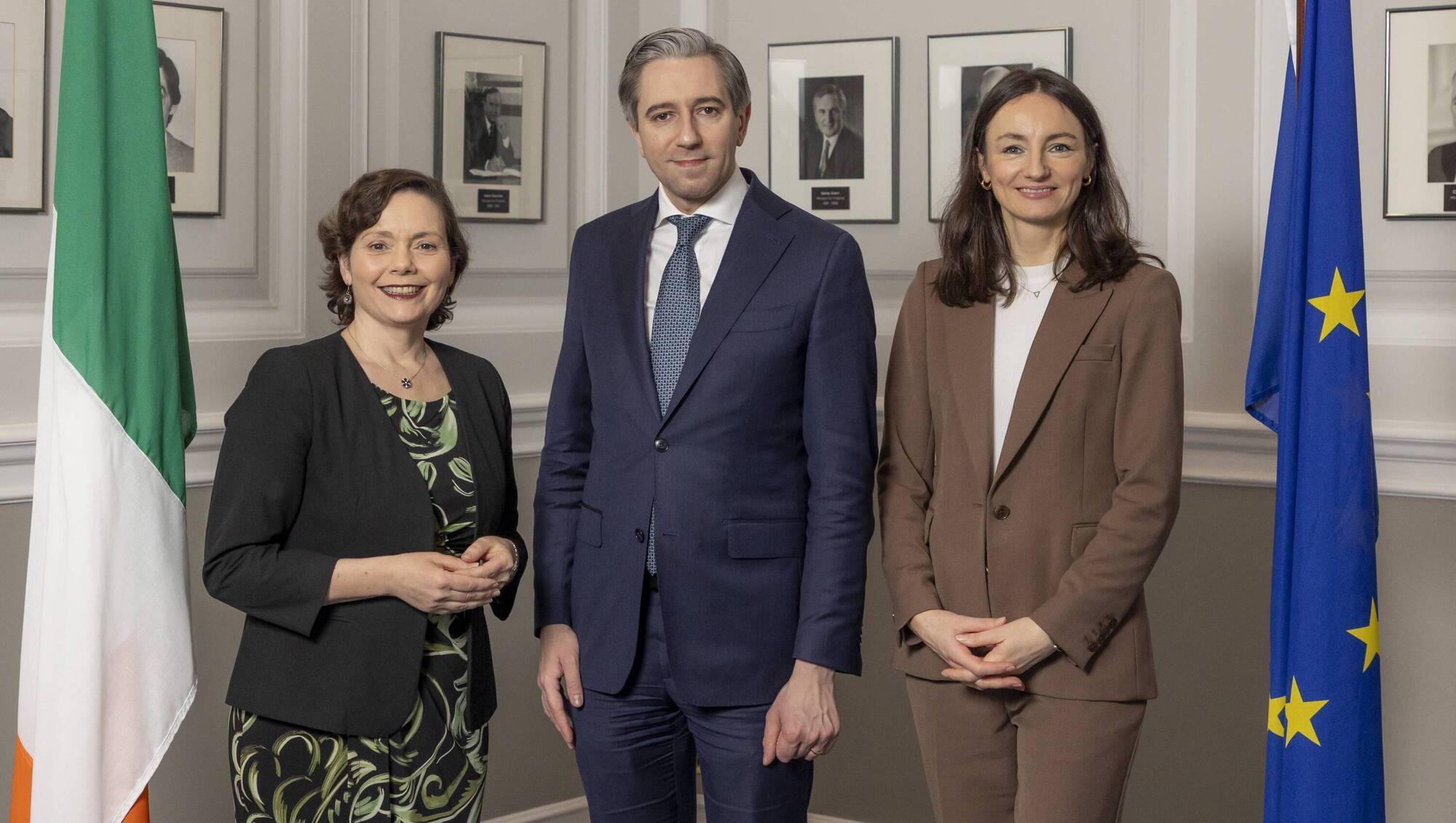
Financial Services Ireland director Patricia Callan, with finance minister Simon Harris, Financial Services Ireland deputy director Audrey Crummy. Mr Harris floated plans to introduce a new savings scheme that would encourage people to invest their built-up savings.
Financial Services Ireland (FSI) has called for the Government’s proposed savings and investments accounts (SIA) to be exempt from capital gains tax and income tax on entry and exit from investment in order “to ensure its successful take-up with retail investors”.
This comes as finance minister Simon Harris has floated plans to introduce a new savings scheme that would encourage people to invest their built-up savings. Other European countries such as Sweden already have similar offerings for savings.
In advance of the Government’s first Annual Savings and Investment Forum, which begins on Tuesday, the FSI is making a number of recommendations on how best to introduce these new SIAs.
FSI, which is a part of the business representative group Ibec, said the initial goal of the accounts is to help “more people in Ireland become financially resilient through investing” and get more money into capital markets to help fund growth.
On top of tax exemptions, FSI also recommended that the account design should not require SIA investors to make an individual tax return and not require the SIA product provider to calculate or withhold tax amounts. It also said there should be no minimum holding period.
The FSI said that, while it is not proposing any annual investment limit for the accounts, it recognises that the Government may choose to do so as to limit the potential impact to the exchequer from tax incentives.
A modelling carried out by the FSI’s SAI taskforce estimated that if 10% of the adult population, and a tax-free allowance of up to €30m a year was implemented, the overall cost to the exchequer would be €54m.
The director at the FSI, Patricia Callan, said that, while keeping money in deposit accounts is “necessary”, there is a “blind spot when it comes to retail investing in Ireland”.
“There is a perception that holding cash on deposit is risk-free, yet we know that in reality with inflation, Irish citizens are losing money over time. Although markets can go up and down at any given time, historically, over a longer time period investing has provided solid returns for investors and an opportunity to build wealth,” she said.
According to the latest data from the Central Bank of Ireland, household savings increased by €1.5bn in January, and stood at a combined €171.3bn at the end of the month. Overnight deposits stood as the main driver of the increase — up €1.4bn.
Research from the Central Bank of Ireland shows that around 38% of financial assets among Irish households are held in cash and deposits, which is above the EU average of 30%, while just 2.3% are in direct investments such as listed equity and debt securities well below the EU average of 7.5%.
CONNECT WITH US TODAY



Be the first to know the latest news and updates