US travel ban to the ‘hermit state’ has a tortured history
Sixty-four years after North Korea and the United States signed an armistice to suspend the Korean War, the US State Department has forbidden American citizens from travelling to the hermit state. The notice was put in the federal register on August 2; it became effective last Friday.
The travel ban is an easy pick amongst a platter of bad choices for Donald Trump, the US president. He has not yet elaborated on his warning to North Korea that “all options are on the table”, after Pyongyang fired a missile over Japan, but the travel ban could be a small sign of what is to come.
Over the last decade, North Korea has detained around 15 US citizens, all of whom have become bargaining chips for Pyongyang in its dealings with Washington.
It’s a pattern that forces US officials to expend resources, time, and political capital to secure the release of these Americans.
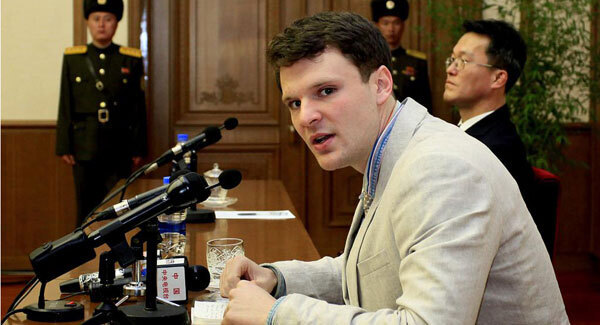
Most tragically, in July, Pyongyang returned one detainee — Michigan
college student, Otto Warmbier — in a coma. His death, a few days later, gave impetus to the US State Department’s push for a travel ban.
Separate from this initiative, and
before Warmbier’s death, a bipartisan-sponsored bill to stop Americans travelling to North Korea began wending its way through the US Congress. It is not clear, yet, what that will include or how this State Department ban will affect that legislation.
But what will the travel ban accomplish? Washington has three main goals: to prevent American visitors being used as bargaining chips by
Pyongyang; to deny the regime tourist dollars; and to send a message about
the unacceptability of Pyongyang’s
behaviour. The first goal will be partially achieved. The ban eliminates the risk of any one of the up to 1,000 Americans who visit each year, on a tourist visa, falling afoul of the authorities.
However, only four of the 15 to 17 Americans who have been detained since 2009 were tourists. (Different sources have different numbers on Americans detained.)
Several cases involved individuals who crossed the China-North Korea border illegally, for religious or journalistic reasons. Others were Americans conducting humanitarian, development, health, or education work.
The US State Department has made clear that US citizens visiting for “limited humanitarian or other purposes may apply to the US Department of State for a special validation passport.” Perversely, such people may now be more vulnerable: if Pyongyang is looking for political pawns, there will be a smaller pool to choose from.
Still, the need for a special passport may allow the US government to vet who can travel to North Korea for work. Many humanitarians or educators focused on North Korea appear to have deep religious convictions that make them vulnerable to breaking some of the country’s rules, written or unwritten.
The ability to deny a ‘special validation passport’ may allow the State Department to protect some of these people from themselves.
There are currently three Americans detained in Pyongyang: Kim Hak-song, Kim Sang-duk, and Kim Dong Chul. They were all detained in separate incidents: Kim Dong Chul had projects in the Rason special economic zone and was accused of espionage; Kim Hak-Song was leaving a teaching post at an evangelical Christian-funded university in Pyongyang, the Pyongyang
University of Science and Technology. Kim Sang-duk was doing the same, 18 months later.
The latter two were both stopped at the airport, as they were about to fly out, and accused of engaging in “hostile acts.”
In the end, a travel ban will probably reduce the number of detainees the United States has to deal with, but it is unlikely to eliminate them.
The second and third goals are more closely related. The roughly 1,000 US tourists a year indeed do contribute to the growing North Korean economy. However, the average Western tourist spends around $2,000 per trip, so their impact is small. Even if all tourism stopped tomorrow — including from China — and Pyongyang lost out on the roughly $30m this industry provides, its nuclear and missile programmes would be unaffected.
Nor do profits from tourism go into some central regime coffer. The major misunderstanding about North Korea today is the assumption that it is a
command economy, with everything done by and for the state.
In fact, it is largely a market economy, with multitudes of companies
connected to different institutions,
paying individual wages, buying input materials from suppliers, and, when possible, even hiding earnings from the authorities. Tourist dollars get spread around to some extent.
That isn’t to say that tourists can
entirely avoid supporting Kim Jong Un’s goals.
When visitors fly into the country on Air Koryo — as most do — they are
paying money to a military-owned company. And that military is, of course, now dedicated to developing weapons that can hit the US mainland.
After the State Department announced, in late July, that it would seek a travel ban, several North Korean
missile tests and multiple rounds of rhetoric were launched across the Pacific Ocean.
Pyongyang, fond of symbolism,
referred to “the powerful nuclear hammer” it could inflict “at the heart of the US”, if it thought Washington was trying to oust Kim.
This travel ban is also a form of symbolism. In a real sense, it is a statement that North Korea’s behaviour is so far outside acceptable norms that the US government is willing to forbid its own citizens from travelling there. It also signals US intent to clamp down on North Korea’s economy, even in small ways.
There will be costs, too. Person-to-person exchanges can influence how people think, even in a controlled state like North Korea.
Exposure to foreign people and ideas has changed how Pyongyang middle and upper-middle class residents see the world.
Observers of North Korea also learn a surprising amount from the tourism industry, as tourists frequently spot changes and trends in-country. Some of this will be lost, if the tourist industry contracts.
The ban is an exceptionally rare
action for the US. It will go down as one more marker in the long history of conflict between the US and North Korea. It is sobering to think that the men who signed the armistice in 1953 are long gone, while this tortured relationship endures.
Andray Abrahamian is a visiting fellow
at the Jeju Peace Research Institute
and at the Centre for Korean Studies,
UC Berkeley. @draylien
CONNECT WITH US TODAY



Be the first to know the latest news and updates