Reports highlight risks facing 3,000 homes planned for Poolbeg
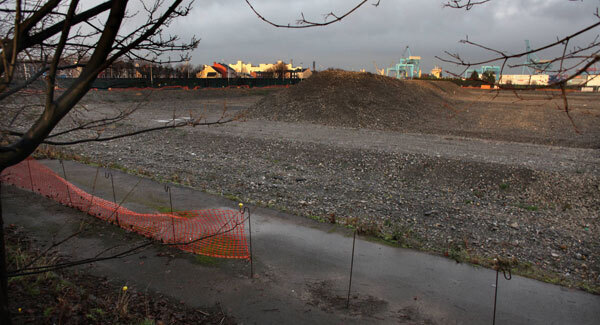
With great fanfare last month, Dublin City Council said the authorisation by Simon Coveney, the Minister for Housing, Planning, and Local Government, to designate the Poolbeg West lands a strategic development zone (SDZ) would fast-track the development of 3,000 homes across 34 hectares, or 84 acres, that comprise the SDZ.
Preparations would be underway by the end of this year, the city council said. The Irish Examiner last week highlighted a report by a senior inspector at the Environmental Protection Agency on the potential for methane emissions still existing at the so-called Irish Glass Bottle site.
This site was for 30 years part of a major Dublin City municipal dump. The Irish Glass Bottle site makes up only about a third of the SDZ lands Dublin City Council wants to develop for housing and other projects.
Written in late 2009, the EPA report showed key challenges in building certain types of homes at the former bottle site.
It said the “development of low-density housing with gardens directly on top of the site would present a risk from ground gas” which may require “the development of buildings with ventilated lower floors raised above ground level”.
The significance of the two other reports that the Irish Examiner highlights today is that they assess the risks of contamination of lands across the entire Poolbeg Peninsula. The reports raise fresh doubts about the costs and speed of building 3,000 homes on the SDZ.
The first of the reports is called the Poolbeg Peninsula Planning Scheme Geotechnical Report, and was commissioned by the Dublin Docklands Development Authority (DDDA). Dublin City Council assumed responsibility for parts of the docklands from the Dublin Docklands Development Authority.
The report was written by consultancy Mott MacDonald Pettit, which was appointed by the DDDA as “infrastructure consultant” to its Poolbeg plans. Dated May 2008, the report assessed the groundwater, contaminated lands, and the likely effects and costs of construction, given the pollution that is likely across the peninsula.
The consultants say “any development proposed in this area will require a detailed geotechnical assessment, including a full site investigation, before design can commence”.
The report confirms that much of the peninsula was used as a domestic landfill until 1978, “but the possibility of some industrial materials having been dumped there cannot be ruled out”, while ashes from the nearby power station and town gas manufacturing have already been detected on the lands.
In an assessment of the so-called “made ground”, it says the materials used to reclaim Poolbeg Peninsula from marsh and sea over many decades include rubble, bricks, concrete, glass, timber, and cinders from the power station.
“The presence of made ground and the frequent industrial industrial usage of land in the Poolbeg area means that hotspots of soil contamination are quite likely to be encountered,” say the consultants.
“In addition to areas being filled with rubble, large parts of the peninsula have previously been used as a domestic landfill meaning contamination associated with domestic wastes is certain in these areas.”
“Exact records of areas that were landfilled do not exist, but it is known that the western part of the peninsula was used and the landfill may have extended as far as the Poolbeg Power Station. The landfill practises at the time would not comply with modern standards for disposal of domestic waste.”
On groundwater, the consultants say that because of the domestic tip and industrial pollutants, water across the peninsula is likely to be polluted.
Under its Groundwater Directive, the EU requires improvement in groundwater even if there is no intention to use it, according to the consultants.
Assessing the soil types across the peninsula on future construction, Mott MacDonald Pettit says the high water table could prove to be a “critical” factor in construction, and “conventional strip or even raft foundations” may not be suitable.
“It is highly likely that significant building anywhere on the peninsula will require extensive piling,” says the report.
“This is technically feasible but will impose costs on developers in the area. Some piling techniques involve the removal of material from deep underground. The use of these techniques may lead to an increased risk of encountering contaminated soil.”
In the worst-case scenario, says the report, soils may need to be removed from the peninsula and exported for decontamination.
“Landfill gases are likely to be encountered at some sites with significant methane concentrations having been noted in previous studies,” the report says.
Developing sites may require trapping or venting gasses. During construction, “there is a possibility of poisonous, explosive or asphyxiating gasses filling trenches or other excavations”.
The Mott MacDonald Pettit consultants also highlight “considerable evidence of low-level contamination” of hydrocarbons “across the entire docklands area, including the Poolbeg peninsula” that may need removing for remedial work.
Bearing on the potential costs of developing Poolbeg and on the potential requirement for special types of building products, is the potential presence of hydrocarbons; phenolic and cyanide compounds linked to town gas manufacturing; sulphates which may require sulphate-resisting cement; volatile organic compounds, including carcinogenic benzene; and toxic metals, including arsenic, barium, chromium, mercury, nickel, lead, and tin, says the report.
The second report, dated February 2009, was commissioned by the DDDA as part of an Environmental Impact Statement for its so-called Poolbeg Planning Scheme.
It was co-ordinated by consultants Cunnane Stratton Reynolds. For a chapter on soils and ground conditions, it commissioned a specialist engineering firm.
This chapter of the Environmental Impact Statement says the eastern edge of the Poolbeg lands was first used in 1903 to generate electricity at the Pigeon House. Subsequently, lands further east were reclaimed for the oil-fired Poolbeg Power Station, which opened in 1971.
Lands to the west were used by Dublin City as a landfill — the Irishtown Tip Head opened in 1948 and closed in 1978.
The Irish Glass Bottle and Fabrizia sites were built on part of the landfill; central parts of the lands on the peninsula were used for the storage of molasses and oil, and other parts by Dublin Port for storage.
The Cunnane Stratton Reynolds report says that domestic and other waste on parts of Poolbeg is likely to have been in the ground for 30 to 50 years.
On the Irish Glass Bottle and Fabrizia areas, “no soil gas venting or collection systems were installed on these sites during operation or after closure. Therefore, landfill gas could potentially be still present,” says the report.
It notes that in 1997, “elevated landfill gas concentrations” were detected in one area of the peninsula, at methane concentrations of 27% to 59% and carbon dioxide of 22% to 32%.
Those readings are in excess of government guidelines of respective concentrations of 1.5% and 0.5%, and “therefore, further assessment of landfill gas production and remedial engineering design measures would be required prior to development, based on those concentrations”, the report says.
Assessing the effects on construction, the engineers in the Cunnane Stratton Reynolds report write: “The landfill gases and contaminated soil encountered during excavation works have also the potential to represent a risk for site workers and surrounding areas”.

CONNECT WITH US TODAY



Be the first to know the latest news and updates











