Being not so ‘green’ about past helps us with our present
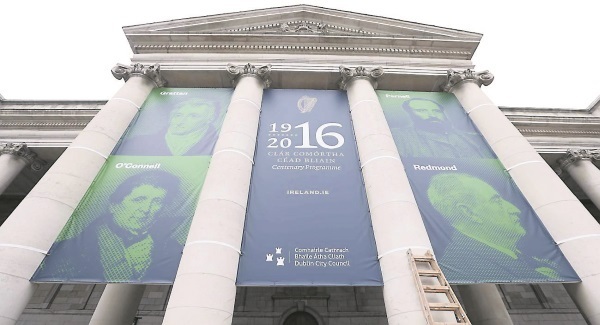
We’ll need our humour and a balanced reading of our history this Easter to negotiate a path through the treacherous waters of commemoration. Let’s hope we can also make room for the voices of the children of the centenary of the Rising, writes Clodagh Finn.

Being not so ‘green’ about past helps us with our present

It’s a tricky time, suspended as we are today between the green-flaggery of St Patrick’s Day and the commemoration, next week, of the defining moment in our nation’s struggle for independence, Easter 1916.

History is dealing us a very heavy hand and it’s almost impossible to be solemn enough, momentous enough, dignified enough, to celebrate what it means to be Irish in an appropriate manner.

Ask the person on the street about our defining characteristics and they are likely to mention one of those humorous telltale signs: An Irish person says ‘filum’ instead of ‘film’, knows what GUBU stands for, and/or probably grew up in a house with a picture of the Sacred Heart over the mantelpiece.

I love those so-called tests of Irish citizenship and the deep questions that arise about a nation divided between those who say scone (to rhyme with tone) and those who say scone (to rhyme with gone).

And that sense of Ireland goes with you wherever you go. It travels all the way to that glorious beach in some far-flung hotspot when your very Irish companion (of a certain age) say: “Jeez, you could fry an egg on the stones here, if you had an egg.”

It makes me laugh every time, just as the ensuing talk about red lemonade, Taytos, and Barry’s tea, does.

If we can generalise for a moment, it’s true to say that most Irish people have a pretty well-developed sense of humour and a delicious line in self-deprecation. It’s just as well, because we’ll need a lightness of touch this Easter to negotiate a path through the treacherous waters of commemoration.

So far, the celebrations have been relatively free of controversy, even if Sinn Féin has done its remembering in parallel to officialdom. In some ways, the fact that we don’t have a government is a good thing — it may take the heat out of what is potentially a deeply divisive day because any time the word “Irish” and “nationalist” sit in the same sentence, someone is hurt (often literally). Indeed, to celebrate at all is almost crass following the death in Belfast of prison officer Adrian Ismay, who died from injuries sustained in a bomb attack claimed by dissident republican group, the New IRA.

The PSNI has warned that those same dissidents are trying to step up their activities to mark the centenary of the Rising.

That callous killing and the deaths of so many others — in the Rising itself, the war that followed and the later conflict in the North — makes any Easter celebration a complicated and deeply ambiguous affair.

It is tempting to line the streets and proudly mark the birth of our nation. However, the problem is that our founding myth is embroidered with many uncomfortable and conflicting truths. Where, for example, in our memorial services is the mention of the 570 Irish-born soldiers who died in gas attacks on the Western Front during Easter week 1916?

While fighting was taking place in Dublin, the Germans released poisonous gas into the trenches in Hulluch in France, killing hundreds of soldiers from the Irish 16th Division.

The 7th Royal Inniskilling Fusiliers suffered heavy casualties, too, losing 263 out of 647 men. An entry from the unnamed unit commander, uncovered in the National Archives in Kew recently, read: “Ireland can be proud of you. In future when asked what battalion did you belong to, you can say with pride that you were in the 7th Royal Inniskilling Fusiliers, a fighting battalion, and you will not have to say anything further.”

How haunting those words are now. Could that unit commander have foreseen that his brave soldiers — and the 30,000 Irishmen who died in the First World War — would be conveniently forgotten as they did not fit into our changing idea of nationhood?

At least their stories are being told now and their contribution remembered and respected as part of the commemoration of the Great War.

What has been heartening in this decade of remembrance, so far, is that the focus, national and international, has been on the events as they really happened. The Rising is being remembered as a revolt by a small, unsupported minority that was crushed almost as quickly as it began.

That is not to denigrate those who took part, or its later significance, but it is a more real, more even telling of events.

It is good, too, to see that the civilians who were killed are being written back into history, along with the women — civilian and militant — and the forgotten children who have been poignantly fleshed out and honoured in Joe Duffy’s bestselling book, Children of the Rising.

What is less spoken about is how Easter 1916 has informed our collective sense of nationalism over the last 100 years. At the best of times, nationalism is a many-headed beast, fuelled by the memory of heroes and martyrs that are aggrandised to give us some singular sense of self. It can be a truly noble and inspiring thing, though, it seems to me, most often it is not.

When I was at school, it used to mean a particularly green — and vicious — version of the past: We were told to write “burn everything British except their coal” into the margins of our history books. When we were younger still, it meant marching around our freezing prefab classroom singing ‘A Nation Once Again’ to get the circulation going on cool winter mornings.

Just this week, though, the beginnings of the Irish Republic were celebrated by giving Irish schoolchildren an opportunity to pen their very own proclamations. That’s progress in anybody’s book, though it was interesting to see that children now sing the national anthem with a clenched fist held to the chest, a symbol that has many different cultural messages.

Let’s hope in the Ireland of 2016 we can, at least, listen to all of them.

x

More in this section

The Business Hub

Newsletter

News and analysis on business, money and jobs from Munster and beyond by our expert team of business writers.

Cookie Policy Privacy Policy Brand Safety FAQ Help Contact Us Terms and Conditions

© Examiner Echo Group Limited