Smooth start amid uncertain future
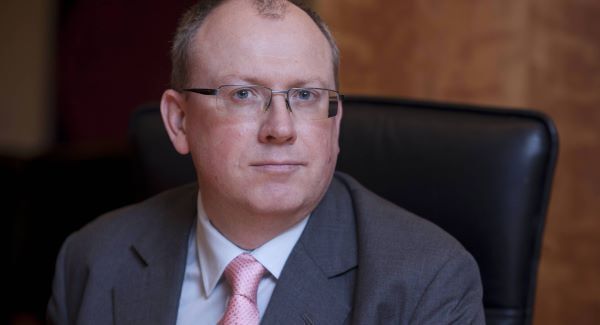
Jeremy Masding took over as CEO of the standalone Permanent TSB less than a year ago.
His task: to shepherd back to viability a bank with a perilous funding position, a growing bad debt book, and a furious customer base.
Its very future was at stake, as the new CEO was quick to acknowledge.
Masding’s selection ahead of former CEO Dave Guinane was a final signal that, these days, it is all but impossible to rise to the top of an Irish bank after a career spent in the country’s banking sector.
The 47-year-old spent much of his career at the leading UK bank, Barclays, rising to the position of director of strategy. Unusually, in the late-1990s, he also spent a year at the UK Government Cabinet Office on secondment.
The CEO’s first task was to decide whether this historic institution — still known to many as the ‘Permo’, from its days as the Irish Permanent Building Society — should continue in business, or follow in the path to wind down blazed by the IBRC and Certus. This was decided in the affirmative within a couple of months of his arrival.
In effect, PTSB is now divided into ‘good’ and ‘bad’ banks, the latter a loan book in gradual wind down.
A restructuring plan was prepared under the supervision of the troika which is acting as a strict guardian to the country’s financially orphaned banking sector.
Two hundred and fifty ‘full time equivalent’ jobs and up to 20 branches are being removed.
The bank has established a new asset management unit to speed up the collection of overdue loans. It is also seeking to rebuild relationships with its disgruntled variable rate borrowers by reducing the exceptionally high borrowing rates to which they have been subjected since 2008.
Permanent TSB knows that if it is to survive in the long run, it must generate profit making new business, and last weekend it surprised, on the upside for a change, with the announcement that it planned to increase its lending fivefold to just over €450m in the current year.
The funding will be broken down as follows: €350m in new home loans, €100m in consumer finance and €10m in credit card loans.
The bank has covered its back by suggesting that the money will only be lent out if there is enough demand from borrowers deemed suitable.
However, the CEO has indicated that the move should herald a substantial upswing in lending in the following years. Of course, much will depend on the wider environment.
The ratings agency, Fitch, rained on the parade with its prediction of a further 20% fall in residential property values, provoking a sharp response from Finance Minister Michael Noonan. He responded that the Paris-based agency is not in touch with what is happening on the ground in the property market here.
The sector points to solid demand and a price upswing for selected family- type properties in strong residential areas.
They are, of course, talking up their own book, but some of the trends appear to be grounded in reality.
The PTSB lending initiative, if implemented in full, should serve to underpin such optimism provided it is backed up by banks elsewhere. It serves at least, as a declaration that PTSB intends to stake a claim as a third force Irish bank.
The Permanent, however, is by no means out of the woods. By March, the next set of financial results is due. They will not look pretty. It is expected that the bank will disclose total losses approaching €1bn. In 2011, the bank lost €424m, but this figure included a one-off gain of €1bn from a ‘liability management exercise’ involving a burning of junior bondholders.
However, sources insist that real progress is now underway. Deleveraging and cost cutting is underway.
In late November, it agreed the sale of its consumer loans business to Deutsche Bank for €287m, generating a €64m book loss on the disposal.
Sources point to the new asset management unit where staff numbers involved in debt management have doubled to 200.
The IT employed allows callers to contact customers the minute a problem arises at times when they are most likely to be at home.
This has ensured a “significant slowing in the pace of arrears growth”.
The long-term future of the unit remains to be decided. It could be merged with the IBRC, or the Bank of Scotland Ireland wind-down vehicle Certus, or it could, like Certus, develop a specialist loan management business, based on its in-house expertise.
The bank, meanwhile, is continuing to deliver, selling off consumer loan books.
It is seeking to rebuild its relations with its hard- pressed variable rate borrowers, many of whom have threatened to leave the bank as soon as possible.
By late September, PTSB had cut its standard variable rate by 85 basis points.
The PTSB is no longer an outlier, with its standard variable rate now at 4.36%. At the same time, the ‘pillar’ banks, AIB and Bank of Ireland, have raised their rates.
AIB and Bank of Ireland have both made progress in the bond markets. The long-term goal is that Irish banks would be in a position to raise funds more cheaply and that reductions would be passed on to customers. PTSB, likewise, is seeking to reduce its dependence on cheap ECB money by increasing its deposit book, a book that had increased greatly in size in the past year.
Speaking in July at a session of the Joint Oireachtas Committee on Finance, Mr Masding pointed to the scale of the problems he inherited. Shareholders had been “wiped out” while customers had “suffered financially over a number of years”, largely through no fault of their own.
He also had a word for the employees, a group often neglected in the discourse: “They have suffered significant loss of reputation and respect, and many have had to leave their jobs.”
The spokesman for the staff’s main trade union, Unite, Walter Cullen, has highlighted the loss of trust among employees. Fences need to be rebuilt if staff are to be motivated — and this must be done at a time of intensive cost cutting.
The CEO identified his three initial priorities at his Oireachtas appearance.
1. Putting in place the restructuring plan.
2. Tackling the high variable loan rate.
3. Addressing the issue of ‘debt collection’.
Much time is being spent in contact with the troika to whom quarterly reports must be submitted.
The new model envisages a “significant reduction in branches”, without a complete withdrawal into the online ether favoured by Danske Bank.
Masding is also rebuilding the top management team, with just one of the 11 positions filled from within PTSB (some came from elsewhere in the former Irish Life & Permanent).
The promised land of viability and independence of European assistance remains a long journey away.
It is too early to say whether the Barclays man could succeed in re-establishing the Permanent as a major force, particularly in the home loan market where it was once the market leader. However, he appears to have got off to a good enough start.
- Age: 47. Grew up in Norwich, East Anglia.
- Education: MBA.
- Family: Married with three children. Relocated family to Dublin, last September.
- 1984: Joined Barclays as a bankteller from school.
- 1984-2007: Served as branch manager in Greece and the US for Barclays. Rose to positions as group director of strategy, and director Barclay Card.
- 1998-1999: Leave of absence at UK Cabinet Office.
- 2007-2009: CEO, Central Trust plc specialist lender.
- 2010-2011: Chairman, Richmond Group — loan broker. Financial consultant.
- February 2012 to date: CEO Permanent TSB.
CONNECT WITH US TODAY



Be the first to know the latest news and updates