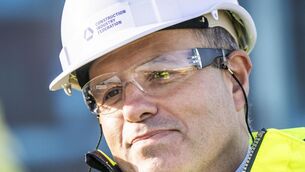
David Vs Goliath challenge for AIB
AIB took an important step on the long road to rehabilitation this week with confirmation of the appointment of Singapore-based David Duffy as group chief executive.
The bank has been operating under the experienced British banker, David Hodgkinson, since the departure of former chief executive, Colm Doherty.
Hodgkinson has had to make the best of what has been a pretty difficult job. The bank has absorbed over €20 billion in taxpayers’ funds. It is deleveraging rapidly and before long its loan book will have shrunk by 50%. Last April the bank confirmed there would be 2,000 job cuts implemented over a three-year period.
The executive chairman is preparing to step up to non-executive chairman after David Duffy takes over next month. However, he has indicated a willingness to remain on as chairman for some time to come.
Irish-born banker Duffy is fortunate in that he comes to the job with clean hands having been out of the country for his entire career.
Having spent his early years in West Cork, he was educated in Terenure College, a strong-rugby playing school — a near contemporary was Cormac McCarthy, former chief executive of First Active and later of Ulster Bank. Duffy moved on to Trinity College for a Business Studies degree before moving to London to work for Goldman Sachs International.
He rose rapidly, becoming head of General Services, Europe in 1988 at the age of 27 with a brief to restructure the commercial and services functions and to develop new offices on the continent.
Later as head of HR, he performed further roles in the area of cost restructuring while “subsequently designing a HR strategy to support the internal growth objective of the group.”
In February 1998, he joined ING Barings as head of HR.
ING is a large Dutch financial institution based in Amsterdam. In 1995, it acquired the venerable British merchant bank, Barings for a consideration of £1 while also assuming more than $1 billion in debts run up as a result of the rogue trades of a Singapore-based dealer, Nick Leeson.
Duffy was moved up into the position of global chief operating officer at ING Barings in November 1998 before heading to New York to run the North American operation in 2000.
Around this time, ING underwent a major shake up. Seven hundred jobs were axed in the City of London and the US business was sold off to ING’s Dutch rival, ABN Amro, for €275m.
In 2006, he moved on to run the London operation of the fast expanding, South African-based Standard Bank, taking on responsibility for the full international franchise, the following year. This included Asia, Central & East Europe, the Middle East, North America and Latin America.
In 2009, Standard acquired a one third share in Russia’s second biggest investment bank, Troika.
As part of the deal, Troika in turn snapped up Standard’s Russian operation.
Standard’s focus has been on emerging markets, many of which have been benefiting from soaring demand for raw materials.
It is now the largest banking group in Africa.
In 2010, Duffy relocated to Asia as Standard’s head of strategic projects before leaving the bank six months later to set up the Singapore-based Celtic Advisory International.
Duffy will be arriving back to Dublin to an organisation which is shrinking and is a state-owned entity in a sector propped up by the state banking guarantee and ultimately by the European Central Bank. With the very survival of the eurozone now in question, he will have to move fast to ready the bank for what is likely to be a pretty uncertain future.
Management will have to walk a very fine line between preserving morale in the organisation and maintaining relations with the IBOA, while at the same time keeping the Department of Finance reasonably sweet.
Relations between unions and management at AIB are now at a low ebb. The union is critical of the lack of guidance on the layoffs and at the poor terms on offer to departing staff.
General secretary Larry Broderick believes that staff are being kept in the dark just as Aviva employees have been.
He believes that the severance terms on offer are too miserly while accepting that the old banking norms can no longer apply.
Duffy’s first task will be to put in place a plan for the future of the bank, one which provides for the retention of the maximum number of jobs and guarantees concerning the future of the business in the North and Britain.
Duffy clearly faces an uphill challenge in bringing a demoralised workforce back on side.
The chairman, David Hodgkinson will have an important role in acquainting Duffy with certain realities. Recently, AIB had its knuckles wrapped when it dragged its feet in passing on an ECB rate cut, leading to a public uproar and a strong instruction from Government to pass on the cut.
Its chairman also crossed swords with the Government over the €500,000 salary cap. The chairman bent the knee and went along with the cap.
Duffy is accepting €500,000, though no doubt with some lucrative strings attached should he meet his targets.
AIB is making some progress. Opening hours are being extended. Staff are being retrained to better handle loan applications. A new culture is being introduced from the ground up. However, the legacy of decades of over centralisation and sloppy banking practices will not be easily eradicated.
There remain signs that the bad old culture outlasted the bank’s balance sheet and deposit base.
David Duffy is completely untainted by the cronyism culture of spoof and bombast that grew up in boomtime banking Ireland.
One of his key tasks will be to whip AIB back into the sort of shape where it can begin to draw backward glances from people who believe in the potential of our crisis-ridden economy.
The aim must surely be to try and attract outside investment into a business that has cost the taxpayer so dearly, in the process, expanding the ability of the bank to lend into an economy that is starved of credit.