White smoke on trade deals calms markets and offers 'off-ramp' to Trump

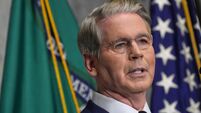
US trade representative Jamieson Greer, left, and US treasury secretary Scott Bessent discuss details of the tariff pause with China. Both the US and China are now looking to undo the damage of the tit-for-tat trade war. Picture: Jean-Christophe Bott/Keystone via AP

Despite warnings that the impact of US tariffs would hit the US economy hardest, the US Federal Reserve sat on its hands last week, using the cover of uncertainty on the outlook to continue its pause on interest rates. However, some clarity is now starting to emerge, with the US agreeing a significant deescalation in tariffs with China, following a framework deal with the UK last week.
The takeaway from these recent developments is that both the US and China are now looking to undo the damage of the tit-for-tat trade war, which was already beginning to be felt in both economies in recent weeks.
On monetary policy, US Fed chair Powell delivered another rhetorical masterclass in hedging his bets on future rate moves at his regular press conference, noting the risks to both “higher unemployment and inflation have risen”, potentially increasing “tension” on the Fed’s dual mandate of maximum employment and stable prices.
When pushed by reporters, Powell was loathe to provide details of a scenario where the Fed might cut rates more aggressively, given the uncertain economic outlook. He noted that the hard economic data remain robust, but that tariffs could be damaging to the economy, depending on the ultimate scale of these trade barriers. An implicit assumption from the Fed pause could be that it is placing a low probability on a return to the full “reciprocal” tariffs measures which were halted for 90 days in mid-April. If the Fed expected a return to these measures, it may have chosen to pre-emptively cuts rates to support the economy at this juncture.
In that context, the US administration has been engaging in trade negotiations with key partners. The announcement of a very limited deal with the UK was the first such agreement. This gives the US market access to the UK for some products (beef, autos), in exchange for some reductions in announced tariffs. However, it appears the UK remains in a relatively worse position versus the January 2025 baseline, with 10% US tariffs in place for most sectors, ahead of further detailed negotiations in the coming months.
The deal hammered out with China is much more significant, lowering tariffs for the next 90 days in a major de-escalation of the trade war. The US will lower tariffs on Chinese goods to 30% from 145% and China will reduce tariffs on US imports to 10% from 125%.
US reports suggest little engagement with the EU so far. In the absence of a deal, the European Commission has announced a list of tariffs it may introduce on US products, worth €95bn, covering a broad range of industrial and agricultural goods.
Overall, the deals suggest US tariffs are unlikely to return to the January 2025 baseline in the trade agreements expected to be finalised in the coming months. However, the deals also imply even threadbare trade frameworks might provide US president Donald Trump with an “off-ramp” from reapplying the more damaging reciprocal tariffs paused in April.