The Big Read: The man who cracked the lottery

Suspicions were raised when a person with a winning ticket chose anonymity rather than claiming the $16.5m prize. Details of a massive scam soon emerged, writes

THE file landed on Rob Sand’s desk with something less than a thud. Despite holding the contents of an investigation still open after more than two years, the file was barely half an inch thick. “Happy birthday,” his boss said.
It was not Rob Sand’s birthday. His boss, an Iowa deputy attorney general named Thomas H Miller, was retiring in July 2014 after nearly three decades of prosecuting everything from murder to fraud.
Now Miller was offloading cases to colleagues. This one, having to do with a suspicious lottery ticket worth $16.5m, was full of dead ends. Investigators didn’t even know if a crime had been committed. The most tantalizing pieces of evidence were on a DVD: Two grainy surveillance clips from a filling station. Sand slid the disc into his laptop and pressed play.
A man walked into a QuikTrip convenience store just off Interstate 80 in Des Moines. It was a weekday afternoon, two days before Christmas.
The hood of the man’s black sweatshirt was pulled over his head, obscuring his face from two surveillance cameras overhead. Under the hoodie, he appeared to be wearing a ball cap; over the hoodie, he wore a black jacket. The man grabbed a fountain drink and two hot dogs.
“Hello,” the cashier said brightly.
The man replied in a low-pitched drawl, a voice that struck Sand as distinct: “Hell-ooooh.”
“Couple hot dogs?” the cashier asked.
“Yes, sir,” the man replied quietly, his head down.
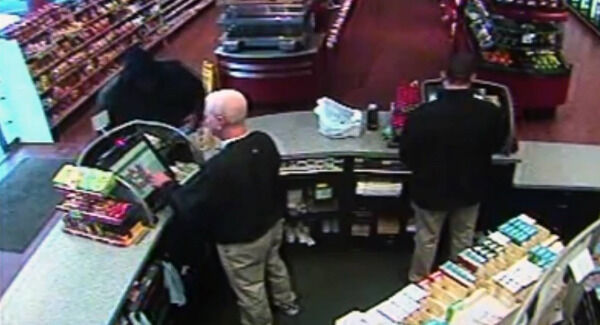
The man pulled two pieces of paper from his pocket. They were play slips for Hot Lotto, a Powerball-like lottery game available in 15 states across America.
A player — or the game’s computer — picked five numbers between 1 and 39 and then a sixth number, known as the Hot Ball, between 1 and 19. The prize for getting the first five numbers right was $10,000.
But a much larger prize that varied according to the number of players who bought tickets went to anyone who got all six numbers right.
The record Hot Lotto jackpot of nearly $20m had been claimed in 2007. The jackpot at the time of this video was approaching the record. The stated odds of winning it were one in 10,939,383.
The cashier took the man’s play slips, which had already been filled out with multiple sets of numbers. At 3.24 pm, the cashier ran the slips through the lottery terminal.
A bus drove by. The cashier handed over his change. Once outside, the man pulled down his hood and removed his cap, got into his SUV and drove away.
The service station gleamed; there had been snow flurries that afternoon.
Two years into the case, that was virtually all the investigators had. Sand watched the video again and again, trying to pick up every little detail: the SUV’s make; the man’s indistinct appearance: most likely in his 40s, and 100lb overweight, maybe more; the tenor of his voice.
Sand, a baby-faced Iowan who turned down Harvard Law School for the University of Iowa College of Law, had a background that seemed perfect for the case. His recent cases included securities fraud and theft by public officials.
The ticket in the video was purchased on December 23, 2010. Six days later, the winning Hot Lotto numbers were selected: 3, 12, 16, 26, 33, 11. The next day, the Iowa Lottery announced that a QuikTrip in Des Moines had sold the winning ticket. But one month after the numbers were drawn, no one had presented the ticket.
Three months after the winning ticket was announced, the lottery issued another public reminder. Another followed at six months and again at nine months, each time warning that winners had one year to claim their money. “I was convinced it would never be claimed,” says Mary Neubauer, the Iowa Lottery’s vice president of external relations.
A man named Philip Johnston, a lawyer from Quebec, called the Iowa Lottery and gave Neubauer the correct 15-digit serial number on the winning Hot Lotto ticket.
Neubauer asked his age — in his 60s, he said — and what he was wearing when he purchased the ticket. His description, a sports coat and gray flannel dress pants, did not match the QuikTrip video.
Then, in a subsequent call, the man admitted he had “fibbed”; he said he was helping a client claim the ticket so the client wouldn’t be identified.
This was against the Iowa Lottery rules, which require the identities of winners to be public. Johnston floated the possibility of withdrawing his claim. Neubauer was suspicious: The winner’s anonymity was worth $16.5m?
One year to the day after the winning numbers popped up on the random-number-generator computers — and less than two hours before the 4pm deadline — representatives from a prominent Des Moines law firm showed up at the Iowa Lottery’s headquarters with the winning ticket.
The firm was claiming the ticket on behalf of a trust. Later, the Iowa Lottery learned that the trust’s beneficiary was a corporation in Belize whose president was Philip Johnston, the Canadian attorney. The Iowa attorney general’s office and the Iowa Division of Criminal Investigation opened a case.
In an interview in Quebec City, Johnston told investigators that he had been contacted about the ticket by a Houston attorney named Robert Sonfield. Johnston also pointed investigators toward a Sugar Land, Texas, businessman named Robert Rhodes.
By the time the file ended up on the desk of Rob Sand in 2014, the case had acquired cultlike status in his office. But all he had was grainy video of a man buying a lottery ticket worth $16.5 million. “We only had one bullet left in our revolver,” Sand says, “and that was releasing the video.”
On October 9, 2014, nearly 46 months after the man in the hoodie left the QuikTrip, the Iowa Division of Criminal Investigation put out a news release that included a link to a 74-second clip of the surveillance footage.
A few days later, in Maine, an employee of the Maine Lottery opened an email forwarded from his boss. The employee recognised the distinct voice in the video: It belonged to a man who had spent a week in the Maine Lottery offices a few years earlier conducting a security audit.
IN DES Moines, a web developer at the Iowa Lottery who watched the video also recognised that voice: It belonged to a man she had worked alongside for years.
A receptionist in another lottery office handed her earbuds to Noelle Krueger, a draw manager, and told her to listen. “Why am I listening to a video or listening to a tape of Eddie?” Krueger replied.

By Eddie, she meant Eddie Tipton, the information-security director for the Multi-State Lottery Association. The organisation runs lotteries for 33 different states plus the District of Columbia, Puerto Rico and the US Virgin Islands. It was based in the Des Moines suburbs. Among the games it ran was the Hot Lotto.
In November 2014, state investigators showed up at Tipton’s office. They asked him whom he knew in Houston. He told them about his family, including his brother Tommy, a former sheriff’s deputy turned justice of the peace near the Texas Hill Country.
He did not mention Robert Rhodes, the man who initially passed the $16.5m ticket to an attorney. By searching Tipton’s LinkedIn profile, investigators found that Tipton had been employed at Rhodes’s Texas-based software company, Systems Evolution, for six years as its chief operations officer.
In fact, the two were best friends and vacationed together. Tipton was arrested in January 2015 and charged with two felony counts of fraud. The prosecution knew he’d fixed the lottery. But how?
Jason Maher, a gaming buddy of Tipton’s, told them about Tipton’s interest in rootkits: malicious software that can be installed via flash
drive in order to take control of a computer while masking its existence until it deletes itself later.
SAND theorised that Tipton went into the draw room six weeks before the big jackpot and, despite the presence of two colleagues, managed to insert a thumb drive into one of the two computers that select the winning numbers.
That thumb drive contained the rootkit; the rootkit allowed Tipton to direct which numbers would win the Hot Lotto on December 29, 2010.
The jury found him guilty on July 20, 2015. He would be sentenced to 10 years in prison, and he would appeal. The State Supreme Court later dismissed his conviction on one charge, tampering with lottery equipment, and the case was sent back to court.
Six weeks after the trial concluded, Sand had returned to his desk. It had been a busy summer. But in the back of his mind, he was still thinking about Eddie Tipton. His gut said other fraudulent lottery tickets were out there.
One morning Sand’s office phone rang, and an area code he recognised popped up: 281, from Texas, where Tipton used to live. Sand picked up. The caller had a drawl and told Sand he’d seen an article in the La Grange, Texas, newspaper about Tipton’s conviction.
“Did y’all know,” the tipster asked, “that Eddie’s brother Tommy Tipton won the lottery, maybe about 10 years back?” Now the hunt was on for more illicitly claimed tickets.
In September 2015, Iowa investigators learned that a $783,257 payout for Wisconsin’s Very Own Megabucks Game had been claimed in early 2008 by a Texas man named Robert Rhodes, who wanted to deposit it into the account of a limited-liability corporation.
That drawing took place on December 29, 2007 — the same day the winning numbers on Tipton’s $16.5m Iowa ticket were selected three years later. Rhodes was Eddie Tipton’s best friend. Another hit.
One evening over the holidays, Sand was at his parents’ house working on his laptop. He noticed that a Kyle Conn from Hemphill, Texas, won a $644,478 jackpot in the Oklahoma Lottery some years back.
Tommy Tipton had three Facebook friends named Conn. Sand got a list of possible phone numbers for a Kyle Conn and cross-referenced them with Tommy Tipton’s mobile phone records. Another hit.
Investigators in Iowa eventually had six tickets they figured were part of a bigger scam. But the question remained: How did it work?
In Wisconsin, investigators found they still had the random-number-generator computers used for the 2007 jackpot sitting in storage. On January 7, 2016, Sand’s phone rang.
It was David Maas, an assistant attorney general in Wisconsin. He told Sand to check his email. Maas had sent him an attachment with 21 lines of “pseudocode,” a common-language translation of McLinden’s forensic analysis that showed part of Tipton’s malicious computer code.
The code was small enough that it would not radically change the size of the file, which might create suspicion. Sand’s rootkit theory had been wrong. And the code hadn’t been hidden. You just needed to know what to look for.
“This,” Maas says, “was finding the smoking gun.”
Here’s how the Multi-State Lottery Association’s random-number generators were supposed to work: The computer takes a reading from a Geiger counter that measures radiation in the surrounding air, which is expressed as a long number of code; that number gives the generator its true randomness.
The random number is called the seed, and the seed is plugged into the algorithm, a pseudorandom number generator called the Mersenne Twister. At the end, the computer spits out the winning lottery numbers.
Tipton’s extra lines of code first checked to see if the coming lottery drawing fulfilled Tipton’s narrow circumstances.
It had to be on a Wednesday or a Saturday evening, and one of three dates in a nonleap year, generally falling around holidays — when Tipton was often on vacation.
If those criteria were satisfied, the random-number generator was diverted to a different track. Instead, the algorithm would use a predetermined seed number that restricted the pool of potential winning numbers to a much smaller, predictable set of numbers.
So Tipton knew what no one else knew: For the Iowa Hot Lotto drawing on Dec 29, 2010, there weren’t really 10,939,383 sets of possible winning numbers. There were only a few hundred.
Late at night before a draw that fulfilled his criteria, Tipton stayed in his messy, computer-filled office. He set a test computer to the date and time of the coming draw, and he ran the program over and over again.
For the first lottery he rigged, the November 23, 2005, drawing in Colorado, Tipton wrote down each potential set of winning numbers on a yellow legal pad. He handed the pad — each sheet had 35 or so sets of six numbers — to his brother.
“Play them,” he said. “Play them all.”
On a clear, blue summer day in Des Moines last year, Eddie Tipton, a square-shaped, balding man who was then 54, trudged up the stairs of the Polk County Courthouse.
He had accepted a plea agreement for masterminding the largest lottery scam in American history: one count of ongoing criminal conduct, part of a package deal that allowed his brother to be sentenced to only 75 days. Tipton was here for his sentencing.
The judge asked if Tipton had anything to say. “Well,” Tipton said matter-of-factly, “I certainly regret my actions. It’s difficult to say that with all the people behind me that I hurt. And I regret it. I’m sorry.”
At another point during the proceedings, Tipton leaned across a divide and extended his hand to Sand. Sand took the handshake as a sign of respect, as if Tipton had thought he outsmarted the system but the system figured him out.
On the day of his sentencing, Tipton told the judge he’d been taking classes to go into ministry. A deputy placed Tipton in handcuffs and led him away.
Reid Forgrave is a writer based in Minnesota. Adapted from an article that originally appeared in the New York Times Magazine
CONNECT WITH US TODAY



Be the first to know the latest news and updates