Rapid emissions cuts needed to ‘minimise’ peak global warming at 1.8C, UN warns
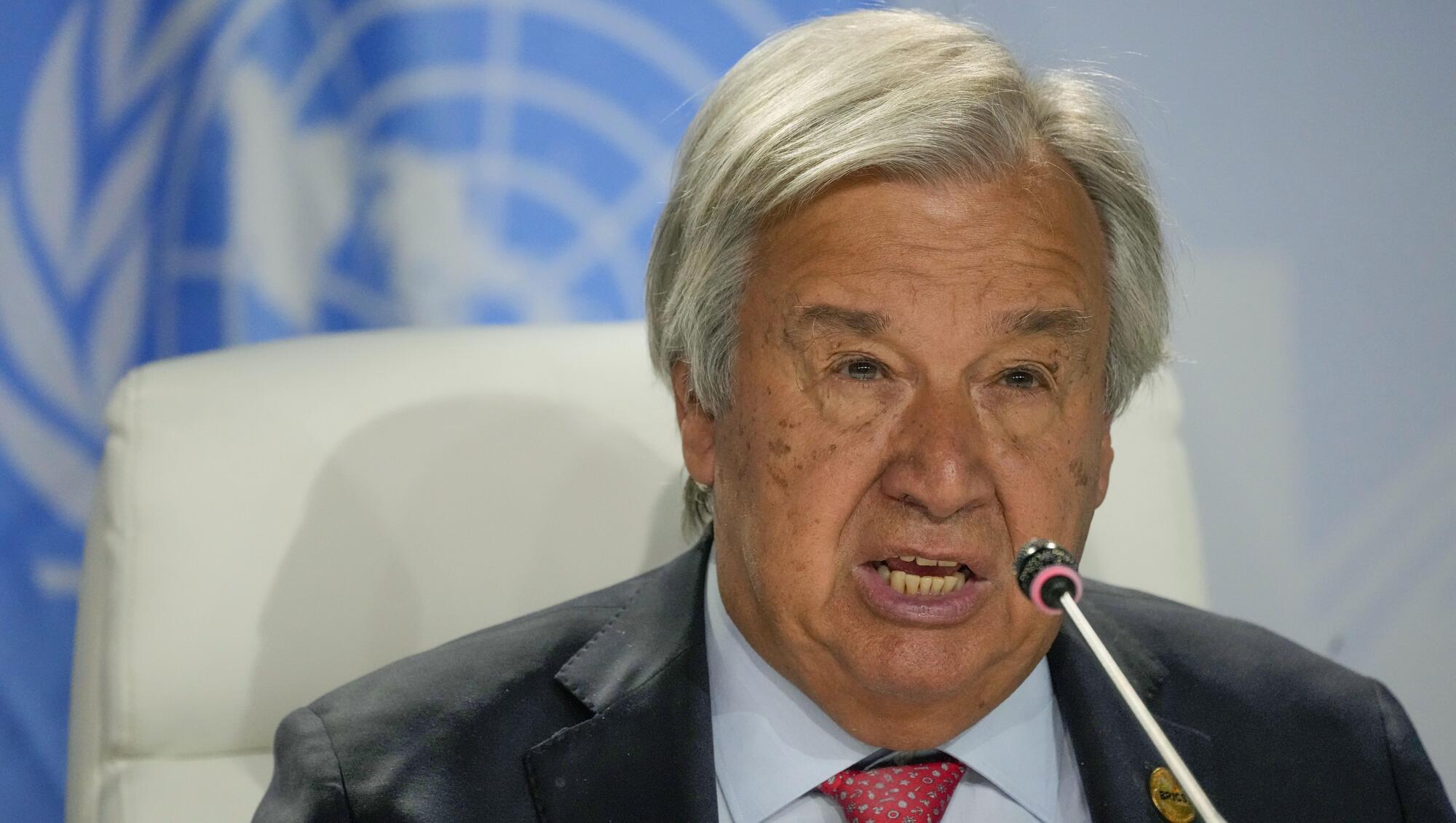
United Nations general secretary António Guterres: 'Overshoot is not surrender. We can still keep it as small and as short as possible — and bring temperatures back below 1.5C by the end of the century.' Picture: AP/Themba Hadebe
Urgent and stringent cuts to planet-heating emissions will be required to minimise peak global warming to 1.7-1.8C above pre-industrial levels at the middle of this century, UN scientists have warned.
The world is set to pass the key threshold of 1.5C warming above pre-industrial levels, worsening the risks of climate change.
But UN secretary-general Antonio Guterres said “overshoot is not surrender” as the UN Environment Programme (UNEP) set out how the world could minimise the magnitude and duration of exceeding the threshold and try to return to below 1.5C as soon as possible.
This temperature threshold was a key part of the landmark 2015 UN Paris Agreement, which saw nations pledging to keep global warming to well below 2C, and pursue efforts to cap it at 1.5C.
Scientists say failing to limit warming to 1.5C will lead to increasingly frequent and intense extreme weather events, including heatwaves, droughts, wildfires and flooding, with wide reaching and severe impacts on human life, economies and nature.
It could also trigger multiple climate tipping points that could bring irreversible destruction, such as breakdowns of major ocean circulation systems, thawing of permafrost and the collapse of tropical coral reef systems.
In its annual Emissions Gap report released on Wednesday, the UNEP outlined different 1.5C overshoot scenarios.
It found the “lowest possible” scenario would now see an overshoot of 1.7C to 1.8C by the middle of the century, and global temperature rise returning to or below 1.5C by 2100, with about a 50% chance.
To get on to this pathway, global emissions would have to be reduced by 18% by 2030, 45% by 2035 and 69% by 2040, all relative to 2025 levels, it said.
However, the UNEP experts found countries’ current climate plans — known as nationally determined contributions (NDCs) which they must publish as part of the Paris Agreement — would only reduce emissions by 5-8% by 2030 and 11-15% by 2035, relative to 2025 levels.
Mr Guterres said: “Overshoot is not surrender.
“We can still keep it as small and as short as possible — and bring temperatures back below 1.5C by the end of the century.”
Under the current policies in place across the world, the UNEP projects warming could reach 2.8C within this century and continue to increase thereafter.
If all NDCs are delivered and similar efforts continue, the agency found warming would be limited to 2.6C.
These projections are higher than the UNEP report’s projections last year, with the experts attributing this to the United States’ withdrawal from the Paris Agreement as well as revised estimates of historical emissions.
New NDCs submitted by countries since last year’s report have made a negligible difference for these projections, it added.
Even in the most optimistic scenario, where all NDCs plus additional net-zero targets are achieved, global warming would only be limited to 2.1C in this century.
The UNEP report said advances in renewable energy and climate policies had delivered real emission reductions across countries and sectors since the adoption of the Paris Agreement, with total energy supply from coal and oil growing slower than projected.
However, it also warned of the massive global scale-up required to get on track to achieve the goals of the Paris Agreement and that there were more opportunities than ever to accelerate action.
Inger Andersen, executive director of UNEP, said: “Every additional fraction of a degree and additional year of warming above 1.5C increases climate impacts and risks, such as the deadly floods, heatwaves and wildfires that have plagued many nations this year.
“We must pull out all the stops to minimise peak warming and return to 1.5C by the end of the century. This is possible.
“We have a wealth of success stories showing that emissions can be cut quickly.
“It is now up to nations to urgently put in place policies that spark fast, deep and sustained emissions reductions, and put the world on track for a more stable climate and more stable economies and societies.”

CLIMATE & SUSTAINABILITY HUB
CONNECT WITH US TODAY



Be the first to know the latest news and updates