Desperation mounts in Venezuela as the earthquake death toll rises to 1,430
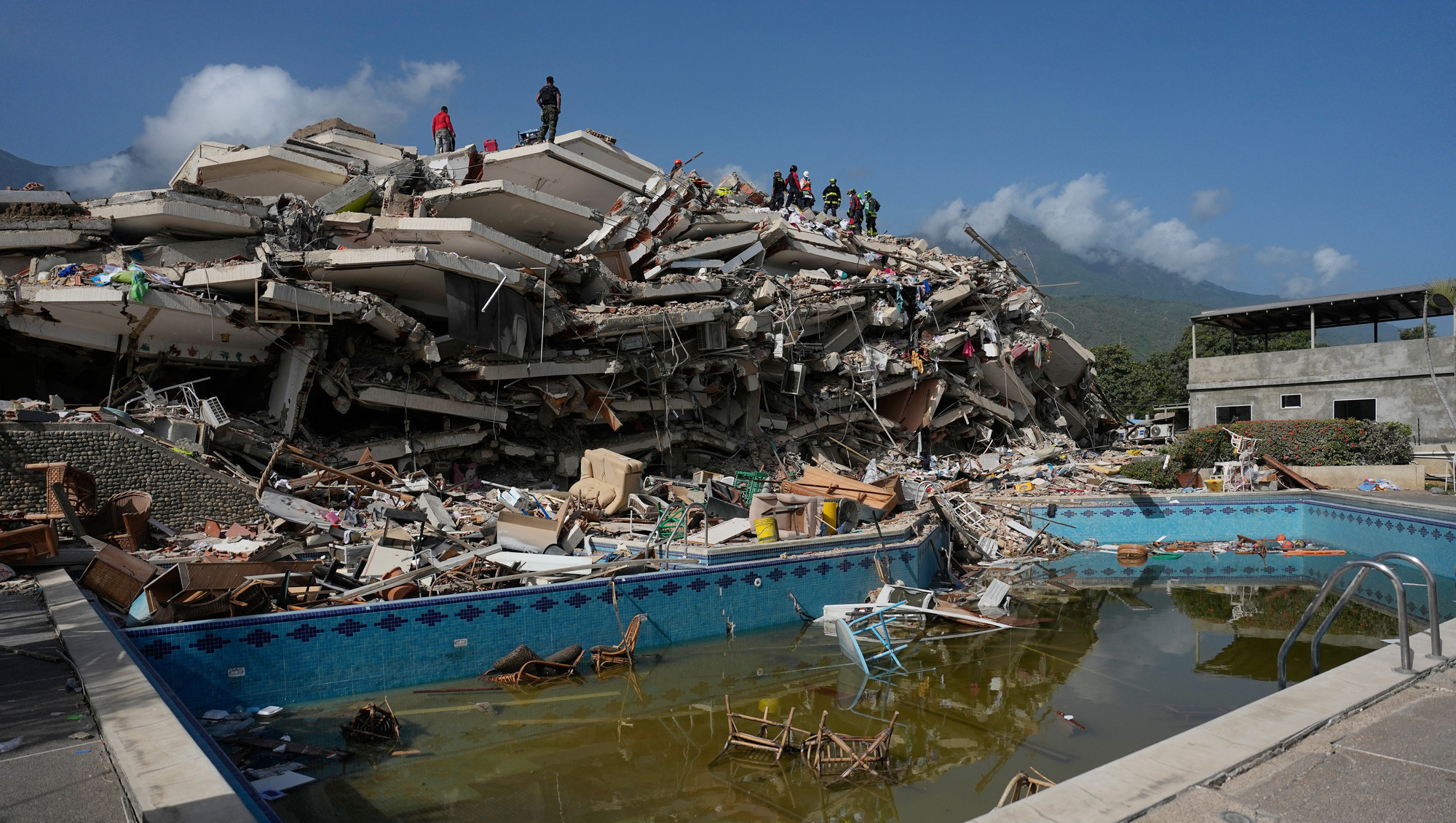
Rescue workers search through the rubble (Fernando Vergara/AP)
The death toll from Venezuela’s earthquakes rose to 1,430 on Saturday, officials said.
The latest figures were released as rescuers continued the search for survivors of the one-two punch of 7.2 and 7.5 magnitude earthquakes that devastated the South American nation three days earlier.
Families had reported at least 68,900 people missing as of Saturday morning.
Venezuelans looking for loved ones and neighbours used shovels, heavy equipment, ropes and bare hands atop mounds of toppled concrete throughout La Guaira, one of Venezuela’s hardest-hit states.

Most of those digging were civilians who took search efforts into their own hands, and tensions spiked over an inadequate response from the Venezuelan government, whose soldiers, firefighters, police and military cadets were evidently under-prepared to respond to the tragedy.
Acting president Delcy Rodriguez said on state television on Saturday that more than 14,000 members of the military and police are patrolling the area, where access is now blocked and special permits are required to enter.
More rescue teams sent by governments across the world arrived in Venezuela on Saturday.
Simon Bolívar International Airport, which serves Venezuela’s capital, Caracas, was badly damaged in the quake.
One runway was operational on Saturday as US teams worked to repair the crucial throughway, said Jeremy Lewin, a senior State Department official in charge of foreign assistance told reporters.
In the state of La Guaira, just north of Caracas, Nazareth Jimenez sobbed into a loved one’s shoulder on Friday as she watched neighbours use hammers and power tools to try to cut through slabs of concrete in a building reduced to a mountain of debris.
She was wracked with anxiety as she waited to see if her siblings, nephews, nieces and friends would emerge alive.
“My God, how are we going to get them out of there?” Ms Jimenez murmured.
“We’re making a call for help to the government and countries across the world,” she said, pleading for machinery capable of moving collapsed structures. “There are still people alive in there.”

Government forces distributed food and water to survivors in La Guaira, and Ms Rodriguez said her government was mounting a full response during these “critical hours for rescuing people alive”.
The disaster poses a huge challenge for Ms Rodriguez, the former vice president who took office in January after the capture and removal of then-president Nicolas Maduro by the United States.
Venezuela has been facing economic disarray for more than a decade, and many people reject the legitimacy of the political movement Ms Rodriguez represents.
The number of dead was expected to climb, and people reported tens of thousands of missing on independent digital databases.
Those figures likely included people who have been incommunicado due to the lack of cellphone signals, and some reports may be duplicated.
Search teams and foreign aid from Mexico, the US, Brazil, El Salvador, France and more continued to arrive to Venezuela on Saturday morning to bolster recovery efforts.
Mr Lewin, the State Department official, said the US military would help coordinate flights to bring in search and rescue workers, mobile hospitals and supplies.
He said two 80-person search teams were at work and a US Navy transport ship was docked off the coast of Venezuela ready to receive airlifted survivors in need of medical attention.
Mr Lewin said it is a “race against the clock” to find people injured in the quakes.

“People are trapped under rubble, and the priority is to get the search and rescue teams and the medical professionals and others to them as quickly as possible to save lives,” he said.
The International Organisation for Migration said up to 6.76 million people could be affected, some two million of them in Caracas alone.
The destruction was amplified by the quick succession of shallow quakes, experts said.
Loyce Pace, the International Red Cross’ regional director for the Americas, said “people are still terrified to reenter what were their homes”.
In the city of Maiquetia, people lined up outside stores and pharmacies that served them one by one behind closed doors.
At one point a woman in a crowd threw herself to the ground to protect a package of nappies with her body, desperate to keep it.
Traffic and throngs of motorcyclists at times disrupted search efforts. Mexican soldiers and volunteers repeatedly asked for silence to try to hear signs of life under the rubble, but bikers — civilian and uniformed — continued to honk horns and rev engines to the first responders’ frustration.
Some people began to carry off basic goods such as toilet paper and food from stores in Catia La Mar, adjacent to the country’s main airport.
Others swarmed a civilian pick-up truck that was giving out bread and water, until a soldier intervened. The parking area of a pharmacy turned into a makeshift shelter with tarps, hammocks and tents.
CONNECT WITH US TODAY



Be the first to know the latest news and updates