40,000 officers deployed across France amid violence after boy shot by police
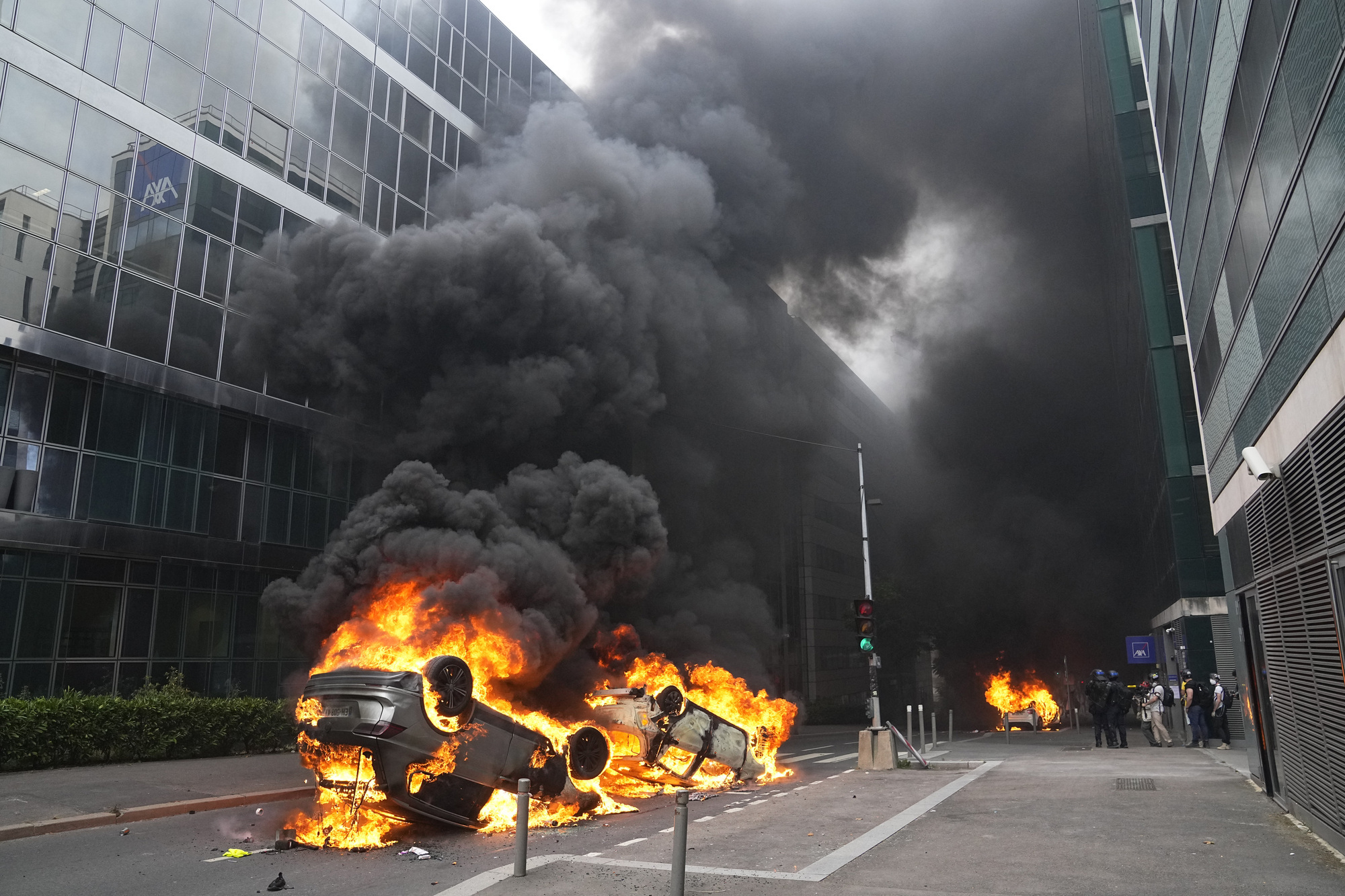
France’s government has vowed to restore order after two nights of violence triggered by the fatal police shooting of a 17-year-old, announcing it will deploy tens of thousands more officers and crack down on neighbourhoods where buildings and vehicles were torched.
Bus and rail services were shutting down early to safeguard transportation workers and passengers, a decision sure to impact thousands of travellers in the French capital and its suburbs.
“Our transports are not targets for thugs and vandals,” tweeted Valerie Pecresse, head of the Paris region.
France’s government said it would deploy 40,000 police officers and take a zero-tolerance approach in neighbourhoods where buildings and vehicles were torched.

Ministers fanned out to areas scarred by the sudden flare-up of rioting, appealing for calm but also warning that the violence that injured scores of police and damaged nearly 100 public buildings would not be allowed to continue.
After a morning crisis meeting, interior minister Gerald Darmanin said policing will be more than quadrupled — from 9,000 officers to 40,000. In the Paris region alone, the number of officers deployed will more than double to 5,000.
“The professionals of disorder must go home,” Mr Darmanin said. While there is no need yet to declare a state of emergency — a measure taken to quell weeks of rioting in 2005 — he added: “The state’s response will be extremely firm.”
The police officer who fired the fatal shot in the Paris suburb of Nanterre will be investigated for voluntary homicide after an initial investigation led local prosecutor Pascal Prache to conclude that “the conditions for the legal use of the weapon were not met”.
The killing of the teenager, identified only by his first name Nahel, came during a traffic stop on Tuesday. The incident captured on video shocked the country and stirred up long-simmering tensions between police and young people in housing projects and other disadvantaged neighbourhoods.

Despite a beefed-up police presence on Wednesday night, violence resumed after dusk with protesters shooting fireworks and hurling stones at police in Nanterre, who fired repeated volleys of tear gas.
As demonstrations spread to other towns, police and firefighters struggled to contain protesters and extinguish numerous blazes.
Schools, police stations, town halls and other public buildings were damaged from Toulouse in the south to Lille in the north — with most of the damage in the Paris suburbs, according to a spokesperson for the national police.
Fire damaged the town hall in the the Paris suburb of L’Ile-Saint-Denis, not far from the country’s national stadium and the headquarters of the Paris 2024 Olympics.
Mr Darmanin said 170 officers had been injured in the unrest but none of the injuries was life-threatening. At least 90 public buildings were vandalised. The number of civilians injured was not immediately released.

Mr Prache, the Nanterre prosecutor, said officers tried to stop Nahel because he looked so young and was driving a Mercedes with Polish licence plates in a bus lane.
He ran a red light to avoid being stopped but then got stuck in a traffic jam. Both officers involved said they drew their guns to prevent him from fleeing.
The officer who fired a single shot said he feared he and his colleague or someone else could be hit by the car, according to Mr Prache. The officers said they felt “threatened” as the car drove off.
Mr Prache requested the officer be held in custody — a decision to be made by a magistrate.

Two magistrates have been named to lead the investigation, Mr Prache said. Under the French legal system, which differs from the US and British systems, magistrates often lead investigations.
Nahel’s surname has not been released by authorities or by his family.
In a separate case, a police officer who fatally shot a 19-year-old Guinean man in western France has preliminarily been charged with voluntary homicide, the local prosecutor said on Wednesday. The man was fatally shot by an officer as he allegedly tried to flee a traffic stop. The investigation is still ongoing.
Scenes of violence in France’s suburbs echo 2005, when the deaths of 15-year-old Bouna Traore and 17-year-old Zyed Benna led to three weeks of nationwide riots, exposing anger and resentment in neglected, crime-ridden suburban housing projects.

The two boys were electrocuted after hiding from police in a power substation in a Paris suburb.
French President Emmanuel Macron held an emergency security meeting on Thursday about the violence.
“These acts are totally unjustifiable,” Mr Macron said at the beginning of the meeting, which aimed at securing hot spots and planning for the coming days “so full peace can return”.
Mr Macron also said it was time for “remembrance and respect” as Nahel’s mother called for a silent march on Thursday that drew a large crowd to the square where he was killed.
Some marchers had “Justice for Nahel” printed on the front of their T-shirts. “The police kill” read one marcher’s placard.
J’ai mal à ma France. 💙🤍💔💔💔
— Kylian Mbappé (@KMbappe) June 28, 2023
Une situation inacceptable.
Tout mes pensées vont pour la famille et les proches de Naël, ce petit ange parti beaucoup trop tôt.
Bouquets of orange and yellow roses now mark the site of the shooting, on Nanterre’s Nelson Mandela Square.
Videos of the shooting shared online show two police officers leaning into the driver-side window of a yellow car before the vehicle pulls away as one officer fires into the window. The videos show the car later crashed into a post nearby.
The driver died at the scene, the prosecutor’s office said.
French football star Kylian Mbappe, who grew up in the Paris suburb of Bondy, was among many shocked by what happened.
“I hurt for my France,” he tweeted.


CONNECT WITH US TODAY



Be the first to know the latest news and updates