Medics seek access to Aleppo amid 'indiscriminate bombing' by Russia and Syria
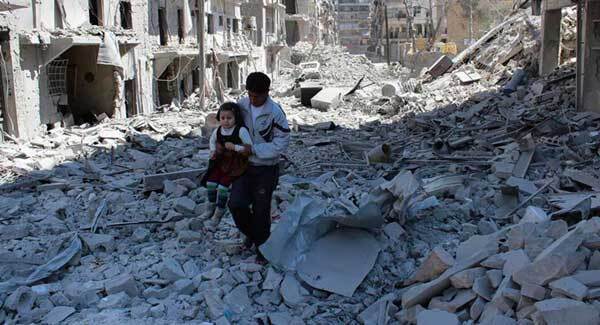
Doctors Without Borders have pleaded for access to treat the wounded in the rebel-held part of Aleppo, as Syrian government forces pressed ahead with an offensive that has killed hundreds of people in recent weeks.
The international charity, also known by its French acronym MSF, said medical workers in Aleppo are exhausted and the overstretched facilities face an impending fuel shortage.
MSF, which supports eight hospitals in Aleppo's besieged eastern quarters, said just 35 doctors remain in the area, serving a population of 275,000.
Eastern Aleppo's Health Directorate said the wounded were sleeping outside overcrowded hospitals, waiting for care.
The UN has warned that the Aleppo bombardment by Syrian and Russian war planes could leave thousands more dead by the end of the year.
"Russia and Syria must stop the indiscriminate bombing now and abide by the rules of war to avoid the extreme suffering of the unprotected civilian population," said Pablo Marco, MSF's operations manager for the Middle East.
The Britain-based Syrian Observatory for Human Rights, which monitors the conflict through local contacts, reported heavy fighting along the east-west Aleppo front lines.
Another activist-run group, the Local Coordination Committees, said rebels were fighting to repel government forces from the city's largest water facility, which serves more than a million people.
In another besieged area near the capital, Damascus, doctors reported up to two dozen cases of kidney failure that they said resulted from malnutrition. Muhammad Darwish, a local physician, said doctors confirmed renal failure in 12 people in the town of Madaya and were investigating another 12 cases.

Government forces have laid siege to Madaya, home to some 40,000 people, since late last year.
Last winter, MSF reported at least 16 deaths there resulting from malnutrition and lack of medical care.
"We are only eating carbohydrates. We aren't receiving any vitamins or protein," said Mr Darwish.
The government has prohibited the UN from delivering seeds or dialysis kits to the town, in what the opposition says is a strategy aimed at forcing the town to surrender.
UN Secretary-General Ban Ki-moon blamed Syrian President Bashar Assad for the bloodshed, saying more than 300,000 people have been killed since the start of the war because of his "failure of leadership".
In an interview with the German broadcaster Deutsche Welle, Mr Ban referenced previous conflicts in which the international community failed to halt mass killings.
This is what the reality is in Aleppo #debate pic.twitter.com/5UAKwpiRC2
— Mic (@mic) October 10, 2016
"We should have prevented Srebrenica. We should have prevented the Rwandan genocide. In Aleppo, we're doing our utmost efforts," he said. "The future of one person, like President Assad, should not block this process."
Earlier, the French foreign minister called on the International Criminal Court to investigate Russia for possible war crimes in Syria.
Jean-Marc Ayrault said: "France intends to get in touch with the prosecutor to find out how the probe can be launched."
Mr Ayrault said France disagrees with Russia's "bombarding" of Aleppo and "is committed as never before to saving the population".
He said the investigation would hinge on Moscow's role in the aerial offensive in the rebel-held eastern part of the city.
On Saturday, Russia blocked a UN Security Council resolution proposed by France and Spain on ending the hostilities.
On Friday, US secretary of state John Kerry called for a war crimes investigation into Russian and Syrian air strikes in Syria - an appeal Russia has angrily rejected.
#Aleppo: Death of a city. Special coverage on the situation in #Syria. Thursday on #SkyNews https://t.co/K4qe34eeFg https://t.co/vrcxdvmvd5
— Sky News (@SkyNews) October 10, 2016