Honduras prison blaze 'could happen again'
Experts have warned a similar disaster to the Honduras prison fire could happen again in Central America.
They say a decade of crackdowns on drug trafficking, gangs and out-of-control street crime has left the region dotted with fire-prone prisons often crammed with more than twice the number of inmates they can safely handle.
The world's worst prison fire in a century happened this week in a lock-up like many in Honduras: a decrepit, suffocating place of dark, overcrowded cell blocks where many inmates were accused only of petty crimes.
They languish for months or even years, as their cases slowly move through backlogged judicial systems.
"You have this tremendous public security crisis and the quick answer that prevailed for all of these years is 'iron fist'," said Jose Miguel Vivanco, Americas director for Human Rights Watch.
"By 'iron fist', you mean increasing penalties, making it more difficult for prisoners to get out of prison."
Honduras implemented laws in 2003 that doubled the maximum jail term for being a gang leader to 12 years. Officials also applied a loose definition of gang leadership, locking people up for having gang tattoos or other signs of apparent criminal affiliation.
That started a wave in Central America, where countries like El Salvador and Guatemala passed their own laws against "Mara" street gangs.
By 2008, the latest year for which figures are available, Honduras' prison system had nearly 38% more prisoners than it was built for, according to the London-based International Centre for Prison Studies.
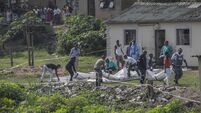
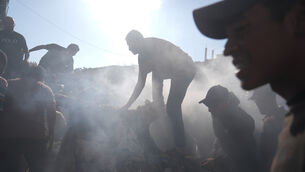
Conditions were ripe for disaster on Tuesday, when a fire started by an inmate raced through the overcrowded Comayagua prison, burning and suffocating 356 screaming people in their locked cells as rescuers desperately searched for the only set of keys to the jail.
Only six guards were on duty, responsible for 852 prisoners, and the guard with the keys fled, leaving hundreds to burn in their cells.
"The conditions at all 25 prisons are really the same as they were in Comayagua," said Renan Inestroza, a congressman with Honduras' governing National Party. "There is tremendous overcrowding.
"The guard personnel in all of the prisons aren't trained in how to handle this type of emergency."
It is the same throughout much of Central America. Prisons in El Salvador are at 253% capacity, according to the International Centre for Prison Studies, and lock-ups in Guatemala at 160%. Panama's prisons are filled with nearly twice as many inmates as they were built for.
"This is a structural problem that we're suffering from in the entire Central American region and it's due to the weakness of our prison policies," Salvadoran president Mauricio Funes said.
"The prisons are overcrowded, they're overpopulated, and this is a warning call."
An inferno like the one at Comayagua - the third deadly prison fire in a decade in Honduras - could happen anywhere in the region, he warned.
In Geneva, Switzerland, the United Nations high commissioner for human rights called for a "thorough independent investigation" into the Comayagua fire.
The UN agency "is concerned that the problems affecting prisons are by no means confined to Honduras", spokesman Rupert Colville said.
"In recent weeks there has been a wave of violence in prisons across Latin America, resulting in loss of lives in Uruguay, Argentina, Venezuela, and Chile," he said.
"These events reflect an alarming pattern of prison violence in the region, which is a direct consequence of, or aggravated by, a range of endemic problems including chronic prison overcrowding; the lack of access to basic services such as adequate floor space; potable water; food; healthcare; and lack of basic sanitary and hygienic standards.
"Such conditions are exacerbated by judicial delays and excessive resort to pretrial detention."
Justice systems in Latin America differ greatly from that of the United States, where defendants are presumed innocent until proven guilty and many cases go before juries. Napoleonic Code-based systems in many Latin American countries require defendants to prove they are not guilty if an investigation results in their arrest.
"A huge reason for the overcrowding is just all these people waiting for trial," said Mark Ungar, a professor of political science at New York's City University Graduate Centre who has visited prisons around the region, including the three in Honduras that were hit with disastrous fires.
He said Honduras was an extreme example of prison dysfunction, where the overcrowding found around the region combined with chaotically bad administration and extreme problems with prison gangs.
"The way they lock them up in these quarters, there's no escape route," he said. "It's an extreme inattention to the physical condition leading up to fire. It's unbelievable how this happened again."
Vilma Nunez, president of the Nicaraguan Centre for Human Rights, said: "The situation in penitentiaries in Central America is very, very serious and comes from overcrowding, lack of security, poor conditions and the inhuman treatment that these people receive from their jailers."
In Brazil, critics say authorities long ago lost control over the activities of the 514,000 inmates in that nation's more-than 1,200 prisons. Jailbreaks are routine as are prison uprisings.
Top drug gang leaders maintain their grip on power in the slums across the nation from behind bars.

CONNECT WITH US TODAY



Be the first to know the latest news and updates