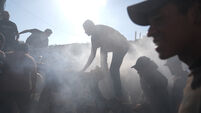
Hunt goes on for quake survivors

Dozens of people remained trapped in mounds of concrete, twisted steel and debris today after the earthquake that struck two Turkish cities.

Hunt goes on for quake survivors

Dozens of people remained trapped in mounds of concrete, twisted steel and debris today after the earthquake that struck two Turkish cities.

At least 270 people died and a thousand more were seriously injured.

Worst-hit was Ercis – an eastern city of 75,000 close to the Iranian border where about 80 multi-storey buildings collapsed.

Yalcin Akay was one of the lucky ones, dug out from a collapsed six-story building with a leg injury after he called a police emergency line on his mobile phone.

Three others, including two children, were also rescued from the same building in Ercis 20 hours after the quake struck.

Rescuers searched for the missing throughout the night under generator-powered floodlights as tearful families members waited by the mounds of debris. Cranes and other heavy equipment lifted slabs of concrete, allowing residents to dig for the missing with shovels.

Aid groups scrambled to set up tents, field hospitals and kitchens to help the thousands left homeless or those too afraid to re-enter their homes.

Over 100 aftershocks rocked the area morning, with three of them reaching 4.7 magnitude, after another 100 aftershocks reverberated on Sunday.

The bustling, larger city of Van, about 55 miles south of Ercis, also sustained substantial damage, but Interior Minister Idris Naim Sahin said search efforts there were winding down.

He expected the death toll in Ercis to rise, but not as much as initially feared. He said rescuers were searching for survivors in the ruins of 47 buildings – including a cafe where dozens could be trapped.

“There could be around 100 people (in the rubble). It could be more or it could be less But we are not talking about thousands.”

Prime Minister Recep Tayyip Erdogan said “close to all” mud-brick homes in surrounding villages had collapsed in the tremor that also rattled parts of Iran and Armenia.

In Ercis, a team specialising in mine disaster rescue combed through the rubble of a student dormitory.

The terrifying moments of the powerful quake still haunted many.

“I was in the street and saw the buildings sway,” Hasan Ceylan, 48, surveying the wreckage of his three businesses, including a grocery store and a veterinary clinic.

Abubekir Acar, 42, was sipping tea with his friends across from a coffee house that was levelled.

“We did not understand what was going on, the buildings around us, the coffee house all went down so quickly,” he said. “For a while, we could not see anything – everywhere was covered in dust. Then, we heard screams and pulled out anyone we could reach.”

The government said it would offer favourable loans to help rebuild small businesses.

Authorities advised people to stay away from damaged homes, warning they could collapse in the aftershocks. Exhausted residents began sheltering in tents, some set up inside a sports stadium, after many spent the night outdoors lighting fires to keep warm. Others sought shelter with relatives in nearby villages.

More than 2,000 teams were involved in search-and-rescue and aid efforts, using around a dozen sniffer dogs.

Several countries offered assistance but Mr Erdogan said Turkey was able to cope for the time being.

Countries around the world conveyed their condolences and offered assistance.

Turkey lies in one of the world’s most active seismic zones and is crossed by numerous fault lines.

In 1999, two earthquakes with a magnitude of more than 7 struck north-western Turkey, killing about 18,000 people.

More recently, a 6.0-magnitude quake in March 2010 killed 51 people in eastern Turkey, while in 2003, a 6.4-magnitude earthquake killed 177 people in the south-eastern city of Bingol.

More in this section

Cookie Policy Privacy Policy Brand Safety FAQ Help Contact Us Terms and Conditions

© Examiner Echo Group Limited