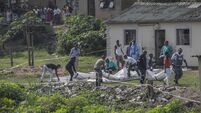
Turkish quake death toll continues to climb

The death toll in a powerful earthquake in eastern Turkey has risen to at least 217, the country’s interior minister said.

Turkish quake death toll continues to climb

The death toll in a powerful earthquake in eastern Turkey has risen to at least 217, the country’s interior minister said.

Idris Naim Sahin said that 117 people had died in the city of Ercis, while some 100 were killed in the city of Van.

Another 140 people have been injured.

Mr Sahin said 80 multi-story buildings had collapsed in Ercis with people trapped inside 40 of them.

The 7.2-magnitude earthquake struck the region, collapsing dozens of buildings into piles of twisted steel and chunks of concrete.

Rescue teams are sifting through heaps of rubble from flattened multi-story buildings trying to reach dozens of people believed trapped.

Hundreds of rescue teams dug through the night in search of survivors while residents also searched for their missing loved ones as aid groups scrambled to set up tents, field hospitals and kitchens to assist the thousands of people left homeless.

Officials said hundreds of mud-brick homes in villages and concrete buildings in cities came down in the earthquake that struck the province of Van, near the border with Iran, on Sunday.

Worst-hit was the city of Ercis, where about 80 multi-story buildings collapsed.

Mr Sahin said some 40 buildings in Ercis still had people trapped inside, giving rise to fears that the death toll could increase substantially.

Prime minister Recep Tayyip Erdogan said “close to all” of the mud-brick homes in surrounding villages had collapsed.

Ercis, an eastern city of 75,000, is in one of Turkey’s most earthquake-prone zones. The bustling, larger city of Van, about 55 miles south of Ercis, also sustained substantial damage, and roads in the area caved in.

Some inmates escaped from a prison in Van after one of its walls collapsed. TRT television said around 150 inmates had fled, but a prison official said the number was much smaller and many later returned.

The quake also damaged some buildings in the town of Patnos, some 30 miles north-west of Ercis, where military and Red Crescent trucks were seen transporting tents and other aid equipment.

US scientists recorded more than 100 aftershocks in eastern Turkey within 10 hours of the quake, including one with a magnitude of 6.0.

Authorities advised people to stay away from damaged homes, warning they could collapse in the aftershocks.

Many residents spent the night outdoors and lit campfires, while the Red Crescent began setting up tents in a stadium. Others sought shelter with relatives in nearby villages.

Around 1,275 rescue teams from 38 provinces were being sent to the region, officials said, and troops were also assisting search-and-rescue efforts.

Several countries offered Turkey humanitarian aid and assistance with search-and-rescue efforts but Mr Erdogan said Turkey was able to cope for the time being. Azerbaijan, Iran and Bulgaria nevertheless sent assistance, he said.

Among those offering help were Israel and Greece. The offer from Israel came despite a rift in relations following a 2010 Israeli navy raid on a Gaza-bound aid flotilla that left nine Turks dead.

Greece, which has a deep dispute with Turkey over the divided island of Cyprus, also offered to send in a special earthquake rescue team.

Turkey lies in one of the world’s most active seismic zones and is crossed by numerous fault lines.

In 1999, two earthquakes with a magnitude of more than seven struck north-west Turkey, killing about 18,000 people.

More recently, a 6.0-magnitude quake in March 2010 killed 51 people in eastern Turkey, while in 2003, a 6.4-magnitude earthquake killed 177 people in the south-east city of Bingol.

More in this section

Cookie Policy Privacy Policy Brand Safety FAQ Help Contact Us Terms and Conditions

© Examiner Echo Group Limited