Libya: Shelling goes on despite ceasefire
Libyan government forces battered the rebel-held city of Misrata with artillery today despite Muammar Gaddafi earlier accepting a cease-fire deal.
After getting apparent agreement with the dictator, an African Union delegation took its proposal to the rebelsâ eastern stronghold and was met with protests by crowds opposed to any peace until Gaddafi gives up power.
More than 1,000 people waved the pre-Gaddafi flags that have come to symbolise the rebel movement and chanted slogans outside a Benghazi hotel. They said they had little faith in the visiting African Union mediators, most of them allies of Gaddafi who are preaching democracy for Libya but do not practice it at home.
The negotiators met Gaddafi late yesterday in the capital, Tripoli, and said he accepted their proposal for a cease-fire with the rebels that would also include a halt to the three-week-old international campaign of airstrikes.
However, an Algerian representative of the delegation was vague on whether the proposal includes a demand for Gaddafi to give up power and would only say that the option was discussed.
The protesters in Benghazi and the opposition leadership based in the city are demanding that Gaddafi step down immediately.
âOn the issue of Gaddafi and his sons, there is no negotiation,â said Ahmed al-Adbor, a member of the oppositionâs transitional ruling council.
Italian Foreign Minister Franco Frattini supported that position.
âThe sons and the family of Gaddafi cannot participate in the political future of Libya,â he said, adding that Gaddafiâs departure would have to happen âin parallelâ with any ceasefire.
He said he was lobbying allies to arm the rebels but that he was against expanding the international operation to include ground forces.
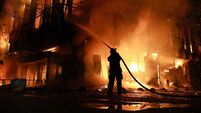
A few hours after the AU announcement in Tripoli, Gaddafiâs forces began bombarding the port in the Mediterranean city of Misrata, the only major city in the western half of Libya that remains under partial rebel control. Fierce fighting has raged there for weeks.
A doctor there said the shelling began overnight and continued intermittently throughout the day. He said six people were killed in residential areas.
Gaddafi has not kept a cease-fire he immediately declared after international airstrikes were authorised last month. He has also rejected demands from the rebels, the United States and its European allies that he relinquish power immediately.
After the talks with Gaddafi late Sunday, the AU delegation said he accepted their âroad mapâ for a cease-fire.
The secretary general of Nato, which took over control of the air operation from the US, said that any cease-fire must be credible and verifiable.
âThere can be no solely military solution to the crisis in Libya,â Anders Fogh Rasmussen said. âNato welcomes all contributions to the broad international effort to stop the violence against the civilian population.â
Nato airstrikes largely stopped heavy shelling by government forces of the eastern city of Ajdabiya â a critical gateway to Benghazi, the oppositionâs de facto capital and Libyaâs second largest city.
Rebels held positions at the western gates of the city, on the fringes of desert littered with bullet casings, scraps of metal and more than a dozen blackened or overturned vehicles, including tanks and pickup trucks outfitted with anti-aircraft guns.
Gaddafi enjoys substantial support from countries of the AU, an organisation that he chaired two years ago and helped transform using Libyaâs oil wealth.
Although the AU has condemned attacks on civilians, last week its current leader, Equatorial Guinea President Teodoro Obiang Nguema, decried foreign intervention in Libyaâs nearly two-month-old uprising, which he declared to be an internal problem.