Final push to unseat Gbagbo
Fighters trying to install Ivory Coast’s democratically-elected president descended on its largest city and seat of power, poised for a final push to oust the entrenched ruler.
Forces backing Alassane Ouattara have overrun nearly 80% of the country as soldiers fled and towns fell in quick succession.
The regular army put up almost no resistance during the four-day offensive, including in the ruler’s home town, where fighters broke into Laurent Gbagbo’s compound and slept in his bed.
But they may face fierce resistance on the peninsula where the presidential palace is located, surrounded on all sides by a natural moat – Abidjan’s glassy lagoon.
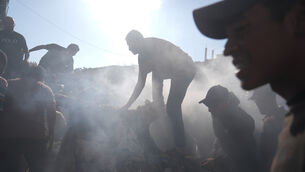
Gunfire could be heard throughout the day, along with the concussive boom of heavy artillery. Reporters saw soldiers in camouflage race across the waterside highway in pick-up trucks mounted with machine guns.
United Nations peacekeepers moved to secure the Abidjan airport by sending armed elements and additional staff there, a peacekeeping official in New York said.
Sources said Gbagbo’s forces requested the UN support to allow their withdrawal.
As his forces amassed on the outskirts of Abidjan, Mr Ouattara made a final appeal to Gbagbo to step down and called on the rest of the army to defect.
“(My fighters) have come to restore democracy and ensure respect of the vote by the people ... Today they are at the doorstep of Abidjan,” he said in an address broadcast on his private TV station.
“To all those who are still hesitating, whether you are generals, superior officers, officers, sub-officers, rank-and-file ... there is still time to join your brothers-in-arms.”
As the columns of pro-Ouattara forces advanced, the head of the army, General Phillippe Mangou, sought refuge at the home of the South African ambassador in Abidjan with his wife and five children, South Africa’s foreign ministry said.
By mid-afternoon, as many as 50,000 soldiers, police and gendarmes had abandoned Gbagbo, according to the head of the United Nations mission, Choi Young-jin.
“Only the Republican Guard and his special forces have remained loyal,” guarding the palace and residence, he told France-Info.
Mr Ouattara was declared the winner of last November’s presidential election by the country’s election commission in results verified by international observers. But after a decade in power, Gbagbo refused to accept his loss.
He has used the military to attack pro-Ouattara areas with heavy-artillery and is accused of arming citizen militias and recruiting foreign mercenaries to defend his grip on power.
Up to one million people have fled the fighting and at least 490 people have been killed since the election, most of them supporters of Mr Ouattara.
Gbagbo has not been seen in public since this week’s military offensive began, even though state TV announced on Wednesday that he was preparing to address the nation.
Those who know him well say even an armed onslaught will not make Gbagbo cede power.
“He has no intention of resigning,” said one of his advisers in Europe, Toussaint Alain. “He will not resign in the wake of this attack. He is not going to abdicate. He is not going to lay down his arms. He will stay in power to lead the resistance to this attack against Ivory Coast.”
But a senior diplomat who has been in contact with members of Gbagbo’s inner circle said a stand-off appeared to be building between hardliners who want Gbagbo to fight to the end and others urging him to step down.
It is not clear what the pro-Ouattara fighters will do if they manage to reach the presidential palace. Mr Ouattara’s spokesman, Patrick Achi, refused to speculate, but said the use of force was necessary because Gbagbo had frustrated all attempts to find a diplomatic solution.
“The end is almost here. It’s a matter of hours,” he said. “We issued our ultimatum yesterday ... If Gbagbo does not want the fighting to happen in Abidjan he should surrender. If he doesn’t, we have no choice.”
In the four months since the disputed election, the international community has repeatedly offered Gbagbo a golden parachute, only to be rebuffed. He twice refused to take a phone call from US president Barack Obama, who offered him a teaching position at a Boston university if he agreed to peacefully step aside.
During this time, Mr Ouattara pleaded with world leaders asking for a military intervention to oust the defiant leader. Although the United Nations passed resolutions allowing its peacekeepers to intervene to protect civilians, pro-Ouattara neighbourhoods like Abobo and Anyama continued to be pummelled with mortars.
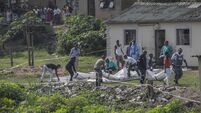
So many people were killed the local mortuary began stacking corpses on the floor because it had run out of space.
Yesterday UN secretary general Ban Ki-moon reiterated his demand that Gbagbo immediately cede power to Mr Ouattara “to enable the full transition of state institutions to the legitimate authorities”, said his spokesman Farhan Haq.
In Washington, the top American diplomat for Africa, Johnnie Carson, said Gbagbo needed to seize this last opportunity to step aside.
“There is a clear indication that the military forces of Gbagbo have started to disintegrate,” he said.
“The rapid pace at which Alassane Ouattara’s forces have been able to move across the country from east to west and up to Abidjan suggests that there have been widespread desertions in the Gbagbo forces.”

CONNECT WITH US TODAY



Be the first to know the latest news and updates