Eighteen die in battle for Libyan rebel city
Muammar Gaddafi’s forces have launched a powerful attack in a bid to recapture a rebel-held city in fierce fighting which left at least 18 people dead.
The casualties of the fighting in Zawiya, the closest opposition-held city to the Libyan capital Tripoli, included the city’s top rebel commander – an army colonel who defected.
In Tripoli, Gaddafi loyalists fired tear gas and live ammunition to halt a new outbreak of protests.
To the east, rebels advanced on an oil port along the Mediterranean coast in their first offensive against Gaddafi’s military.
Explosions were heard as the two sides battled around the air strip at Ras Lanouf, residents said.
The fighting underlined how both sides are pushing against the deadlock that has gripped Libya’s 18-day-old upheaval.
The rebellion has broken away the entire eastern half of the country from Gaddafi’s control and has swept over several cities in the west close to the capital.
So far, Gaddafi has had little success in taking back territory, with several rebel cities repelling assaults in the past weeks.
But the opposition forces have seemed unable to go on the offensive to march on areas still under. Meanwhile, in Tripoli – Gaddafi’s most important bastion - his loyalists have waged a campaign of terror to ensure that protesters do not rise up in significant numbers.
Today’s assault on the rebel city of Zawiya, about 30 miles west of Tripoli, appeared to be the strongest yet by Gaddafi’s forces after repeated earlier forays against it were beaten back.
In the morning, troops from the elite Khamis Brigade – named after the son of Gaddafi who commands it – bombarded the city’s western edges with mortars, heavy machine guns, tanks and anti-aircraft guns, several residents said.
By the evening, they had also opened a front on the eastern side. Armed Zawiya citizens backed by allied army units were fighting back.
The commander of the rebel forces – Hussein Darbouk – was shot dead by fire from an anti-aircraft gun, said Alaa al-Zawi, an activist in the city.
A witness who was at Zawiya’s hospital said at least 18 people in the city were killed and 120 wounded. Libyan state TV claimed the attackers had retaken the city.
But al-Zawi, the witness and other residents said it remained in opposition hands, with skirmishes continuing after nightfall.
The day’s other fighting took place at Ras Lanouf, a small oil port 380 miles east of Tripoli, just outside the long swathe of eastern Libya controlled by the opposition.
Rebels attacked Ras Lanouf feeling flush with victory after repelling Gaddafi forces who attacked them days earlier at Brega, a larger oil facility just to the east.
Fighters armed with Kalashnikovs and heavy machine guns were seen streaming in pickup trucks and other vehicles from Brega heading in the direction of Ras Lanouf.
They battled with about 3,000 pro-Gaddafi troops, mainly around the facility’s airstrip, said a resident of the town.
She reported heavy explosions starting around 4 pm. As night fell, the explosions eased, she said, but it was not clear who was in control of the complex, which includes a port and storage facilities for crude coming from fields in the deserts to the south.
In Tripoli, pro-Gaddafi forces have carried out a wave of arrests against suspected demonstrators, snatching some from their homes in night-time raids, instilling fear in the most restive neighbourhoods.
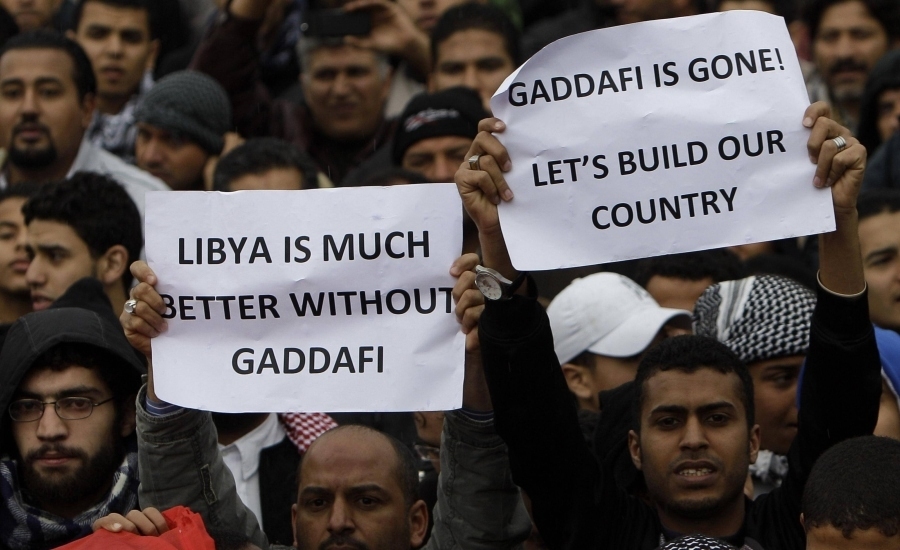
In the latest opposition attempt, more than 1,500 protesters marched out of the Murad Agha mosque after noon prayers today in the Tripoli district of Tajoura, chanting “the people want to bring the regime down” and waved the red, black and green flag of Libya’s pre-Gaddafi monarchy, adopted as the banner up the uprising.
But pro-Gaddafi forces quickly moved in. They fired volleys of tear gas and - when the marchers continued – opened fire with live ammunition, according to witnesses.
It was not clear if they fired at the crowd or into the air, but the protesters scattered, many of them taking refuge back in the mosque, according to an Associated Press reporter at the scene. A doctor said several people were wounded and taken to a nearby hospital.
“All these people are threatened with death,” said a 35-year-old among the Tajoura protesters. “We have no education, no economy, no infrastructure. ... We want nothing but the end of the regime. We were born free but he is suppressing us.” He said he had recently had kidney surgery, but “look at me, still I went out with the people because we are oppressed people.”
“I am not afraid,” said another man in the march. “We want to show the world that we are not afraid.”
The fear seemed to have had an impact, and some protests in other parts of the capital did not get off the ground. One resident said he went to prayers at a mosque and found police officers standing outside to ensure no one marched. After prayers, the worshippers dispersed without protests.
Instead, dozens of Gaddafi supporters turned up for a counter-demonstration in Tripoli’s central Green Square, waving green flags.
Ahead of the planned protests, internet services, which have been spotty throughout Libya’s upheaval, appeared to be halted completely in Tripoli.
Google’s transparency report, which shows traffic to the company’s sites from various countries, showed that internet traffic had fallen to zero in Libya.
Libyan authorities briefly barred many foreign journalists from leaving their hotel in Tripoli, claiming it was for their protection because they had information “al-Qaida elements” plan to open fire on police to spark clashes. They later allowed them to go out into Tripoli.
Several hours before prayers, security forces began to take up positions. In Tajoura, police set up two checkpoints on the main highway.