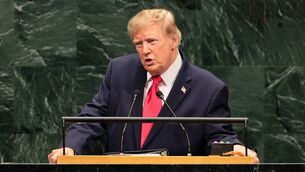
Obama reaches out to Muslims in boyhood home
US president Barack Obama told the Muslim nation that was his boyhood home that American relations with the Islamic world were still frayed, but urged all sides to look beyond “suspicion and mistrust” to forge common ground against terrorism.
Forcefully returning to a theme he sounded last year in visits to Turkey and Egypt, Mr Obama said in Indonesia: “I have made it clear that America is not and never will be at war with Islam. ... Those who want to build must not cede ground to terrorists who seek to destroy.”
Beaming with pride, he delivered perhaps the most intensely personal speech of his presidency, speaking phrases in Indonesian to a cheering crowd of young people who claimed him as their own.
“Let me begin with a simple statement: Indonesia is part of me,” he said in Indonesian during a morning speech at the University of Indonesia in Jakarta.
He praised the world’s most populous Muslim nation for standing its ground against “violent extremism” and said: “All of us must defeat al Qaida and its affiliates, who have no claim to be leaders of any religion. ... This is not a task for America alone.”
Seeking to cement relations with fast-growing Asian trading partners, Mr Obama also paid tribute to the economic dynamism of the region at a time of global financial stress.
“America has a stake in Indonesia that is growing, with prosperity that is broadly shared among the Indonesian people – because a rising middle class here means new markets for our goods, just as America is a market for yours,” he said.
The speech came before a meeting of the G20 major economic powers that begins tonight in Seoul, South Korea, a session expected to be marked by trade tensions between the US and major exporting nations such as China and Germany.
Earlier in Jakarta, Mr Obama visited the Istiqlal Mosque, the largest in south-east Asia – one that he noted was under construction when he lived in Indonesia as a boy from 1967 to 1971.
“Because Indonesia is made up of thousands of islands, hundreds of languages, and people from scores of regions and ethnic groups, my times here helped me appreciate the humanity of all people,” he said.
The president’s brief but nostalgic visit to his boyhood home lent an unusually personal tone to the speech, a portion of which he devoted to his childhood there.
Mr Obama reminisced about living in a small house with a mango tree at the front, and learning to love his adopted home while flying kites, running along paddy fields, catching dragonflies and buying such delicacies as satay and baso from street sellers.
He spoke of running in fields with water buffalo and goats and the birth of his sister Maya, who is half Indonesian.
Mr Obama moved to Indonesia when he was six and lived with his mother Stanley Ann Dunham and Indonesian stepfather Lolo Soetoro.
“While my stepfather, like most Indonesians, was raised a Muslim, he firmly believed that all religions were worthy of respect,” Mr Obama said.
Mr Obama, a Christian, attended state and Catholic schools while in Indonesia. He returned to Hawaii when he was 10 to live with his grandparents.
The president’s homecoming had been twice-delayed – first because of his health care legislative battle and then because of the BP oil spill.
And this trip was being cut short, too, so Air Force One could take off ahead of a big cloud of ash from the erupting Indonesian volcano Mount Merapi.
Reaching out to the Islamic world, Mr Obama said efforts to build trust and peace were showing promise but were still clearly incomplete.
“Relations between the US and Muslim nations have been frayed over many years. As president, I have made it a priority to begin to repair these relations,” he said.
He said a choice must be made by both sides. “We can choose to be defined by our differences and give in to a future of suspicion and mistrust. Or we can choose to do the hard work of forging common ground and commit ourselves to the steady pursuit of progress,” he said.
Mr Obama praised Indonesia for having “made progress in rooting out terrorists and combating violent extremism”.
Noting that the path from colonial rule to democracy had been a rocky one, he said: “Of course, democracy is messy.”
And, just over a week after seeing his own Democratic Party suffer bruising mid-term election defeats in the US Congress, he added: “Not everyone likes the results of every election. You go through ups and downs. But the journey is worthwhile.”
CONNECT WITH US TODAY



Be the first to know the latest news and updates