Turkish police hunt for bombers
Turkish authorities were today trying to establish the identity of bombers who killed 17 people in blasts at a crowded Istanbul square.
Officials blamed the deadly explosions on Kurdish rebels, but Kurdish militants have denied any involvement.
Prime Minister Recep Tayyip Erdogan served as a pallbearer yesterday as a crowd surged around 10 coffins draped in the red and white Turkish flag at a mosque in Gungoren, a residential district near Istanbul's international airport that houses many poor migrants.
Mr Erdogan said the Sunday night bombings appeared to be in revenge for the Turkish military's air raids on the rebel Kurdistan Workers' Party, or PKK, strongholds in northern Iraq.
Some analysts agreed, even though rebels themselves denied involvement and an investigation was ongoing.
The deadliest attack against civilians in Turkey in five years could benefit militants by sowing more suspicion among Turkey's feuding power circles.
Nobody has claimed responsibility however, and Turkey is home to a variety of violent groups besides the PKK, including Islamic extremists and alleged coup plotters with ties to the secular establishment.
The PKK attributed the attack to "dark forces", an apparent reference to hardline Turkish nationalists who allegedly seek to foment chaos in order to strengthen the political influence of the military.
"The Kurdish freedom movement has nothing to do with this event, this cannot be linked to the PKK," pro-Kurdish news agency Firat quoted rebel leader Zubeyir Aydar as saying.
"We think this attack was carried out by dark forces. We extend our condolences to the families of the victims and to the Turkish people."
Sinan Ogan, head of the Turkish Centre for International Relations and Strategic Analysis in Ankara, said Gungoren was a "softer target" for the PKK than more central parts of Istanbul with more security.
"Al-Qaida, for example, wants more international targets, like a multinational company or a consulate," he said. "I think PKK is trying to say to Turkish officials: 'Look, we can hit you in bigger cities as well. We are already hitting you with land mines in the southeast, but this is not limited to that region'."
Mr Erdogan said the bombings represented Turkey's "heavy" costs for its cross-border attacks on Kurdish rebels in Iraq. He urged Turks not to back political parties that "support terrorism", an indirect criticism of the Democratic Society Party, a pro-Kurdish group believed to be heavily influenced by the PKK.
The US and EU say the PKK, which seeks autonomy for Kurds, is a terrorist organisation.
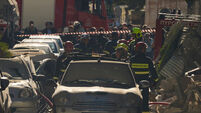
The bombings were unusual in their apparent aim to cause as many civilian casualties as possible with no government or strategic target. Authorities said the vast majority of the 17 deaths and 150 injuries occurred when a curious crowd gathered after an initial, small blast. Then, a second, larger bomb exploded.
Mr Erdogan said 100 of the injured were later released from hospitals.
Five of the dead were children. Anatolia news agency said one victim was a 12-year-old girl who rushed with her parents to the balcony of their apartment to see what was going on after the first explosion.
The Cihan news agency said the second bomb consisted of a plastic explosive of the same kind used in a suicide attack in Ankara in May last year that killed seven people. That attack was blamed on the PKK.
Sunday's attack was the country's worst since November 20, 2003, when al-Qaida linked suicide bombings struck the British Consulate and a British bank, killing at least 30 people. Five days earlier, suicide truck bombs attacked two Istanbul synagogues, killing 27.
On July 9, gunmen opened fire on police guarding the US Consulate in Istanbul, killing three officers. Three attackers also died in a shootout with police. Authorities were investigating whether the gunmen were inspired by al-Qaida.