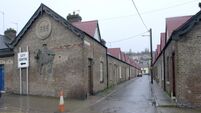
Dungeon father 'boasted of house making history'
An Austrian man who held his daughter captive for 24 years and fathered her seven children repeatedly warned his captives that they would be gassed if they tried to overpower him, investigators said today.
The news comes as a man claiming to be a former tenant says Josef Fritzl had also boasted his house would one day go down in history.
Separately, authorities said Fritzl forced his captive daughter to write a letter last year indicating he may have been planning to release her from the windowless dungeon where she lived with three of their children.
Police spokesman Franz Polzer said Elisabeth Fritzl wrote to her family, who believed she had fled to a cult, that she wants to come home but "it's not possible yet".
DNA testing on the letter proved that 42-year-old Elisabeth had written the letter, but Mr Polzer said she was forced by her father to do so.
"He may have had plans to end the captivity at some point," Mr Polzer said today, adding: "It just shows how perfectly he planned everything."
A man claiming to be a former tenant of Fritzl's, meanwhile, said he heard occasional suspicious noises from the area of confinement during his 12 years of residency starting in 1995.
Alfred Dubanovsky told AP news agency that that he occasionally heard "knocking, banging" and what sounded like objects being dropped while living in a ground floor apartment of the building owned by Josef Fritzl and above the basement dungeon.
He told the AP that he asked Fritzl whether the noise came from the basement gas heater and Fritzl said "yes".
On another occasion, Fritzl bragged: "This house is going to make history one day," Mr Dubanovsky said.
Fritzl's elaborate crime came to the attention of authorities on April 19 when one of Elisabeth's daughters, 19-year-old Kerstin, was admitted to a hospital suffering from an illness linked to an unidentified infection.
Baffled doctors then appealed on TV for Kerstin's mother to come forward because they needed information from her about her daughter's medical history. Fritzl then accompanied Elisabeth to the hospital, and her story came to light.
"It shows that he must have had a spark of humanity," Mr Polzer said.
Meanwhile, Federal Bureau of Investigations spokesman Helmut Greiner said investigators were checking to verify whether Fritzl had indeed set up a mechanism that could send gas into the enclosure as he had claimed during initial police questioning.
Experts are also checking another Fritzl claim that the reinforced door leading to the enclosure had a timer that enabled it to open automatically or be easily opened from the inside if he was gone for an unusually long period of time, said Mr Greiner.
Fritzl told all residents of the apartment house that the basement was off limits and that they were not allowed to take photos in the area, Mr Dubanovsky said, adding that Fritzl threatened to evict those who broke that verbal agreement.
Fritzl once asked him whether he wanted to change his ground-floor flat for a bigger one on the upper floor but he declined, Mr Dubanovsky said.
Days before Elisabeth told police of her 24 years in captivity, law enforcement officials had become suspicious and started investigating Fritzl, according to a police statement.
It said police decided to compare DNA samples of the hospitalised Kerstin and of Fritzl, along with family members living with him in late April, about 10 days before revealing the ordeal to the public.
Fritzl and Elisabeth were detained April 26 near the hospital where Kerstin was being treated and Elisabeth then told her story to interrogators.
The letter is one part of evidence that authorities are using to piece together Josef Fritzl's double life.
One of the children she bore him died, and Fritzl has confessed to tossing the body into a furnace. He managed to smuggle the other three out to be raised by him and his wife, who was led to believe Elisabeth had given them up.
Police in Upper Austria are also examining whether Fritzl was also responsible for an unsolved murder in the nearby lakeside village of Mondsee two decades ago, where his wife owned an inn and camping ground.
The bound body of Martina Posch was found on a shore of the Upper Austrian lake of Mondsee on November 12, 1986.

CONNECT WITH US TODAY



Be the first to know the latest news and updates