Bridge collapse toll could stay steady at five
A rush-hour crawl that gave vehicles little momentum to slide into the river and a bridge design that minimised falling debris appear to have kept the death toll relatively low in the collapse of a bridge into the Mississippi River.
After divers spent a second day searching the waters, the number of dead stood at five, and authorities cast doubt on an earlier estimate that as many as 30 people were missing. They said it could in fact be as few as eight.
Divers were preparing today to resume their search for cars and bodies in the swirling, muddy currents. President George W Bush was also scheduled to visit, with a flyover of the site.
Of the roughly 100 injured in Wednesday’s collapse, 28 remain hospitalised and five were critically ill.
“We were surprised that we didn’t have more people seriously injured and killed,” Minneapolis Fire Chief Jim Clack said. “I think it was something of a miracle.”
Clack cited the bridge design, a quick response by rescue crews and the slow speed of traffic.
In addition, experts say the speed and depth of the water in the Mississippi River were much lower than normal on the day of the collapse – largely the result of a drought. That may have made it easier for people to escape the disaster.
“It’s a horrible, tragic event. But it could have been a hell of a lot worse,” said Kent Harries, assistant professor of civil and environmental engineering in the University of Pittsburgh’s School of Engineering.
Minnesota officials say they do not yet know how many cars were travelling the span during the collapse. But judging by the length of road, the lanes that were open, time of day and widely accepted traffic formulas, Northwestern University engineering professor Joseph Schofer estimated that between 100 and 150 vehicles were on the bridge.
Despite the low death toll, divers were still contending with a treacherous combination of sunken cars, broken cliffs of concrete and jagged rebar as they searched for bodies.
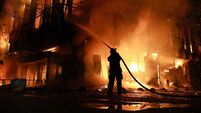
Firefighters pulled the fifth victim, the driver of a tractor-trailer that was engulfed in flames, from the wreckage late Thursday. Video of the burning rig - nose down in the crevasse between two broken concrete slabs – was among the most compelling images shown in the immediate aftermath of the collapse. The driver was identified as Paul Eickstadt, 51.
Early in the day, authorities said as few as eight people were still missing. However, they cautioned later that number could rise, in part because there was no way to know how many victims were in the water. Some people without family in the area may not have been reported missing, said Police Lt Amelia Huffman, a spokeswoman.
The missing included a 23-year-old pregnant woman and her 2-year-old daughter, who was in the back seat of the family’s car when the bridge crumbled.
Sadiya Sahal, an immigrant from Somalia, called her family at 5.30pm saying she was stuck in traffic, said Omar Jamal, executive director of the Somali Justice Advocacy Centre. That was her last phone call. “Her husband is destroyed. He’s in shock,” Jamal said.
Authorities still do not know what caused the 6.05pm collapse. Engineers had theories including heavy traffic and construction work that might have put an undue burden on the span. The bridge was deemed “structurally deficient” by the federal government as far back as 1990.
Minnesota transportation officials spent another day dealing with scrutiny arising from reports and inspections over the years that raised alarm about the bridge, including rust-eaten steel beams, missing bolts and cracks in the welding that held load-bearing parts together.
A consulting company that thoroughly examined the bridge noted that one possible fix – steel plating of fractures – carried a “relatively high cost,” according to a January report. Transportation officials deny that cost pressures swayed their decisions.
Authorities and engineers agree that the truss-style design of the bridge played a big role in saving lives. The steel that supported the bridge was below the structure – as opposed to above the span in more traditional bridge designs.
“I think that was a lifesaving feature,” Schofer said. “They had this huge advantage. They weren’t crushed by steel.”
Even though the collapse occurred during rush hour, the heavy traffic was an advantage because the cars were almost stopped and did not have much momentum, Clack said. Because of that, the collapse was less likely to hurl moving cars into the river.
“They didn’t have forward velocity,” he said, “so when the bridge fell, they went straight down.”
Scott Bratten, who regulates locks and dams on the river for the local district of the Army Corps of Engineers, said that because of the drought in Minnesota, the water at the time of the collapse was flowing at just a third of its normal speed.
That may have made it easier for people in cars to escape them, and it almost certainly made it easier for rescuers to make their way into the water and help the dazed and injured.
“During the spring it’s a raging torrent in there and it would be a very dangerous place,” said Whitney Clark, executive director of Friends of the Mississippi River. “The low water I’m sure was a factor in not making currents very much of an issue. If this had happened during the spring snowmelt or something it would have been a much different situation.”
CONNECT WITH US TODAY



Be the first to know the latest news and updates