Warplanes pound Beirut
Israeli warplanes pounded Beirut’s southern suburbs and other parts of Lebanon early today, local media reported.
Airstrikes on the capital’s southern suburbs, a Hezbollah stronghold, began just before 1am local time (10pm Irish time Thursday), causing two huge explosions. Yesterday, Israeli aircraft dropped leaflets on the area warning people to leave.
Fighter planes appeared to focus on the southern suburb of Ouzai, making 24 pre-dawn over-flights in less than an hour, local media outlets said.
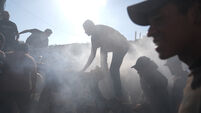
Lebanon’s independent New TV aired footage of huge fires raging against the night sky in several locations in the suburb. A road in the area runs parallel to one of Beirut airport’s runways, but it wasn’t immediately apparent what the warplanes targeted.
The attacks on Ouzai, a predominantly Shiite Muslim area, were the first since fighting between Hezbollah and Israel began 24 days ago. At daybreak, New TV reported two additional strikes on the area, airing footage of smoke billowing from buildings.
The capital’s southern suburbs have been the target of repeated Israeli attacks since fighting began July 12.
Israeli jets launched three attacks near Baalbek in eastern Lebanon, Hezbollah’s TV, Al-Manar, and witnesses reached by telephone said.
Another airstrike was launched near the Lebanese-Syrian border crossing at Masnaa, east of Beirut, the Voice of Lebanon radio said.
The Israeli military confirmed airstrikes on Hezbollah targets across Lebanon, but did not give specific locations.
The Lebanese Broadcasting Corporation television station reported that Israeli warships shelled the southern suburbs of Haret Hreik and al-Ruweis.
Hezbollah leader Hassan Nasrallah, in a speech televised yesterday, offered to halt rocket attacks on Israel in return for an end to the air attacks. He also threatened to launch missiles at Tel Aviv if Israel attacks Beirut proper.
Israeli ambassador to the United Nations, Dan Gillerman, told CNN that Nasrallah’s suggestion for a halt to the rocket attacks was “a sign of weakness,” suggesting that Hezbollah’s leader, “may realize that his forces are being degraded and looking for a way out.”
On Nasrallah’s threats against Tel Aviv, Gillerman said, ”I am sure that he, as well as his sponsors, realize the consequences of doing something as unimaginable and crazy as that.”
CONNECT WITH US TODAY



Be the first to know the latest news and updates