Emergency talks as East Timor crisis continues

East Timor’s government showed signs of unravelling today, as desperate residents scuffled over scarce food in the capital and looters defied foreign peacekeepers sent to restore order.

Emergency talks as East Timor crisis continues

East Timor’s government showed signs of unravelling today, as desperate residents scuffled over scarce food in the capital and looters defied foreign peacekeepers sent to restore order.

Jose Ramos Horta, the country’s Nobel Peace Prize-winning foreign minister, acknowledged the government had “failed miserably” to prevent the country’s descent into chaos in the past week.

He directed the blame towards prime minister Mari Alkatiri, who faced growing calls for his resignation as he called a second day of crisis meetings with his cabinet in a heavily-guarded palace in Dili.

“In some areas, particularly in political dialogue in embracing everybody, in resolving problems as they arise, well, the government has failed miserably,” Ramos Horta told Australia’s Nine Network.

“And that’s why so many people are upset with the prime minister and wish him to resign,” he said.

He said cabinet may decide today to make some changes to its line-up, “but in regards to a possible resignation of the prime minister, I don’t believe it has been discussed or will happen today”.

Outside the meetings, the crisis showed little sign of easing.

Hundreds of demonstrators at the palace demanded Alkatiri’s fall.

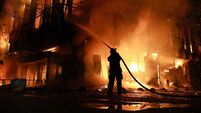
Elsewhere around the city, mobs torched houses and ransacked government offices and scuffles broke out at a warehouse being used as a food-distribution centre.

Aid workers expressed frustration at the insecurity despite the presence of more than 1,300 foreign troops from Australia, New Zealand, Malaysia and Portugal.

Australian forces are “invisible”, said Tim Costello, chief of World Vision, incensed that troops in body armour and with automatic weapons seemed unable to stop the machete-wielding gangs that have terrorised the capital.

Australian military commanders insisted they were getting the upper hand.

The violence that has engulfed the city, killing at least 27 people and wounding 100 others in the past week, was triggered by the dismissal in March of 600 soldiers from the 1,400-member army.

What started with sporadic clashes between former soldiers and government troops has spiralled into open gang warfare. The level of violence has fluctuated from day to day, heightening the sense of instability.

Today, sporadic fighting was reported in some parts of the city and ambulances were seen ferrying injured people to a hospital. It was not clear how many had been hurt.

At a warehouse being used as a food-distribution centre, Australian troops struggled to keep order as thousands of residents tussled with each other to get bags of rice.

“We need more food. The situation is terrible,” said Daniel Afonso, who fled from his destroyed home with his parents and four children and was staying at a church refugee centre. “It is dangerous to go out looking for food and the shops are closed.”

Much of the antagonism on the streets revolves around accusations, often unfounded, that one person or another harbours sympathies for Indonesia, which pulled out of East Timor after its people voted overwhelmingly for independence in 1999 after a 24 years of often harsh rule.

The Indonesian military and its proxy militias responded by laying waste to the region, killing 1,500 Timorese and forcing 300,000 from their homes before an Australian-led force restored order.

The attorney general’s office was looted today, including the Serious Crimes Unit where evidence of 1999 massacres was stored, staff member Abilio Reis said.

The mob, which smashed windows and locks with machetes, entered several other offices in the building, and looted computers and other valuable items.

“I was afraid. I tried to stop the looting, but couldn’t,” Reis said. UN security guards had fled, he said.

It didn’t appear as if the attackers were deliberately trying to destroy documents related to the earlier violence, which have never been publicly released and remain a symbol of the traumatic period.

More in this section

Cookie Policy Privacy Policy Brand Safety FAQ Help Contact Us Terms and Conditions

© Examiner Echo Group Limited