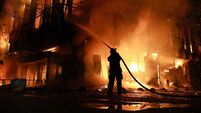
French rioting spreads to 300 towns
Rioting by French youths spread to 300 towns overnight and a man hurt in the violence died of his wounds – the first fatality in 11 days of unrest, police said today. Governments worldwide urged their citizens to be careful in France.
As urban violence spread to neighbouring Belgium and possibly Germany, the French government faced growing criticism for its inability to stop the violence, despite massive police deployment and continued calls for calm.
Vandals burned more than 1,400 vehicles overnight, and clashes around the country left 36 police injured, setting a new high for nightly arson and violence since rioting started October 27, France’s national police chief, Michel Gaudin, told a news conference.
Australia, Britain, Germany and Japan advised their citizens to exercise care in France, joining the United States, Russia and at least a half dozen other countries in warning tourists to stay away from violence-hit areas.
The victim was identified as 61-year-old Jean-Jacques Le Chenadec, who died after being beaten by an attacker. The man, a retired car industry worker, was trying to extinguish a fire in a rubbish bin last Friday at his housing project in the northeastern suburb of Stains when an attacker caught him by surprise and beat him into a coma, police said.
Apparent copycat attacks spread outside France for the first time, with five cars torched outside Brussels’ main train station, police in the Belgian capital said.
The mayhem started as an outburst of anger in suburban Paris housing projects and has fanned out nationwide among disaffected youths, mostly of Muslim or African descent, to become France’s worst civil unrest in over a decade.
Attacks overnight were reported in 274 towns, and police made 395 arrests, Gaudin said.
“This spread, with a sort of shock wave spreading across the country, shows up in the number of towns affected,” Gaudin said, noting that the violence appeared to be sliding away from its flash point in the Parisian suburbs and worsening elsewhere.
It was the first time police had been injured by weapons’ fire and there were signs that rioters were deliberately seeking out clashes with police, officials said.
Among the injured police, 10 were hurt by youths firing fine-grain birdshot in a late-night clash in the southern Paris suburb of Grigny, national police spokesman Patrick Hamon said. Two were taken to hospital, but their lives were not considered in danger. One was wounded in the neck, the other in the legs.
The unrest began on October 27 in the low-income Paris suburb of Clichy-sous-Bois aftr the deaths of two teenagers who were of Mauritanian and Tunisian descent. The youths were accidentally electrocuted as they hid from police in a power sub-station, apparently thinking they were being chased.
All told, 4,700 cars have been burned in France since the rioting began and 1,200 suspects were detained at least temporarily, Gaudin said.
The growing violence is forcing France to confront long-simmering anger in its suburbs, where many Africans and their French-born children live on society’s margins, struggling with high unemployment, racial discrimination and despair - fertile terrain for crime of all sorts as well as for Muslim extremists offering frustrated youths a way out.
France, with some five million Muslims, has the largest Islamic population in western Europe.
President Jacques Chirac, whose government is under intense pressure to halt the violence, promised stern punishment for those behind the attacks, making his first public comments on Sunday since the riots started.
“The law must have the last word,” Chirac said after a security meeting with top ministers. France is determined “to be stronger than those who want to sow violence or fear, and they will be arrested, judged and punished.”
France’s biggest Muslim fundamentalist organisation, the Union for Islamic Organisations of France, issued a fatwa, or religious decree. It forbade all those “who seek divine grace from taking part in any action that blindly strikes private or public property or can harm others.”
Arsonists burned two schools and a bus in the central city of Saint-Etienne and its suburbs, and two people were injured in the bus attack. Churches were set ablaze in northern Lens and southern Sete, he said.
In Colombes in suburban Paris, youths pelted a bus with rocks, sending a 13-month-old child to the hospital with a head injury, Hamon said, while a daycare centre was burned in Saint-Maurice, another Paris suburb.
Much of the youths’ anger has focused on law-and-order Interior Minister Nicolas Sarkozy, whose reference to the troublemakers as “scum” appeared to inflame passions.
CONNECT WITH US TODAY



Be the first to know the latest news and updates