Protests spread to more Afghan cities

Four people were shot to death today in clashes with police as protests over allegations that interrogators in Guantanamo Bay desecrated Islam’s holy book spread to more Afghan cities, officials and witnesses said.

Protests spread to more Afghan cities

Four people were shot to death today in clashes with police as protests over allegations that interrogators in Guantanamo Bay desecrated Islam’s holy book spread to more Afghan cities, officials and witnesses said.

The deaths brought to 11 the number of people killed in the biggest outpouring of anti-American sentiment since the fall of the Taliban in 2001 – a deepening worry for the government of US-backed President Hamid Karzai.

Pakistan and Saudi Arabia – both US allies – registered dismay over the allegations, as did the 57-nation Organisation of the Islamic Conference and the outlawed Egyptian Muslim Brotherhood.

But in Pakistan, a call for mass street protests from a coalition of hardline religious parties fell flat.

Afghan officials said some of the protesters who took to the streets chanting anti-American slogans and stoning the offices of international relief organisations ignored the urgings of mullahs during Friday prayers to remain calm.

“This is organised by particular groups who are the enemies of Afghanistan,” Interior Ministry spokesman Latfullah Mashal said. “They are trying to show that the situation, that security is not good.”

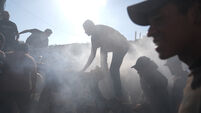
In Baharak district of north-eastern Badakhshan province, three men died when police fired to control hundreds of protesters who streamed out of a mosque shouting “Death to America!” Gov Abdul Majid sai. Another 22 people were reported hurt, including three police officers.

Majid said the mob set fire to the office of Focus, a reconstruction agency funded by the Aga Khan Foundation of the spiritual leade of the world’s 20 million Ismaili Muslims, and a British aid group.

Another man died in the north-west when police opened fire during a demonstration after prayers in Qala-e-Naw, capital of Badghis province, provincial police chief Amir Shah Naibzada said.

“The mullah told them that what happened in Guantanamo was none of their business, that God would give them their punishment,” Naibzada said.

Shooting also broke out in the centre of Ghazni city, where hundreds of people gathered to chant slogans outside the offices of the governor and the police chief, witnesses said. Local officials confirmed there was a protest, but declined to give details.

Fresh protests in Kabul and Gardez ended without casualties, officials said.

Unrest began in Afghanistan on Tuesday after Newsweek magazine reported in its May 9 edition that interrogators at Guantanamo Bay, Cuba, placed Qurans in washrooms to unsettle suspects, and in one case “flushed a holy book down the toilet.”

The crackdown on the first major protest in Jalalabad that left four people dead has enflamed passions further, and demonstrations – many of them violent - have taken place in at least 10 towns and cities.

Many of the 520 inmates at Guantanamo are Muslims arrested during the US-led war against terror in Afghanistan. In both Afghanistan and Pakistan, insults to the Quran and Islam’s prophet, Muhammad, are regarded as blasphemy and punishable by death.

US officials, including US Secretary of State Condoleezza Rice, have promised to investigate their grievances, saying disrespect for the Quran would never be tolerated.

“Respect for religious freedom for all individuals is one of the founding principles of the US,” Rice said yesterday in Washington.

In Pakistan, the powerful opposition Islamic coalition Mutahida Majlis-e-Amal appealed for Muslims to protest after Friday prayers.

But in the main cities of Islamabad, Lahore, Peshawar, Quetta, Multan and Karachi no more than a few hundred turned out, despite fiery rhetoric from some preachers.

There were no reports of violence, although in Quetta, protesters burned an effigy of President Bush.

“We think President George Bush has started a crusade war by insulting Quran,” hardline cleric Anwar ul-Haq told a congregation there. He warned that people would be forced to take “extreme steps against American citizens in the world” if there there was another such incident.

But Sadique Bajrani, a cleric in Karachi, urged people to remain peaceful. “Americans did a bad thing, but you should not hurt anyone while protesting against America,” he said.

During a visit to Australia, Pakistani Foreign Minister Khursheed Kasuri called the alleged slur against Islam’s holy book “debased, inhuman (and) depraved,” and said the Bush administration should take “very strong action” to investigate the incident and punish those responsible.

Saudi Arabia has also urged that any offenders be quickly disciplined.

The Saudi-based Organisation of the Islamic Conference said it had written to Rice urging a strong response.

“These abhorring incidents are indicative of backward mentalities (and) deserve more than condemnation and indignation,” it said in a statement.

In the first hint of unrest in South-east Asia, about 50 people protested outside three hotels in the eastern Indonesian city of Makassar, demanding they hand over any Americans inside. The demonstrators were blocked from entering the hotels and it wasn’t clear if there had been any American staying there, witnesses said.

The outlawed Muslim Brotherhood, Egypt’s largest Islamic group, claimed the alleged desecration of the Quran was “a link in the series of aggressions on the Islamic sanctities".

More in this section

Cookie Policy Privacy Policy Brand Safety FAQ Help Contact Us Terms and Conditions

© Examiner Echo Group Limited